
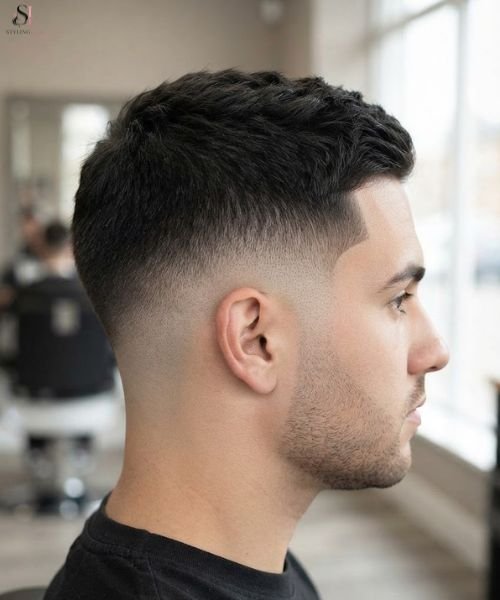
If you want short hair that looks clean without making the sides feel too bare, a low taper fade is one of the easiest cuts to customize. The taper stays low around the sideburns, ears, and neckline while leaving more of the side panel intact than a higher fade.
The best part is that you don’t need much length on top. A low taper can be paired with a textured crop, buzz cut, crew cut, French crop, curls, coils, waves, a side part, or even a short messy top. Below, you’ll find 20+ short-hair variations, exact barber wording, face-shape guidance, styling advice, maintenance tips, cost information for the USA, and answers to common questions.
Quick Low Taper Fade Guide
| Feature | Typical choice |
|---|---|
| Taper location | Low around sideburns and neckline |
| Top length | Usually short, but customizable |
| Shortest point | #0, #0.5, #1, or skin depending on preference |
| Side appearance | More weight retained than a high fade |
| Styling time | Usually a few minutes or less |
| Best for | Straight, wavy, curly, and coily hair |
| Maintenance | Usually around every 2–4 weeks depending on how sharp you want it |
What Is a Low Taper Fade on Short Hair?
Think of the haircut as having two separate jobs. The short hair on top creates the overall hairstyle. The low taper cleans up the perimeter around the sideburns, ears, and neckline. The two parts don’t have to be identical in length or texture.
A barber normally creates a gradual transition rather than leaving a visible step between lengths. The exact guards depend on your hair density, desired contrast, and whether you want a shadow, zero, or skin finish.
One important distinction is that a low taper isn’t necessarily the same as a full low fade. A low taper can keep most of the side panel intact, while a low fade can remove more hair across the lower side.
If you’re unsure, tell your barber you want the taper compact around the edges and that you want to keep fullness above the ears.
How Does a Low Taper Fade Compare to Other Fade Haircuts on Short Hair?
The main difference is where the shortening happens.
| Haircut | Where the transition sits | Overall effect |
|---|---|---|
| Low taper fade | Sideburns, ears, low neckline | Subtle and controlled |
| Mid fade | Around the middle/temple area | More noticeable contrast |
| High fade | Much higher on the sides | Strong, exposed sides |
| Low fade | Low around the sides and back | More extensive than a taper |
| Skin fade | Can be low, mid, or high | Very close/bare finish |
A low taper is useful when you want your short haircut to retain some natural shape. If you want the entire side to become extremely short, ask specifically for a low fade or skin fade instead.
Also read: Low Taper Fade for Wavy Hair: 25 Best Styles (2026 Guide)
20 Best Low Taper Fade Styles for Short Hair
1. Classic Textured Crop with Low Taper Fade
The classic textured crop is one of the easiest ways to wear a low taper with short hair. The top is kept around 1 to 1.5 inches, with the barber using scissors or point cutting to create small pieces of texture. The low taper stays close to the sideburns and neckline, so the sides don’t look completely stripped down.
This style works especially well for straight or slightly wavy hair. Use a small amount of matte clay or texture paste, work it through damp or dry hair, and push the top slightly forward. Don’t make every strand perfect the uneven texture is what gives the crop its character.
Tell your barber:
“Keep about 1 to 1.5 inches on top with natural texture. I want a low taper around the sideburns and neckline, but keep the upper sides fairly full.”
2. Side Part with Low Taper Fade
A short side part gives you a cleaner and more traditional appearance while the low taper keeps the haircut modern. The top needs enough length to move naturally toward one side, usually around 1.5 to 2 inches depending on your hair type.
Ask your barber for a natural part if you want the style to grow out easily. A hard part can be added with a razor if you prefer a more noticeable line, but it will require more maintenance.
For everyday styling, apply a small amount of styling cream or light pomade. Comb the hair sideways and slightly backward rather than pressing it completely flat.
Tell your barber:
“I want a short side part with about 2 inches on top. Keep the sides neat but don’t take them too high. Give me a low taper around the ears and neckline.”
3. Slick Back with Low Taper Fade
You don’t need long hair for a slick-back. A short slick back generally needs around 1.5 to 2.5 inches on top, depending on how easily your hair moves backward.
The low taper gives the back and sides a clean outline while leaving enough side weight to keep the haircut from looking overly severe. Straight and slightly wavy hair are particularly easy to style this way.
Apply a small amount of styling cream or pomade to damp hair. Use a comb to direct everything backward, then use your fingers to soften the finish if you don’t want a formal appearance.
Tell your barber:
“Keep enough length on top to brush backward, around 2 inches. I want a low taper around the sideburns and neckline, not a high fade.”
4. Short Messy Top with Low Taper Fade
If you prefer a relaxed haircut that doesn’t look overly polished, try a short messy top. The top can stay around 1 to 1.5 inches, with plenty of texture cut into it.
The trick is to create controlled messiness. Your barber should remove unnecessary bulk while keeping different lengths on top so the hair doesn’t sit like a flat block.
Use a matte paste or clay. Rub a tiny amount between your fingers, work it through the top, and lift random sections. You can finish the style in less than a minute.
Tell your barber:
“Give me a short textured messy top with a low taper. Keep the taper low and leave enough texture on top for a messy finish.”
5. Comb Over with Low Taper Fade
A short comb over is similar to a side part but usually has a softer, less defined separation. It works particularly well for straight hair because the hair naturally follows the direction of the comb.
Keep approximately 1.5 to 2 inches on top. The upper sides should retain some weight, while the low taper cleans up the area around the ears and neckline.
Use a lightweight cream or matte paste instead of heavy gel. Comb the hair diagonally across the top, then use your fingers to break up any overly smooth sections.
Tell your barber:
“I want a short comb over with a low taper. Keep the top around 1.5 to 2 inches and leave some fullness above the taper.”
6. Short Wavy Messy Top with Low Taper Fade
Short wavy hair already has natural movement, so you don’t need a complicated cut. Keep the top around 1.5 to 2 inches and let the waves create the texture.
The low taper should remain compact around the sideburns and neckline. Avoid taking the taper too high because doing so can remove the visual balance between the wavy top and the sides.
After washing, towel-dry gently and apply a lightweight curl or wave cream. Scrunch the hair instead of brushing it flat, then let it dry naturally.
Tell your barber:
“Keep my natural waves on top, around 1.5 to 2 inches, and give me a low taper around the sideburns and neckline. Don’t take the taper high.”
7. Short Wavy Textured Crop with Low Taper Fade
This variation combines the compact shape of a crop with natural waves. The fringe can sit slightly forward while the rest of the top follows its natural movement.
A good length is around 1 to 1.5 inches, although your barber should adjust it based on how much your hair shrinks when dry.
Use a lightweight matte cream. Apply it to damp hair and use your fingertips to push the fringe forward while allowing the waves to form naturally.
Tell your barber:
“I want a short wavy textured crop with a low taper. Keep the natural wave pattern and make the fringe slightly textured instead of perfectly straight.”
8. Short Curly Top with Low Taper Fade
A short curly top looks sharp when the curls remain visible rather than being cut too short. Around 1 to 2 inches can work, but the correct length depends heavily on your curl pattern and shrinkage.
The taper should clean the sideburns and neckline while leaving the curls as the main feature. A natural lineup or subtle edge-up can be added if you want more definition.
Use curl cream on damp hair. Apply it evenly, scrunch the curls upward, and avoid repeatedly touching the hair while it dries.
Tell your barber:
“Keep my curls short but visible. I want around 1 to 2 inches on top with a low taper around the temples and neckline.”
9. Short Afro with Low Taper Fade
A short afro with a low taper keeps natural texture on top while making the perimeter cleaner. The top can be shaped into a rounded or slightly squared silhouette depending on your preference.
The barber should pay attention to the natural density and growth direction rather than removing too much hair from one area. The low taper should frame the hairstyle, not dominate it.
You can use a moisturizing cream or curl sponge if you want additional definition. A natural neckline gives the haircut a softer appearance, while a sharper lineup creates more contrast.
Tell your barber:
“Keep my short afro shape on top and clean the edges with a low taper. I want the taper concentrated around the sideburns and neckline.”
10. Burst Fade with Short Curly Top
A burst fade is different from a traditional low taper because the blend curves around the ear. It can be a good alternative if you want more definition around the ears while keeping the curly top short.
Keep the curls around 1 to 2 inches and allow their natural shape to remain visible. The burst section should follow the ear instead of climbing straight upward.
This style is particularly noticeable from the side and can be paired with a short curly fringe or textured top.
Tell your barber:
“I want a short curly top with a compact burst fade around the ears. Keep the top natural and don’t remove too much curl.”
Important: If you specifically want a low taper, tell your barber that instead of assuming a burst fade is the same thing.
11. Short Coily Top with Low Taper Fade
Short coily hair can create a strong contrast against a clean low taper. Keep enough length on top for the coils to remain visible, usually around 1 to 2 inches depending on shrinkage.
The taper can be finished with either a natural hairline or a sharper lineup. If your goal is a softer, more natural haircut, avoid making every edge extremely sharp.
A moisturizing curl product can keep the coils defined without making them stiff.
Tell your barber:
“Keep my coils short but visible, and taper low around the sideburns and neckline. Keep the natural shape on top.”
12. Short Coily Top with Highlights and Low Taper Fade
Adding highlights to a short coily top creates another layer of contrast. The color becomes easier to notice because the hair is compact, while the low taper keeps the perimeter clean.
Keep the top short enough to remain easy to manage but long enough for the highlighted sections to show. Your barber or stylist should consider the condition of your hair before any lightening service.
The taper itself doesn’t need to be dramatic. A subtle low taper often lets the textured and colored top remain the main focus.
Tell your barber:
“Keep the highlighted coils short and defined. I want a low taper around the sides and neckline without taking too much off the top.”
13. Short Thick Textured Crop with Low Taper Fade
Thick hair can quickly become bulky when cut short, so the goal isn’t simply to remove as much hair as possible. Your barber should control the weight while maintaining enough density for the textured crop.
Around 1 to 1.5 inches on top works well for a compact textured look. Point cutting can create separation without making the hair look thin.
Use a matte clay or paste. Work it into the roots and ends, then pinch small sections between your fingers to create texture.
Tell your barber:
“My hair is thick, so remove some weight while keeping the top dense. Give me a short textured crop with a low taper.”
14. Shadow Low Taper Fade for Thinning Short Hair
A shadow taper can be useful when you want a softer transition instead of a very exposed skin finish. The shortest section retains a small amount of visible hair, which can make the transition look less abrupt.
Keep the top textured rather than slicked tightly against the scalp. Around 1 to 1.5 inches can work for a short textured style, depending on your density.
A lightweight matte styling product is usually more useful than heavy pomade because it adds separation without making the hair look weighed down.
Tell your barber:
“I have thinner areas, so keep the taper soft and low. I don’t want the sides taken completely to skin. Keep the top short and textured.”
15. Buzz Cut with Low Taper Fade
The buzz cut is one of the lowest-maintenance options on this list. The hair on top is cut with a clipper guard, while the low taper adds a little more definition around the sideburns and neckline.
A #1 or #2 on top creates a very short appearance. Going longer gives you slightly more texture and coverage.
Because there’s so little hair, your head shape becomes more visible. Ask your barber to check the shape from several angles before finishing the taper.
Tell your barber:
“Give me a short buzz cut with a low taper around the sideburns and neckline. Keep the transition low and clean.”
16. Crew Cut with Low Taper Fade
The crew cut gives you slightly more length and shape than a buzz cut. The top can be kept around ¾ to 1.5 inches, with a little more length toward the front.
The low taper keeps the sides and neckline controlled without making the haircut look overly faded.
For styling, you can use a tiny amount of matte paste to lift the front. If your hair naturally stands up, you may not need any product.
Tell your barber:
“I want a short crew cut with a low taper. Keep the front slightly longer and taper low around the sideburns and neckline.”
17. French Crop with Low Taper Fade
The French crop is built around a short forward fringe and textured top. A low taper makes the overall haircut cleaner without removing too much from the sides.
Keep approximately 1 to 1.5 inches on top and slightly shorter toward the fringe if needed. Texture is important because a completely smooth top can make the crop look too basic.
Use matte paste and push the hair forward. Separate the fringe slightly with your fingers rather than creating a perfectly straight wall.
Tell your barber:
“Give me a short French crop with a textured forward fringe and a low taper around the sideburns and neckline.”
18. Caesar Cut with Low Taper Fade
The Caesar is an excellent option when you want extremely short hair with a defined forward fringe. The top is usually compact and fairly uniform, so there isn’t much daily styling involved.
The low taper provides a clean transition around the perimeter without changing the short character of the Caesar.
You can leave the fringe natural or ask for a precise edge. A matte product can add a little separation if the top looks too flat.
Tell your barber:
“I want a short Caesar with a low taper. Keep the top compact and the fringe short and forward.”
19. Short Textured Fringe with Low Taper Fade
A textured fringe gives you more movement than a traditional Caesar while keeping the overall haircut short. The top can be around 1 to 1.5 inches, with the front slightly longer if you want a stronger fringe.
This style works especially well with straight and wavy hair, but it can also be adapted to curls.
Use a matte paste or cream and work it forward with your fingertips. The goal is separation, not a perfectly smooth fringe.
Tell your barber:
“I want a short textured fringe with about 1 to 1.5 inches on top. Keep the fringe natural and add a low taper around the sides and neckline.”
20. Short Quiff with Low Taper Fade
A short quiff gives you a little height without requiring the longer top of a traditional quiff. Around 1.5 to 2 inches on top can provide enough length to lift the front.
The low taper keeps the sides neat while allowing the front to become the main point of the haircut. This is particularly useful for straight or slightly wavy hair.
Apply a small amount of matte clay, blow-dry the front upward if you want extra volume, and finish with your fingers.
Tell your barber:
“Keep the top around 2 inches with enough length in front for a short quiff. Give me a low taper on the sides and neckline and keep the upper sides full.”
Which Face Shape Suits a Low Taper Fade Best for Short Hair?
A low taper can be adapted to oval, square, round, rectangular/long, and heart-shaped faces. The important part is what you do with the short top.
| Face shape | Short-hair approach |
|---|---|
| Oval | Most short variations can work |
| Square | Textured crop, crew cut, short curls |
| Round | Add modest height/texture rather than excessive width |
| Long/rectangular | Avoid creating unnecessary height; keep balance through the sides |
| Heart | Textured top with controlled side volume |
These aren’t strict rules. Hair density, natural growth patterns, forehead height, and personal preference can matter just as much.
Does a Low Taper Fade on Short Hair Work for All Hair Types?
It can be adapted to most common hair textures, including straight, wavy, curly, and coily hair. The technique changes depending on how the hair behaves.
For example, straight hair may need more deliberate texturing, while curly and coily hair often already have enough natural texture.
Fine or thinning hair may benefit from a softer shadow finish rather than an extremely exposed skin finish.
Is a Low Taper Fade on Short Hair Suitable for All Ages?
The haircut can be adapted for teenagers, young adults, working professionals, and older men. What changes is the top style and finishing detail.
For a conservative workplace, keep the taper low and the neckline natural. For a more modern look, you can add stronger texture, a sharper lineup, or a more defined fade.
How Do You Ask Your Barber for a Low Taper Fade on Short Hair?
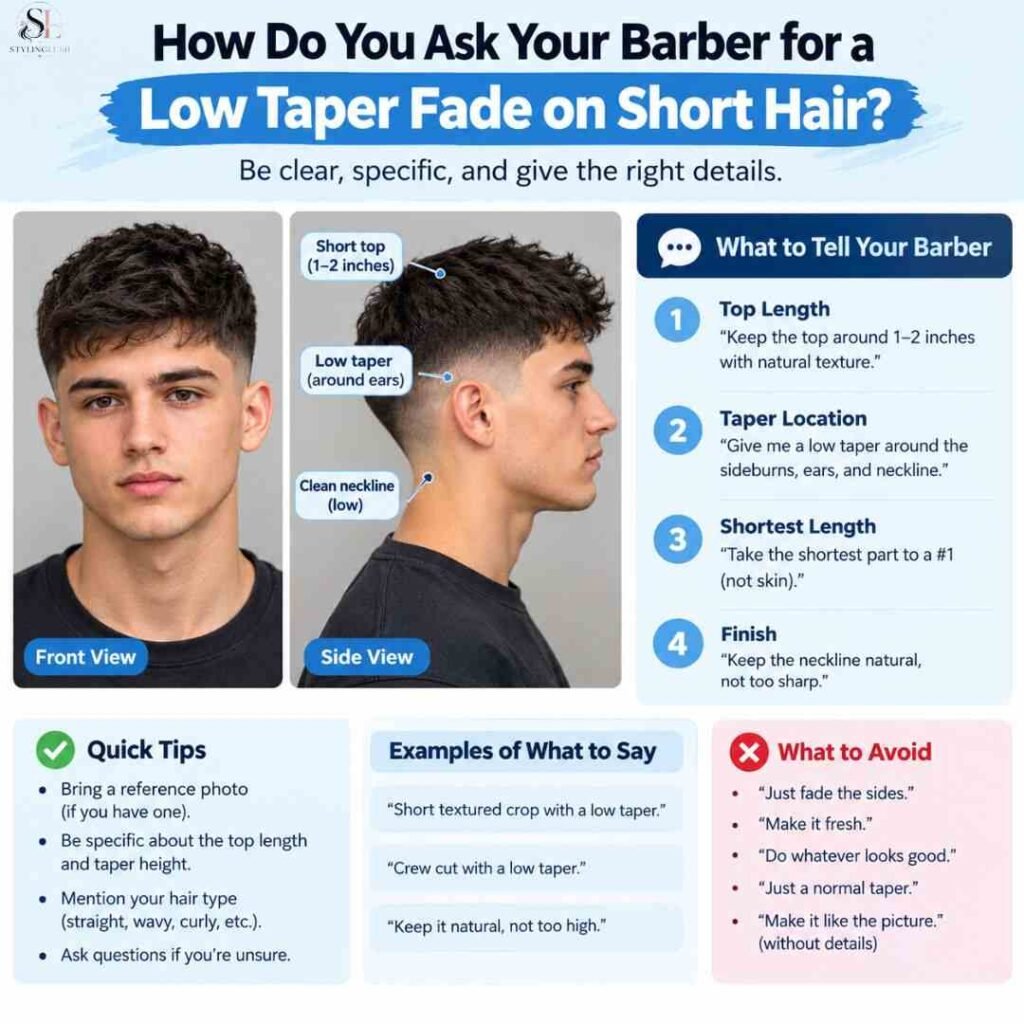
Don’t just say “low taper” and sit down.
Give your barber four pieces of information:
- Top length
- Taper location
- Shortest taper length
- Hairline/neckline finish
For example:
“I want the top short, around an inch, with natural texture. Keep the sides mostly full and give me a low taper around the sideburns and neckline. Take the shortest part to a #1, not skin, and keep the neckline natural.”
This gives the barber far more useful information than simply naming a haircut.
Exact Barber Scripts for Each Short Hair Low Taper Variation
| Style | Barber script |
|---|---|
| Textured crop | “Keep about 1–1½ inches on top, add texture, and give me a compact low taper around the sideburns and neckline.” |
| Side part | “Short side part on top, low taper around the edges, and keep the upper sides full.” |
| Slick back | “Keep enough length on top to brush backward, with a low taper around the ears and neckline.” |
| Messy top | “Short textured messy top with a low taper. Don’t take the taper too high.” |
| Wavy crop | “Preserve my natural waves and keep the top short. Low taper only around the lower edges.” |
| Curly top | “Keep my curls short but visible and taper low around the temples and neckline.” |
| Buzz cut | “Give me a short buzz on top with a low taper around the sideburns and neckline.” |
| Crew cut | “Short crew cut with a low taper, keeping the top slightly longer toward the front.” |
| French crop | “Short French crop with forward fringe and a low taper around the edges.” |
| Caesar | “Short Caesar with a compact low taper and short forward fringe.” |
Bring a front and side reference photo if you have one. Haircut names can mean slightly different things from one barber to another.
What Words and Phrases Should You Avoid Telling Your Barber?
Avoid vague instructions such as:
- “Make it fresh.”
- “Do whatever looks good.”
- “Just fade the sides.”
- “Give me a normal taper.”
- “Make it like the picture” without explaining what you like about the picture.
Also avoid saying “low taper” when you actually want the entire lower side faded. If you want a broader fade, say so.
Can You Do a Low Taper Fade on Short Hair at Home?
You can clean up an existing taper at home, but creating a professional low taper from scratch is considerably harder.
The difficult part isn’t simply removing hair. It’s creating a smooth transition without accidentally moving the taper higher on one side.
If you’re inexperienced, don’t try to copy a skin fade using only one clipper guard. Uneven pressure, inconsistent angles, and poor visibility around the back of the head can quickly create patches.
For home maintenance, a safer approach is usually:
- Keep your existing taper shape.
- Use a guarded trimmer carefully around the neckline.
- Don’t chase individual hairs higher and higher.
- Use a mirror setup that lets you see both sides.
- Stop if you aren’t sure which length you’re removing.
When the entire taper needs reshaping, a barber is the safer choice.
How Do You Style a Low Taper Fade with Short Hair?
Styling depends more on the top than the taper. Start with slightly damp hair, apply a small amount of product, and shape the top according to the haircut. The taper itself generally doesn’t require styling.
For a textured crop, work forward. For a side part, direct the hair sideways. For curls, enhance the natural curl pattern rather than brushing it straight.
What Products Work Best for a Low Taper Fade on Short Hair?
| Hair/top style | Useful product |
|---|---|
| Textured crop | Matte clay or paste |
| Short messy hair | Matte paste |
| Side part | Styling cream or light pomade |
| Slick back | Pomade or styling cream |
| Wavy hair | Lightweight curl cream |
| Curly hair | Curl cream or leave-in |
| Coily hair | Moisturizing curl product |
| Fine/thinning hair | Lightweight matte product |
You don’t need five products. One suitable product used sparingly is usually easier to manage.
What Is the Daily Styling Routine for a Low Taper Fade on Short Hair?
Morning routine:
- Wet or lightly dampen the top.
- Towel-dry gently.
- Apply a small amount of product.
- Shape the top with your fingers or comb.
- Check the fringe and sideburn area.
- Leave the taper itself natural.
For a very short crop or buzz cut, you may need virtually no daily styling.
How Do You Maintain a Low Taper Fade on Short Hair?
The cleaner you want the taper to look, the more often you’ll need a refresh. A skin or zero taper usually shows growth sooner. A #1 or shadow finish can be more forgiving between appointments. One barbering guide puts a skin taper’s refresh point around two to three weeks, while a guarded #0.5 or #1 can stay tidy for roughly three to five weeks, depending on growth and personal standards.
How Does a Low Taper Fade on Short Hair Grow Out?
Because the taper is concentrated low on the head, growing it out doesn’t necessarily destroy the entire haircut immediately.
The first thing you’ll usually notice is that the sharp contrast around the ears and neckline becomes softer. Eventually, the lower edges start looking fuller and the original taper shape becomes less defined.
A simple maintenance schedule might look like this:
| Time after haircut | What you’ll notice |
|---|---|
| 1 week | Still very crisp |
| 2 weeks | Slightly softer edges |
| 3 weeks | Taper starts losing definition |
| 4 weeks | More visible growth around ears/neck |
| 5+ weeks | Usually ready for a full reshape |
These are practical estimates, not fixed biological timelines. Hair growth varies from person to person.
How Much Does a Low Taper Fade on Short Hair Cost in the USA?
There isn’t one national price. Location, barber experience, shop type, service length, and whether you add a beard or lineup all affect the bill.
Current US shop menus show examples around $30–$50 for fade/taper services, while some services and markets run higher. For example, one Phoenix shop lists a fade at $35, an Orlando barbershop lists a taper fade at $40, and a San Francisco shop lists fades from $40.
A useful planning range for many US barbershops is roughly $25–$60, but always check the individual barber’s current menu before booking.
What Beard Styles Pair Best with a Low Taper Fade on Short Hair?
The beard should connect naturally with the haircut rather than competing with it.
Good options include:
- Short boxed beard
- Heavy stubble
- Light stubble
- Short tapered beard
- Natural beard with a clean cheek line
- Goatee with a clean side profile
If your haircut has a very subtle taper, don’t automatically make the beard extremely sharp. Matching the level of definition often produces a more balanced appearance.
Which Celebrities Wear a Low Taper Fade on Short Hair?
The clearest documented celebrity example connected specifically to the phrase is Ninja (Tyler Blevins). In January 2024, after the viral ericdoa audio, Ninja actually got a low taper fade and posted the haircut using the original sound.
Celebrity and athlete hairstyles change frequently, so it’s better not to treat one person’s haircut as a permanent signature. If you’re using a celebrity photo as a reference, show your barber the actual current image and explain which part of the cut you want copied.
What Is the Low Taper Fade Meme and Why Did It Go Viral?
The low taper fade meme came from a January 2024 ericdoa Twitch freestyle. During the stream, he sang the phrase about imagining Ninja with a low taper fade. A clip then spread on TikTok and became a viral audio and meme format.
The joke became even more recognizable because Ninja actually got the haircut on January 13, 2024 and posted the result using the original audio.
Frequently Asked Questions
Is a low taper fade good for short hair?
Yes. Short hair and a low taper work particularly well together because the taper cleans the perimeter while the short top keeps the haircut easy to manage.
How short should the top be for a low taper fade?
There is no single required length. Around ½–2 inches covers many short styles, while buzz cuts can be considerably shorter. Choose the length based on whether you want texture, a fringe, a part, curls, or almost no styling.
Is a low taper fade the same as a low fade?
Not always. A low taper is usually concentrated around the sideburns and neckline, while a low fade may remove more hair across the lower sides. Barber terminology can vary, so explain the exact area you want tapered. (barber.style)
How often should I get a low taper fade?
Many people refresh it around every 2–4 weeks, depending on how quickly their hair grows and how sharp they want the edges. A softer taper can be worn longer. (Fade Artist)
Can I get a low taper fade with very short hair?
Yes. Buzz cuts, crew cuts, Caesar cuts, and French crops can all be paired with a low taper. The barber simply adjusts the blend to work with the limited length.
Does a low taper fade work with curly or coily hair?
Yes. The taper can frame curls and coils while leaving the natural texture on top. Your barber should account for shrinkage and your natural growth pattern rather than treating textured hair exactly like straight hair.
Is a low taper fade good for thinning hair?
It can be. A shadow or guarded taper may create a softer transition than taking the lowest section completely to skin. The top should also be shaped to make the most of the hair you have rather than relying on excessive product.
What should I tell my barber if I want a low taper fade on short hair?
Give four details: top length, taper location, shortest guard, and neckline finish. A strong example is: “Keep the top around one inch, give me a low taper around the sideburns and neckline, take the shortest point to a #1, and keep the neckline natural.”
2 thoughts on “Low Taper Fade on Short Hair: 20+ Best Styles for Men (2026)”