

A low taper fade design combines a clean, gradual taper around the temples and neckline with a shaved pattern or line. Unlike a high fade, the taper stays low, so you can add a design without removing too much hair from the sides. It works especially well with curly, straight, wavy, coily, and textured hairstyles.
For 2026, popular choices range from simple side lines and small geometric cuts to freestyle patterns, back designs, and Edgar-inspired looks. The best design depends on your haircut, hair texture, face shape, workplace, and how much maintenance you’re willing to handle.
The key is to choose a design that fits the available space. A small line can look sharp on a short taper, while a larger geometric or freestyle pattern needs enough hair around the fade to make the shape visible.
What Is a Low Taper Fade Design?
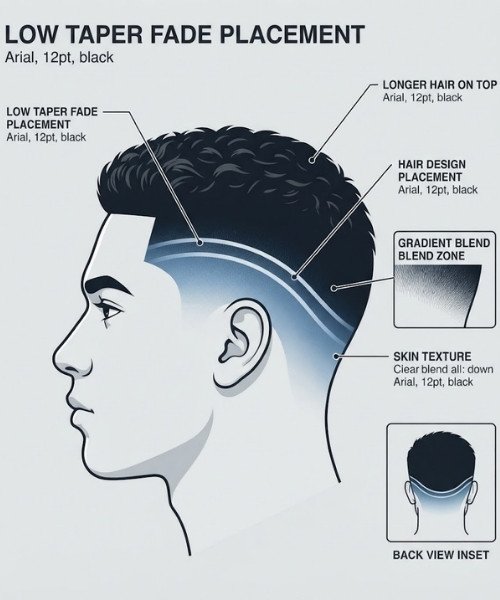
A low taper fade design is a low taper haircut combined with a decorative shaved pattern. The taper gradually reduces the hair near the bottom of the sides and back instead of taking the fade high up toward the parietal ridge.
This creates a useful canvas for designs while keeping the overall haircut relatively conservative.
You can place the design in several areas:
- Temple: Best for small lines and subtle patterns.
- Side: Good for slashes, curves, zigzags, and geometric shapes.
- Back: Works well for symmetrical or larger designs.
- Behind the ear: Ideal for discreet patterns.
- Multiple areas: Creates a more dramatic freestyle look.
One important detail is that a design doesn’t need to reach the skin to be visible. Your barber can create a softer line by removing only a small amount of hair, which can be useful if you want a design that isn’t extremely bold.
Why Choose a Low Taper for a Design?
The low placement gives you more flexibility than a high fade. You can keep substantial length above the taper while still getting a clean, modern detail. It’s also easier to grow out than a large high fade because less of the side hair has been removed. A low taper is particularly useful when you want something that can move between casual and professional settings. A single short line can be much easier to hide or grow out than an elaborate pattern covering the entire side.
Also read: Low Taper Fade on Short Hair: 20+ Best Styles for Men (2026)
Low Taper Fade vs. Skin Fade: Which Is Better for Designs?
Neither haircut is automatically better. A low taper fade is generally better if you want a subtle design with more hair retained, while a skin fade gives stronger contrast and makes shaved patterns stand out more dramatically.
The difference comes down to how short the fade goes and how much contrast exists between the skin and the surrounding hair.
| Feature | Low Taper Fade | Skin Fade |
|---|---|---|
| Hair at lowest point | Very short but not necessarily skin | Blended down to bare skin |
| Overall appearance | Subtle and natural | Sharp and high-contrast |
| Design visibility | Moderate to strong | Very strong |
| Growing out | Usually more forgiving | More noticeable as it grows |
| Professional look | Easier to keep conservative | Can look more dramatic |
| Best for | Everyday versatility | Bold designs |
If you’re getting your first design, a single side line with a low taper is a safe starting point. If you already like sharp fades and want the design to be the main feature, a skin fade can create more contrast.
45+ Best Low Taper Fade Designs for Men (2026 Gallery)
There isn’t one perfect design for every haircut. Your barber should consider the amount of space available, your hair length, the direction your hair naturally grows, and whether you want the design to be noticeable from the front, side, or back.
Here are 45+ ideas to use as inspiration.
Back Low Taper Fade Designs
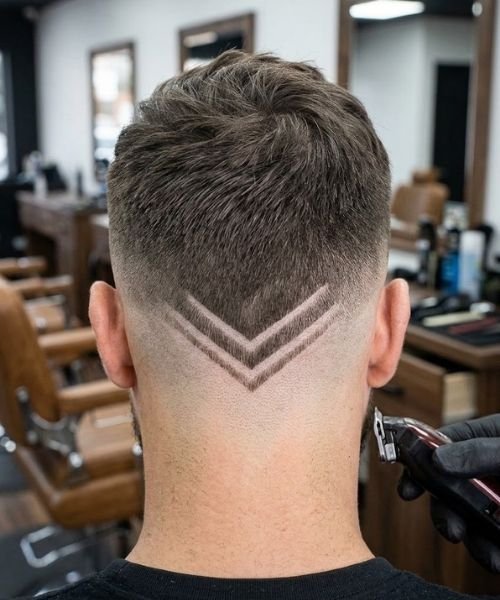
1. Clean V Back Design
A small V-shaped line at the back of the low taper gives the neckline a defined finish. Keep the V narrow if you want the style to remain understated.
2. Double V Design
Two connected V shapes create a layered pattern without covering the entire back. This works particularly well with a clean neckline and short textured hair.
3. Back Lightning Bolt
A lightning-bolt shape adds movement to the back of the taper. Keep the bolt relatively narrow so it doesn’t overwhelm the haircut.
4. Center Back Slash
One angled slash through the tapered section creates a minimalist design. It is one of the easier patterns to maintain because there are fewer edges to redraw.
5. Twin Back Lines
Two parallel lines placed symmetrically on either side of the neckline create a balanced appearance. This is a good choice if you prefer structure over freestyle designs.
6. Curved Back Design
A curved line follows the natural shape of the head instead of using straight angles. It can soften an otherwise sharp taper.
7. Crown-to-Taper Accent
For longer hair on top, a small line can begin near the lower side and visually point toward the back taper. The design should remain separated from the crown so it doesn’t look crowded.
8. Back Diamond Detail
A small diamond shape can be placed in the center of the lower back. Because the pattern has several corners, precise detailing is important.
9. Split V Design
A V shape with a small gap in the center creates a modern broken-line effect. It looks especially clean when the neckline is naturally squared or softly rounded.
10. Minimal Back Arc
A single shallow arc across one side of the back provides detail without turning the haircut into a full pattern. It’s a strong option for someone trying designs for the first time.
Side Low Taper Fade Designs
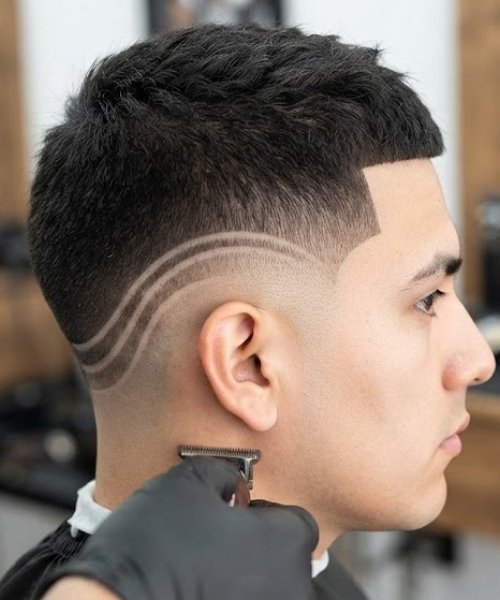
11. Single Side Slash
The classic single slash is simple, recognizable, and easy to request. Ask your barber for a clean diagonal line through the tapered side.
12. Double Side Slash
Two parallel slashes make the design more noticeable. Keep the gap between the lines consistent for a cleaner finish.
13. Curved Temple Line
Instead of a straight slash, a curved line can follow the shape of the temple. This pairs well with curly and wavy hair.
14. Side V Design
A small V near the temple adds geometric detail while using very little space. It’s a practical choice for a low taper with short sides.
15. Side Lightning Design
A short lightning pattern can be placed above or behind the ear. It gives the haircut a more energetic appearance without requiring a large shaved area.
16. Three-Line Side Design
Three short lines can be positioned at slightly different angles. This works best when the rest of the haircut is relatively simple.
17. Parallel Curves
Two curved lines following the same direction create a layered appearance. Your barber should keep the distance between them even.
18. Broken Side Line
A line with a small intentional gap creates a contemporary detail. It can look cleaner than a complicated graphic when paired with a textured top.
19. Side Arrow Design
Two angled lines can form a subtle arrow pointing toward the back. This works especially well on haircuts with a directional top.
20. Temple Accent Line
A very short line near the temple gives you the design effect without taking up much of the side. This is one of the easiest options to hide as it grows.
Freestyle Low Taper Fade Designs
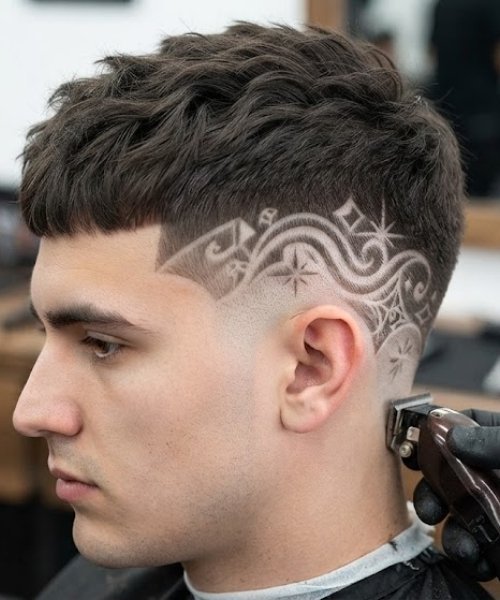
Freestyle designs give your barber more freedom to create a pattern based on the shape of your head and available hair. If you’re choosing this option, show your barber several reference photos and explain how bold you want the final result.
21. Freestyle Wave
Several flowing curves create a wave-like pattern. The design looks especially natural with wavy or curly hair.
22. Abstract Curve
One irregular curved line creates an artistic look without following a strict geometric shape.
23. Swirl Detail
A small swirl adds movement to the side of a low taper. Keep it compact if your haircut has limited space.
24. Interlocking Lines
Two or three lines can cross or approach each other without becoming a full graphic. The barber needs enough side length to keep the pattern readable.
25. Freestyle Flame
Curved, pointed edges can create a flame-inspired pattern. This is better suited to casual styles than conservative workplace haircuts.
26. S-Curve Design
An S-shaped line provides a distinctive shape while remaining relatively simple. It looks best when the curve follows the natural contour of the head.
27. Abstract Zigzag
A short zigzag creates sharp movement on the side. Because the corners need to be crisp, regular touch-ups help preserve it.
28. Wave and Slash Combination
Combine one curved line with one straight slash for contrast. This gives the design more character without requiring a large pattern.
29. Freestyle Leaf-Inspired Pattern
Soft curved lines can form a leaf-like shape near the taper. It’s a less common alternative to basic slashes and lightning designs.
30. Asymmetrical Freestyle Pattern
An asymmetrical design doesn’t try to make both sides identical. This is ideal when you want an artistic haircut rather than a traditional symmetrical pattern.
Edgar Cut with Low Taper Fade Designs
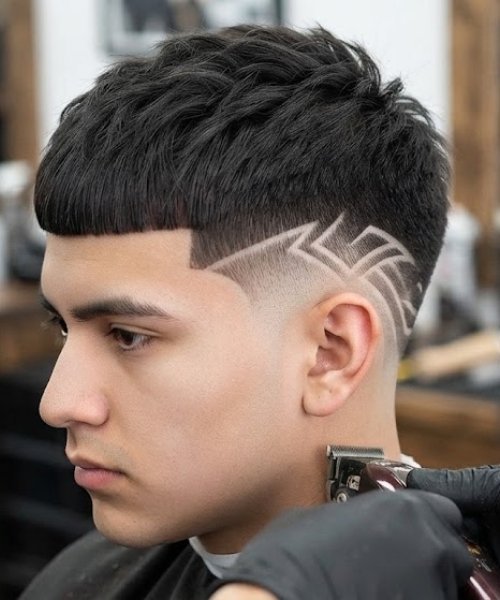
An Edgar already has a strong shape, particularly around the straight or textured fringe. Adding a low taper design can make it more personalized.
31. Edgar with Single Side Line
A single diagonal line gives a traditional Edgar a simple update. Keep the line separate from the front fringe so the haircut still has a clear shape.
32. Edgar with Double Slash
Two short lines create a stronger contrast against the cropped sides. This works best when the top remains relatively clean and structured.
33. Textured Edgar with Curved Design
A textured Edgar combined with a curved side line creates a softer appearance than a completely geometric pattern.
34. Edgar with Temple V
A small V around the temple adds detail without competing with the blunt front. It’s a good option for someone who wants a noticeable but compact design.
35. Edgar with Back V Design
Instead of putting the design beside the face, place a small V at the back taper. This keeps the front of the Edgar clean while adding interest from behind.
Small & Subtle Low Taper Fade Designs
Subtle designs are ideal if you want a little personality without making the haircut the center of attention.
36. Tiny Temple Slash
A very short diagonal line near the temple is easy to maintain and works with almost any top style.
37. Mini Double Line
Two tiny parallel marks create a detail that is visible up close but less obvious from a distance.
38. Small Crescent
A small crescent-shaped line adds a curved element without taking over the taper.
39. Short Diagonal Accent
One short diagonal mark is one of the simplest designs you can ask for. It works particularly well with short, medium, and textured tops.
40. Tiny V Accent
A miniature V placed behind the ear gives the haircut a discreet design.
41. Small Back Arrow
A tiny arrow-shaped pattern can be placed in the lower back taper. It provides detail without changing the overall silhouette.
Low Taper Fade Designs by Hair Type
The same design can look completely different depending on hair texture. Curly and coily hair often creates more visual volume above the taper, while straight hair makes the lines and angles easier to see.
| Hair type | Good design choices | Main consideration |
|---|---|---|
| Curly | Curves, waves, small slashes | Follow curl volume |
| Straight | Geometric lines, V shapes, slashes | Keep edges precise |
| Wavy | Curves, freestyle patterns | Work with natural movement |
| Afro-textured | Bold lines, curves, geometric designs | Preserve shape and density |
Low Taper Fade Designs for Curly Hair
Curly hair provides natural texture, so the design doesn’t need to be extremely complicated. Curved lines and short slashes usually complement curls without fighting their movement.
For tighter curls, make sure the barber doesn’t remove too much hair around the design area. The goal is to create enough contrast for the pattern to show while maintaining the shape of the curls above it.
Good choices include:
- Curved temple lines
- Wave designs
- Single slashes
- Small V patterns
- Freestyle curves
- Low taper with curly fringe and side detail
Shrinkage also matters. Tight curls can appear considerably shorter when dry than when stretched, so your barber should judge the haircut based on how you normally wear your hair.
Low Taper Fade Designs for Straight Hair
Straight hair provides a clean background for sharp designs. Geometric shapes, parallel lines, V patterns, and lightning-inspired cuts can all stand out clearly.
If your hair is fine, avoid filling the side with too many lines. A single design with strong spacing can look more substantial than several thin marks that disappear into the haircut.
For thick straight hair, a low taper can remove enough weight around the edges while leaving the top full.
Low Taper Fade Designs for Wavy Hair
Wavy hair works particularly well with curved and freestyle designs because the pattern can echo the natural movement of the hair.
A curved side line, wave pattern, or simple slash can create contrast between the textured top and the cleaner taper below.
Don’t make the design too wide if your waves are long. Leaving enough side hair around the pattern helps maintain the haircut’s overall balance.
Low Taper Fade Designs for Afro-Textured Hair
Afro-textured hair can provide strong contrast between a fuller top and a detailed taper. Bold lines, curves, geometric shapes, and clean temple designs can work particularly well.
The most important point is maintaining the shape of the natural texture. A design should complement the haircut rather than removing so much side hair that the top suddenly looks disconnected.
For 4A, 4B, and 4C textures, your barber should account for shrinkage and the way your hair expands when dry. A design that looks correctly positioned on freshly stretched hair may appear different once the hair returns to its natural shape.
How Are Low Taper Fade Designs Created? (Step-by-Step)
A good design starts with the haircut itself. The pattern should be planned after considering the taper, side profile, and available hair.
Step 1: Establish the Low Taper
The barber first creates the low taper around the temples and neckline. The shortest section stays low rather than climbing high up the side.
Step 2: Blend the Taper
The barber gradually blends the shortest area into longer hair using different clipper guards and controlled lever adjustments.
The exact guard sequence varies according to hair density, texture, and the desired finish. There isn’t one universal guard number that works for every head.
Step 3: Plan the Design
Before cutting the design, the barber should decide where it will sit. This is the point to check whether the pattern works with your head shape and existing haircut.
Step 4: Outline the Pattern
A trimmer or detailer is used to mark the design. For a simple slash, this may take only a few strokes. More complex designs require careful outlining before excess hair is removed.
Step 5: Clean the Design
The barber removes the hair inside or around the outlined pattern to create contrast. A razor may be used for an especially crisp finish, depending on the barber’s technique and the client’s preference.
Step 6: Check Both Sides
If the design is symmetrical, the barber should compare both sides before finishing. Small differences can become noticeable once the haircut is complete.
Step 7: Final Edge-Up
The temples, hairline, and neckline are cleaned up. The finished design should look connected to the haircut rather than appearing like a separate mark placed on the side.
How to Ask Your Barber for a Low Taper Fade Design
Don’t simply say, “Give me a low fade with a design.” That leaves too much open to interpretation.
Instead, tell your barber four things:
- Where you want the taper: “Keep the taper low around my temples and neckline.”
- How short you want it: “I don’t want the taper taken high up the sides.”
- Where the design goes: “Put one diagonal line behind my temple.”
- How bold you want it: “Keep the line clean but fairly narrow.”
For example, you could say:
“I want a low taper around the temples and neckline. Keep the sides fuller above the taper, and add one clean diagonal design line above the ear. I want it sharp but not too wide.”
For a more complex design, bring a photo. A picture communicates the shape, placement, angle, and size much more accurately than a haircut name alone.
Also tell your barber how often you plan to return. If you only visit every three or four weeks, a highly detailed pattern may not remain sharp for the entire time.
Best Styling Products for Low Taper Fade Designs
The design itself doesn’t require a special styling product. Products are mainly used to control the hair above and around the taper.
Choose the product according to your hair texture and the finish you want.
For Curly Hair
Use products that define curls without making them stiff or excessively greasy.
Good options include:
- Curl cream
- Lightweight leave-in conditioner
- Curl-defining gel
- Light styling mousse
Apply the product mainly to the longer hair. Avoid covering the freshly detailed taper with heavy product.
For Straight Hair
Straight hair often benefits from products that provide texture or control.
Consider:
- Matte clay
- Styling paste
- Lightweight pomade
- Texture powder
A matte product is useful when you want a natural finish. Pomade works better when you want shine and stronger control.
For Wavy Hair
Wavy hair usually looks best when the natural movement remains visible.
Try:
- Sea-salt spray
- Lightweight mousse
- Texture cream
- Light styling paste
Work the product through damp hair, then allow the waves to form naturally or use a diffuser if appropriate.
For Afro-Textured Hair
Choose products based on the desired shape rather than trying to flatten the natural texture.
Useful options include:
- Leave-in conditioner
- Curl cream
- Curl sponge
- Light styling gel
- Moisturizing hair cream
If you’re wearing a defined coily style, apply product evenly rather than concentrating it around the taper. The design should remain visible beneath the finished hairstyle.
How to Maintain a Low Taper Fade Design
A low taper design looks best when both the fade and the pattern remain intentional.
You don’t necessarily need to cut the entire haircut every week. Often, a design and taper cleanup can be enough between full haircut appointments.
Maintenance schedule
| Time after haircut | What usually changes |
|---|---|
| 1–3 days | Design looks very crisp |
| Around 1 week | Fine growth begins softening the pattern |
| Around 2 weeks | Design is noticeably less sharp |
| Around 3–4 weeks | Taper and design usually need a fuller refresh |
These are general time frames, not fixed rules. Hair growth speed, texture, haircut length, and how sharp you want the design to look all affect the schedule.
At home
- Don’t attempt to recreate detailed lines with a trimmer unless you’re experienced.
- Wash and condition your hair according to its texture.
- Keep the longer top styled so it doesn’t cover the design.
- Avoid heavy buildup around the temple area.
- Sleep in a way that doesn’t constantly flatten or disturb your hairstyle.
- Return to your barber when the design starts looking uneven.
A common mistake is trying to extend a sharp design for too long. Once the pattern becomes fuzzy, adding more lines at home can easily make it uneven.
Low Taper Fade Design Mistakes to Avoid
1. Choosing a Design Without Considering Hair Density
A pattern that looks great on thick hair may disappear on fine or sparse hair. Your barber should choose a design that matches the amount of hair available.
2. Making the Design Too Large
A large design can dominate a low taper. If you want something versatile, start with one or two simple lines.
3. Ignoring the Haircut’s Shape
The design should follow the haircut rather than looking randomly placed. Placement matters as much as the pattern itself.
4. Asking for a Design Without Showing a Reference
Names like “freestyle,” “slash,” or “lightning” can mean different things to different barbers. A reference image removes much of the confusion.
5. Putting Too Many Lines Together
Crowded lines can merge visually as the hair grows. Good spacing makes even a simple pattern look cleaner.
6. Forgetting About Grow-Out
A design that looks excellent on day one won’t look exactly the same after two weeks. Choose a pattern you can comfortably maintain.
7. Overusing the Razor
A razor can create an extremely crisp appearance, but not every haircut needs a razor-finished design. Your barber can help determine whether a trimmer-only finish is more appropriate.
8. Taking the Taper Too High
If you specifically want a low taper, make this clear before the haircut starts. Taking the taper higher changes the overall shape and reduces the amount of hair available for the design.
Frequently Asked Questions
How long does a low taper fade design last?
The design usually looks its sharpest for several days and gradually becomes softer as the hair grows. Many people need a design cleanup around 1–2 weeks, while a full haircut may last roughly 2–4 weeks depending on personal preference.
Is a low taper fade good for a design?
Yes. A low taper leaves more hair above the tapered area, giving you room for a side, back, or freestyle pattern without creating an extremely high-contrast haircut.
Does a low taper design work with curly hair?
Yes. Curly hair works especially well with curved lines, waves, small slashes, and freestyle designs. Your barber should account for curl shrinkage when deciding the placement and size.
What is the easiest low taper fade design to maintain?
A single diagonal line is one of the easiest choices. It has fewer edges than complicated geometric or freestyle patterns and can still look sharp when the rest of the taper begins to grow out.
Can I get a low taper fade design with an Edgar?
Yes. An Edgar with a low taper pairs well with single slashes, double lines, small V designs, and back patterns. Keeping the design relatively compact helps preserve the Edgar’s strong front shape.
How often should I get a low taper fade design touched up?
If you want the design to stay very crisp, consider a cleanup roughly every 1–2 weeks. If you’re comfortable with a softer appearance, you can wait longer and get the taper and design refreshed together.
Should I get a skin fade or low taper for a design?
Choose a low taper if you want a more subtle, versatile haircut with more hair retained around the sides. Choose a skin fade if you want maximum contrast and a more dramatic design.
Can I create a low taper fade design at home?
Simple maintenance may be possible if you’re experienced with clippers and trimmers, but creating a clean design is difficult without practice. A professional barber is the safer choice for symmetrical lines, curves, and detailed patterns.
Final Thoughts
A low taper fade design gives you a way to personalize your haircut without committing to a high or aggressive fade. The best designs don’t necessarily have to be complicated—a clean slash, small V, curved line, or subtle back detail can completely change the look.
Choose the pattern based on your hair texture, haircut length, lifestyle, and how often you can maintain it. If you’re unsure, start small. A simple design is easier to grow out, easier to maintain, and gives your barber room to adjust the style at your next appointment.
For a first design, a low taper with a single side slash is an excellent starting point. If you want something more expressive, try a curved freestyle pattern, geometric back design, or a custom design that follows the natural shape of your haircut.