

A high taper fade for straight hair is a strong choice when you want clean sides, visible contrast, and enough length on top to create texture or volume. Straight hair can actually make the taper look especially crisp because the gradual change in length is easy to see.
Yes, a high taper works with straight hair. The key is choosing the right amount of length on top and telling your barber exactly how high you want the taper to start. Thick, fine, light, dark, short, and long straight hair can all work with this haircut, but the styling approach should change depending on your hair type.
This guide explains how the high taper works with straight hair, how to make the taper visible on blonde or light hair, which hairstyles pair with it, what products to use, how to style it at home, and how to explain exactly what you want to your barber.
What Is a High Taper Fade and Does It Work for Straight Hair?
A high taper fade gradually reduces the hair around the temples and sideburn area, with the transition beginning higher than it would on a low or mid taper. The top remains significantly longer than the tapered sections.
Although people sometimes use “taper” and “fade” interchangeably, a traditional taper usually focuses on specific areas such as the sideburns and neckline. A fade can remove more hair and create a broader transition around the sides and back.
With a high taper, the starting point is closer to the upper temple. This creates a noticeable contrast between the longer hair above and the shorter hair around the edges.
For straight hair, that contrast can look particularly clean. Straight strands don’t naturally hide the transition as much as tightly curled hair can, so the shape of the cut remains easy to see.
How high should the taper start?
There isn’t one universal measurement because head shape and the desired style matter. However, you can describe the position to your barber using the temple as a reference point.
A useful explanation is:
“I want the taper to start high around the temple, but don’t take the blend too far into the top. Keep the top long enough for me to style.”
If you want a very noticeable high taper, tell your barber that you want stronger separation between the top and the tapered area. If you want a softer appearance, ask for the transition to remain more gradual.
High taper fade vs. high skin fade
A high taper does not automatically mean the sides must be shaved completely to the skin. High skin fade takes the shortest section down to bare skin and usually creates a more dramatic contrast. A high taper can instead finish at a very short clipper length while keeping the transition more subtle.
For straight hair, this distinction matters. Fine or light-colored hair may look more natural with a softer finish, while thick dark hair can handle a sharper skin-level contrast.
Also read: Mid Taper Fade for Long Hair: 20+ Best Styles +Expert Barber Guide (2026)
Will a High Taper Fade Show Up on Light or Blonde Straight Hair?
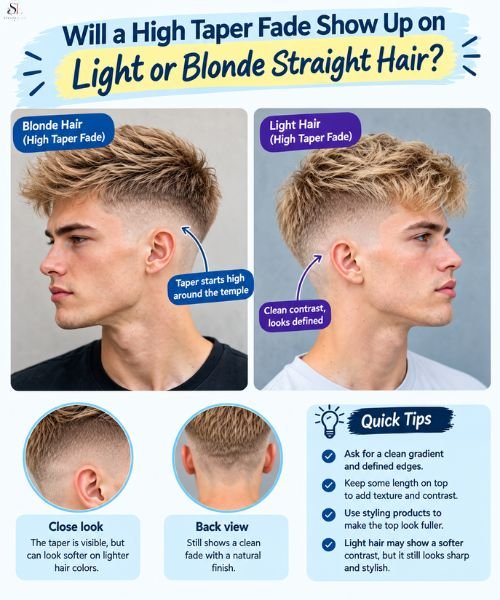
Yes, but the contrast may look softer than it does on dark straight hair. The visibility of a taper depends on the difference between the lengths, your hair color, skin tone, lighting, and how closely the shortest area is cut. Blonde or light-brown hair can sometimes make a subtle taper appear less dramatic because the transition between hair and skin isn’t as visually strong.
That doesn’t mean you need an extremely aggressive fade. Instead, ask your barber to create a clean gradient and maintain a clear shape around the temple and sideburn. Styling the longer top with texture can also make the overall haircut look more defined.
If your blonde straight hair is fine, avoid removing too much weight from the top. Keeping some density above the taper can prevent the haircut from looking overly thin.
Technique 1 — The Hard Part
A hard part adds a shaved or sharply defined line that separates two sections of hair. With a high taper, the hard part can create another point of contrast. For example, you could combine a high taper with a side part and leave around 2–3 inches on top for a controlled professional style.
The part should follow the natural direction of your hair rather than being placed randomly. Your barber can locate the natural part and then decide whether a shaved line would improve the shape.
A hard part works particularly well when you want the haircut to look intentional without needing complicated styling.
Ask your barber:
“Give me a high taper around the temples and sideburns, then add a clean hard part on my natural parting line. Keep enough length on top for a side-swept finish.”
Technique 2 — Soft Gradient Over Skin Fade
If you like the cleanliness of a skin fade but don’t want an extremely harsh appearance, ask for a soft gradient. The barber gradually moves from the shortest section into longer hair instead of creating a sudden visual jump. On straight hair, this helps keep the taper polished while preventing the sides from looking disconnected.
A skin-level finish can be particularly striking with thick, dark straight hair. However, the shortest section should be blended carefully because straight hair can reveal uneven transitions quickly. For light or fine straight hair, a slightly softer finish may be easier to maintain visually as it grows out.
Technique 3 — Textured Top Styling
Straight hair can sometimes fall into one flat direction. Texture changes that by separating sections of hair and creating movement.
Your barber can use techniques such as point cutting or controlled texturizing depending on your hair density and desired shape. The goal isn’t to make every strand messy. It’s to remove enough weight or create enough separation for the top to move naturally.
For example:
- 2 inches: good for a short textured top.
- 2.5–3 inches: useful for a quiff or side part.
- 3–4 inches: gives more options for volume and slick-back styling.
- 4+ inches: provides more styling flexibility but requires more daily maintenance.
The correct length depends on thickness and the final style you want.
What Products Does Straight Hair Need for a High Taper Fade?
Straight hair usually benefits from products that provide texture, volume, or controlled hold without making the strands look heavy.
The right product depends on whether your goal is matte texture, natural movement, shine, or strong control.
| Product | Best for | Finish | Hold |
|---|---|---|---|
| Matte clay | Thick straight hair | Natural/matte | Medium-high |
| Styling paste | Everyday styling | Natural | Medium |
| Texture powder | Flat or fine hair | Matte | Light-medium |
| Sea salt spray | Loose texture | Natural | Light |
| Pomade | Side parts and slick backs | Medium-high shine | Medium-high |
| Hair cream | Longer straight hair | Soft/natural | Light |
| Hairspray | Finishing volume | Natural to shiny | Medium-high |
Don’t automatically use the strongest product available. Very strong products can make straight hair look stiff, greasy, or overly flat.
How much product should you use?
Start with a small amount, roughly pea-sized for a short-to-medium top. Warm it between your palms before applying.
If your hair needs more control, add a little more rather than applying a large amount at once.
Fine straight hair usually needs less product than thick straight hair. Too much product can make fine strands separate into thin-looking sections.
How to Style a High Taper Fade on Straight Hair
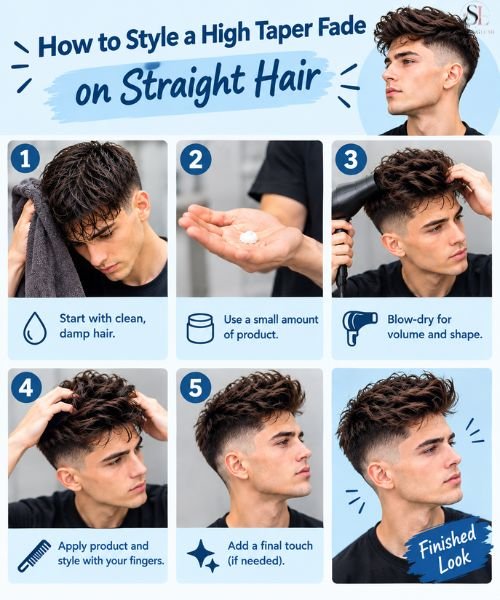
Start with slightly damp hair rather than soaking-wet hair.
- Wash or lightly dampen your hair.
- Apply a small amount of pre-styler if you need extra volume or heat protection.
- Blow-dry in the direction you want the hair to sit.
- Lift the roots with your fingers or a vent brush if you want height.
- Apply a small amount of styling product.
- Work the product through the middle and ends first.
- Use your fingertips to shape the front and top.
- Finish with hairspray if your style loses volume quickly.
For a quiff, direct the blow dryer upward and slightly backward at the front. For a side part, dry the hair diagonally toward the chosen side. For a slick back, push the hair backward while drying it and finish with a suitable pomade or styling cream. The taper itself requires little styling. Most of your effort should go toward controlling the longer hair on top.
Which High Taper Fade Styles Work Best on Straight Hair?
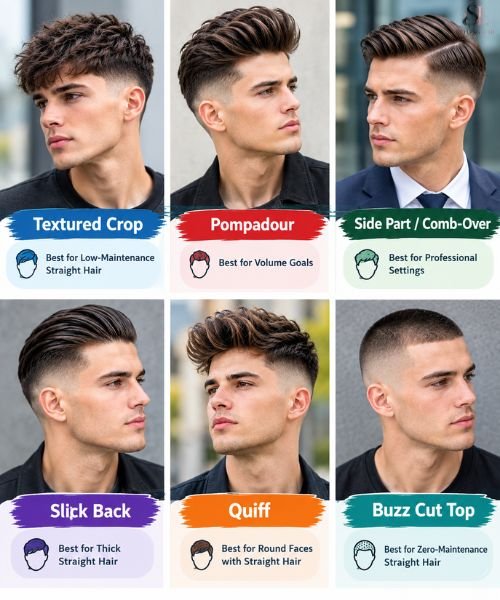
Straight hair gives you a wide range of options because the strands can be directed, lifted, separated, or brushed into a clean shape. The best choice depends on your hair density, face shape, lifestyle, and willingness to style it every morning.
| Style | Top length | Styling effort | Best for |
|---|---|---|---|
| Textured crop | 1.5–2.5 inches | Low | Easy everyday styling |
| Pompadour | 3–5 inches | High | Maximum volume |
| Side part | 2–3.5 inches | Low-medium | Professional settings |
| Slick back | 3–5 inches | Medium | Thick straight hair |
| Quiff | 2.5–4 inches | Medium | Added height |
| Buzz cut | 0.5–1.5 inches | Very low | Minimal maintenance |
Textured Crop Best for Low-Maintenance Straight Hair
A textured crop is one of the easiest choices for straight hair. The top stays relatively short, while texture prevents it from looking like a single solid block. The high taper keeps the temples and sideburns clean.
Ask your barber to leave enough length at the front to create a slight forward movement. The exact length depends on your hair density and how much texture you want.
At home, rub a small amount of matte clay or paste between your fingers and pinch small sections of the top. You don’t need a perfectly messy finish. Controlled texture usually looks more natural.
Pompadour Best for Volume Goals
A pompadour is designed around height and volume at the front. It works especially well with thick, straight hair because dense strands can support the elevated shape. However, it requires more blow-drying and product than a crop or side part.
Keep around 3–5 inches on top if your hair has enough density for the style. The front can be slightly longer than the crown so you have material to lift.
Use a blow dryer to create the shape before adding your finishing product. If you put a heavy pomade into wet hair and expect it to create volume by itself, the hair may become weighed down.
Side Part / Comb-Over Best for Professional Settings
A side part creates a controlled appearance without requiring extreme volume. It’s a good choice if you need a haircut that can move between casual and professional environments. You can wear it neatly during work and add texture on weekends.
Ask your barber to locate your natural part instead of forcing a completely different direction. Keep roughly 2–3.5 inches on top, depending on how much movement you want. A high taper around the temples keeps the sides tidy while the longer top maintains a traditional shape.
Slick Back: Best for Thick Straight Hair
The slick back works particularly well when your straight hair has enough density to maintain a full appearance. Longer top hair can be brushed backward while the high taper removes bulk from the sides. This creates a strong front-to-back contrast.
For a modern finish, avoid making every strand perfectly flat. A little natural separation can make the style look less rigid. Use a medium or strong styling product depending on your hair thickness. Pomade works well if you want shine, while clay or paste can create a more modern matte appearance.
Quiff: Best for Round Faces with Straight Hair
A quiff adds height at the front, which can visually lengthen the appearance of a round face. The high taper also reduces width around the sides. Together, these elements can create a more vertically focused shape.
Keep the top long enough to lift, usually around 2.5–4 inches depending on your hair density. Blow-dry the front upward and slightly backward before applying your finishing product.
Don’t make the sides excessively wide. The point of this combination is to maintain height while keeping the overall silhouette controlled.
Buzz Cut Top Best for Zero-Maintenance Straight Hair
If you don’t want to style your hair every morning, a short buzzed top can be paired with a high taper. This creates a clean, simple haircut with very little daily work. You can wash, dry, and go.
The trade-off is that you have fewer styling options. A buzz cut also exposes the shape of your head more than a longer top, so discuss the desired length with your barber before cutting.
Which Face Shape Gets the Best Results from a High Taper Fade?
A high taper can work with most face shapes, but the top and side proportions should be adjusted to balance your natural features.
| Face shape | Useful approach | What to avoid |
|---|---|---|
| Round | High taper + height on top | Excessive side volume |
| Square | High taper + textured top | Overly boxy edges |
| Oval | Most styles work | Very little needs correcting |
| Long | Keep moderate height | Excessive vertical volume |
| Heart | Controlled sides + textured top | Extremely tight sides with too much top |
| Diamond | Balanced top and sides | Excessively narrow sides |
Round face
A high taper can reduce some visual width around the temples. Pairing it with a quiff or textured top adds height.
Square face
Square faces already have strong angles. A textured top can soften the overall appearance without hiding the natural structure.
Oval face
An oval face generally gives you considerable flexibility. You can experiment with a crop, quiff, side part, slick back, or longer textured top.
Long face
Be careful with excessive height. A very tall pompadour combined with a high taper can make the face appear visually longer. Instead, consider moderate height and some controlled width.
How Often Does a High Taper Fade Need to Be Trimmed?
Most people who want a consistently sharp high taper schedule a cleanup roughly every 2–3 weeks. If you prefer a more grown-in appearance, you may stretch it closer to 4 weeks.
Your growth rate, hair color, taper height, and preferred sharpness all affect the ideal schedule.
A high taper can lose its crisp appearance before the longer top actually needs cutting. That’s why some people ask their barber for a quick taper cleanup instead of taking significant length off the top.
| Time after haircut | Typical appearance |
|---|---|
| 0–7 days | Freshest and sharpest |
| 1–2 weeks | Still clean with natural growth |
| 2–3 weeks | Taper becomes softer |
| 3–4 weeks | More grown-in appearance |
| 4+ weeks | Often ready for a full cleanup |
These are practical grooming intervals rather than fixed rules. Your own growth rate should determine the schedule.
How to Extend Your High Taper Fade at Home
You can maintain the general appearance between barber visits, but be careful around the temple because a small mistake can change the entire shape.
If you are experienced with clippers, you can carefully clean obvious stray hairs around the sideburn and neckline. However, don’t try to recreate the entire fade by repeatedly moving the clipper higher. This is a common way to accidentally push the taper too high.
A safer maintenance routine is:
- Keep the top untouched.
- Clean obvious stray hairs around the edges.
- Avoid changing the original taper line.
- Use a small detail trimmer only if you’re comfortable.
- Let your barber perform the actual blend.
If you’re unsure, leave it alone. A slightly grown-out taper is easier for a barber to correct than an accidentally raised taper.
How Do You Ask Your Barber for a High Taper Fade on Straight Hair?
The easiest way is to describe four things: taper height, shortest length, top length, and top style.
Instead of simply saying “high taper,” try:
“I want a high taper around the temples and sideburns. Keep the taper clean and gradually blended, but don’t take it too far into the top. Leave about 3 inches on top because I want a textured quiff. Keep the neckline natural and clean up the edges.”
If you want skin at the shortest point:
“Take the shortest part down to skin around the taper, then blend it gradually into the longer hair.”
If you don’t want skin:
“Keep the shortest part very short but not completely down to the skin. I want a softer taper.”
Tell your barber what you don’t want
This can be just as important as explaining what you do want.
For example:
- “Don’t take the taper too far back.”
- “Don’t remove too much weight from the top.”
- “Don’t make the part extremely hard.”
- “Keep the front long enough for volume.”
- “I want the sides clean but not completely disconnected.”
Bring a reference photo showing the side and front whenever possible. A single front-facing photo may not clearly show the taper height.
High Taper vs. Mid Taper vs. Low Taper: Which Is Right for Your Straight Hair?
The main difference is where the taper begins and how much contrast it creates.
| Taper | Starting area | Overall effect | Good pairing |
|---|---|---|---|
| Low taper | Near sideburns and lower neckline | Subtle | Side part, crop |
| Mid taper | Around the middle temple area | Balanced | Quiff, textured top |
| High taper | Higher around the temples | Strong contrast | Pompadour, quiff, buzz |
A low taper is useful if you want a conservative haircut and don’t want the taper to dominate your appearance.
A mid taper provides a middle ground. It gives visible cleanup without pushing the transition too high.
A high taper creates the strongest visual contrast of the three. It can make the longer top stand out more dramatically.
For straight hair, your choice should depend on how much contrast you want and how much hair you want removed from the sides.
Which Straight Hair Type Works Best with a High Taper Fade?
There isn’t one straight-hair type that automatically wins. Density, thickness, natural direction, and styling goals matter more than simply calling your hair “straight.”
Fine straight hair
Fine hair can work with a high taper, but don’t remove too much density from the top. A textured crop, short quiff, or side part can work well. Lightweight styling products are usually easier to manage than heavy waxes.
Medium-density straight hair
This is highly flexible. You can experiment with crops, quiffs, side parts, comb-overs, and slick backs. The biggest decision is how much top length you want to maintain.
Thick straight hair
Thick hair gives you plenty of material for pompadours and slick backs, but it can also become bulky.
Ask your barber to control excess weight without making the top look thin. Strategic texturizing can help the hair move more easily.
Very straight, stubborn hair
Hair that naturally falls flat or refuses to change direction may need more blow-drying and pre-styling. Don’t rely entirely on strong wax. Training the hair with a blow dryer often produces a better shape before the finishing product goes in.
Straight hair with a cowlick
A cowlick doesn’t automatically rule out a high taper. Your barber can work with the natural growth pattern instead of fighting it. Keeping slightly more length around the affected area may give you more control.
Seasonal Styling Adaptations for a High Taper Fade on Straight Hair
Your haircut can stay the same throughout the year, but your styling routine may need to change with the weather.
Summer — Humidity and Sweat
Hot weather can make straight hair lose volume or become oily faster. Use lighter products and avoid applying excessive amounts near the roots. If your hair becomes flat, a small amount of texture powder can help restore lift without adding a heavy coating.
Sweat can also make the scalp and hair feel greasy. Regular washing based on your hair and scalp needs can help keep the style fresh. If you’re outdoors often, consider a slightly shorter top during the hottest months.
Winter — Static and Dryness
Cold, dry air can make straight hair more prone to static and dryness. A lightweight moisturizing product can help keep the strands manageable. Avoid constantly applying heavy wax just to control static because buildup can make straight hair look greasy. If you wear hats regularly, remember that compressed hair may need a quick blow-dry or restyling after removing the hat.
Spring and Fall — Flexible Hold
Milder weather gives you more freedom to experiment. This is a good time to switch between matte texture, side parts, quiffs, and more relaxed styles without fighting extreme humidity or dryness. A medium-hold paste is a practical everyday option if you want a hairstyle that can be reshaped during the day.
Frequently Asked Questions
Is a high taper fade good for straight hair?
Yes. Straight hair can work very well with a high taper because the clean transition is easy to see. You can combine it with a crop, quiff, pompadour, side part, slick back, or buzz cut.
How long should straight hair be on top for a high taper?
It depends on the hairstyle. Around 1.5–2.5 inches works well for a short textured crop, while 2.5–4 inches gives you more flexibility for quiffs and side parts. Longer styles such as pompadours and slick backs may need 3–5 inches or more.
Does a high taper look good on blonde straight hair?
Yes, but the taper may appear softer because light hair can create less visual contrast with the skin. A clean gradient, defined edges, and textured top can make the haircut more noticeable.
Is a high taper better than a low taper for straight hair?
Neither is universally better. A high taper creates stronger contrast and exposes more of the upper sides, while a low taper gives a more subtle appearance. Choose based on the amount of contrast and maintenance you prefer.
Can thin straight hair get a high taper fade?
Yes. The key is keeping enough density on top. Avoid removing too much hair from the top or using heavy products that flatten fine strands.
How often should I get a high taper fade?
A cleanup every 2–3 weeks keeps the taper looking particularly sharp for many people. If you prefer a grown-out appearance, you can wait longer.
Can I style a high taper fade without a blow dryer?
Yes. A short crop or buzz cut can require little or no blow-drying. Longer styles such as pompadours and quiffs usually benefit from blow-drying because heat helps establish volume and direction before styling product is applied.
What should I tell my barber if I don’t want the taper too high?
Be specific. Say, “I want a high taper, but keep the transition close to the temple and don’t push it too far into the upper sides.” Showing a side-view reference photo can make the desired height even clearer.
Key Takeaways
A high taper fade for straight hair is a versatile haircut that combines a clean, high transition around the temples with longer hair on top. Straight hair makes the taper easy to see, while the longer top gives you room to create texture, volume, or a controlled finish.
Keep these points in mind before your next appointment:
- A high taper starts higher around the temple than a low or mid taper.
- Straight hair works with both subtle and dramatic taper finishes.
- Blonde or light straight hair may show softer contrast.
- A textured crop is a practical low-maintenance option.
- A pompadour gives thick straight hair maximum volume.
- A side part works well when you need a neat, professional style.
- A slick back is particularly useful for thick straight hair.
- A quiff can add visual height for a rounder face shape.
- A buzz cut gives you the simplest daily routine.
- Fine straight hair should retain enough density on top.
- Thick straight hair may benefit from controlled texturizing.
- A small amount of styling product is usually better than overloading the hair.
- Blow-drying can make a major difference when creating volume.
- A taper cleanup every 2–3 weeks can keep the haircut looking sharp.
- Don’t try to recreate the entire taper at home unless you’re experienced with clippers.
- When talking to your barber, explain the taper height, shortest length, top length, and desired style.
Most importantly, don’t choose the top hairstyle separately from the taper. Think about the entire shape of the haircut. A high taper with a textured crop creates a completely different silhouette from a high taper with a tall pompadour or slick back. Once you match the taper height and top length to your straight hair’s thickness, growth pattern, face shape, and daily routine, the haircut becomes much easier to manage.
1 thought on “High Taper Fade for Straight Hair: Styling Guide for Volume & Contrast”