

A high taper fade for curly hair removes or shortens the hair around the temples and sideburns while keeping the natural curls on top. Because the taper starts higher than a low or mid taper, it creates a cleaner, sharper contrast between the sides and the curly top.
This haircut works especially well when you want your curls to remain the main feature while keeping the sides controlled. You can wear it with short curls, a curly fringe, a high top, sponge curls, a curly crop, or longer textured hair. The key is choosing the taper height and top length according to your curl pattern, face shape, and preferred maintenance level.
What Is a High Taper Fade?
A high taper fade is a taper that begins relatively high around the temples and sideburns. The hair gradually becomes shorter as it approaches the edge, creating a clean transition while leaving the upper hair longer.
The word taper refers to gradually reducing hair length toward an edge. A fade describes a very close, blended transition that can move toward the skin. In everyday barber language, the terms can overlap, so it’s useful to show your barber a reference photo.
For a curly style, you should also tell your barber whether you want:
- A high taper that stops around the temples
- A high taper with a clean neckline
- A high taper with a skin-level finish
- A natural taper without exposing much scalp
- A sharper edge-up
- A softer natural hairline
Your top length is just as important as the taper. A very short curly top produces a completely different result from 3–5 inches of defined curls.
| Feature | High taper fade | High skin fade |
|---|---|---|
| Main focus | Temples/sideburns and selected edges | Larger side/back area |
| Top | Usually kept longer | Usually kept longer |
| Curl volume | More can be preserved | More contrast with sides |
| Scalp exposure | Can be minimal to noticeable | Usually more visible |
| Overall effect | Clean but textured | Sharper, higher contrast |
Does a High Taper Fade Work on Curly Hair?
Yes. Curly hair is one of the hair types that can work particularly well with a high taper fade because the short, clean edges contrast with the natural texture and volume on top.
The haircut can also help define the overall silhouette of curly hair. Instead of allowing the sides to become equally wide as the top, the taper creates a more controlled outline.
However, the result depends heavily on the curl pattern.
Loose curls may need less bulk removal because they naturally fall closer to the head. Tight curls and coils can appear much fuller, so the barber may need to shape the sides carefully rather than simply taking them extremely short.
If your hair has strong shrinkage, tell your barber how your curls look when completely dry. Cutting only while the hair is stretched or wet can make it difficult to judge the final shape.
For 2C and 3A curls
Keep enough length on top for the curls to form properly. A very short cut can make the texture look more wavy than curly.
For 3B and 3C curls
These curl patterns usually provide plenty of definition and volume. A high taper can create a strong contrast without requiring a very short top.
For 4A, 4B, and 4C hair
The taper can look particularly clean around the temples and edges. The top can be shaped into a defined curly or coily profile, sponge-textured finish, afro-inspired shape, or short natural style.
Also read: High Taper Fade for Straight Hair: Styling Guide for Volume & Contrast
High Blowout Taper Haircut Guide: Low vs Mid vs High, Every Hair Type
Will a High Taper Fade Suit My Face Shape?
A high taper fade can suit many face shapes, but the height and shape of the curly top should be adjusted to balance your proportions.
A high taper naturally removes visual width around the upper sides. If your face is already long, adding excessive height on top can make it appear longer. If your face is round, controlled height can help create a more elongated appearance.
| Face shape | Curly top approach | Taper suggestion |
|---|---|---|
| Oval | Most curly styles can work | High taper with your preferred finish |
| Round | Add moderate height | High taper with controlled side volume |
| Square | Keep texture balanced | High taper with a clean but not overly sharp shape |
| Long/oblong | Avoid excessive height | High taper with more top width and moderate height |
| Heart | Add balanced width | High taper with textured curls |
| Diamond | Keep proportions balanced | High taper with controlled temple area |
Oval face
An oval face gives you plenty of flexibility. You can try short curls, a curly fringe, textured volume, a curly high top, or a longer top. The main decision is how much maintenance you want rather than whether the haircut will technically work.
Round face
A little vertical height can make the face appear more elongated. A high taper combined with controlled volume on top can create that effect.
Avoid allowing the sides to become extremely wide and rounded.
Square face
A square face already has strong angles. A clean high taper can emphasize the jaw and cheek structure while the curls add softness and texture. You can choose either defined curls or a slightly fuller natural finish.
Long or oblong face
Be careful with excessive height. If your curls naturally stand tall, ask your barber to preserve more width rather than creating a very tall top. A moderate high taper can keep the sides clean without making the overall head shape appear unnecessarily long.
Heart-shaped face
A textured curly top can help balance a narrower chin. Avoid making the taper so aggressive that the upper face becomes visually much wider than the lower face.
20 High Taper Fade Styles for Curly Hair
1. High Taper Fade with Short Defined Curls
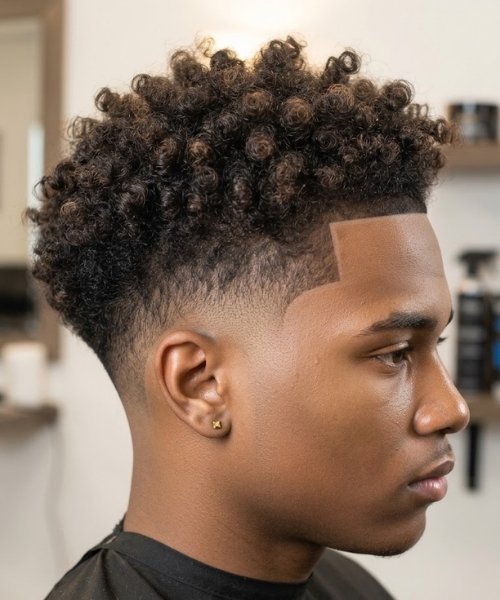
A high taper fade with short defined curls is a clean, easy-to-manage option for men who want their natural texture to stand out without keeping a lot of length. The hair around the temples and sideburns is tapered high, while the top is left long enough for individual curls to form.
The top usually works best when it has enough length to show the natural curl pattern rather than being clipped extremely short. A small amount of curl cream can separate the curls and reduce frizz while keeping the finish natural.
This style works especially well for 3A, 3B, 3C, and shorter 4A curls. It is also a good choice if you want a professional-looking curly haircut that doesn’t require complicated styling.
Ask your barber: “Give me a high taper around the temples and sideburns, keep the top short but long enough for my curls to stay defined, and blend the transition smoothly.”
2. High Taper Fade with Curly Fringe
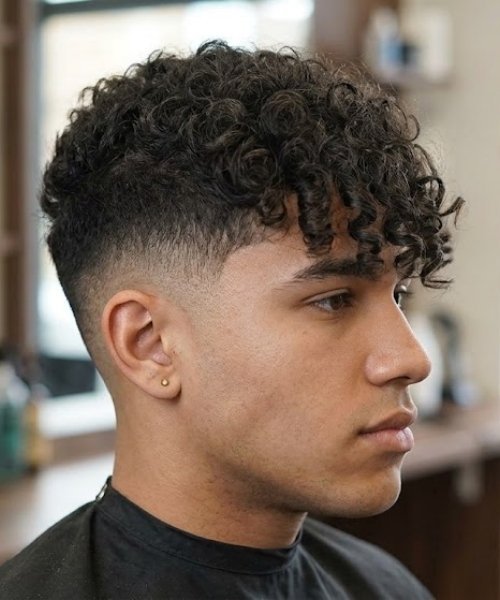
A curly fringe brings the curls forward toward the forehead while the high taper keeps the sides and temples clean. The fringe can be short and controlled or left longer for a softer, more relaxed appearance.
This style is particularly useful if you like your curls to be the main focus from the front. Your barber should avoid cutting the fringe too short because curly hair can shrink considerably once it dries.
For a balanced shape, the curls should fall naturally rather than being forced into a perfectly straight line. A small amount of curl cream or mousse can help define the fringe without making it stiff.
Best for: 2C, 3A, 3B, and 3C curls.
Ask your barber: “Keep my curls toward the front as a natural fringe, but give me a high taper around the temples and sideburns.”
3. High Taper Fade with Curly High Top
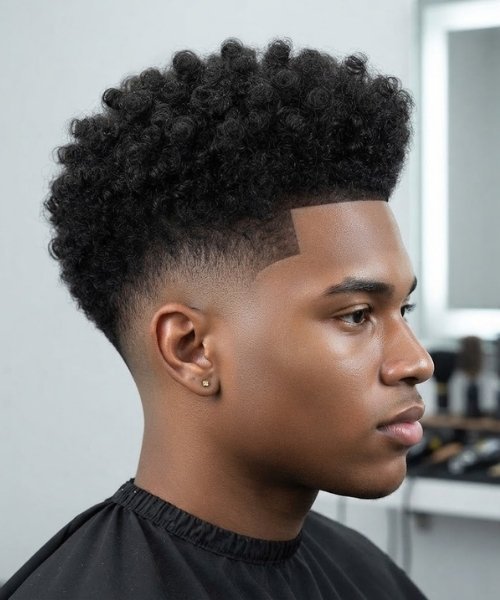
A curly high top creates height and volume above a sharply cleaned-up taper. Instead of cutting the curls close to the scalp, the barber leaves substantial length on top and shapes it into a taller silhouette.
This style works especially well for dense curls and coils because the natural texture can provide volume without requiring excessive styling. The sides are kept controlled so the top becomes the main visual feature.
If your face is long, don’t make the top excessively tall. A wider, moderately high shape can create better overall balance.
Best for: Dense 3C, 4A, 4B, and 4C hair.
Ask your barber: “Keep plenty of height and volume on top, but take the taper high around the temples and keep the transition clean.”
4. High Taper Fade with Sponge Curls
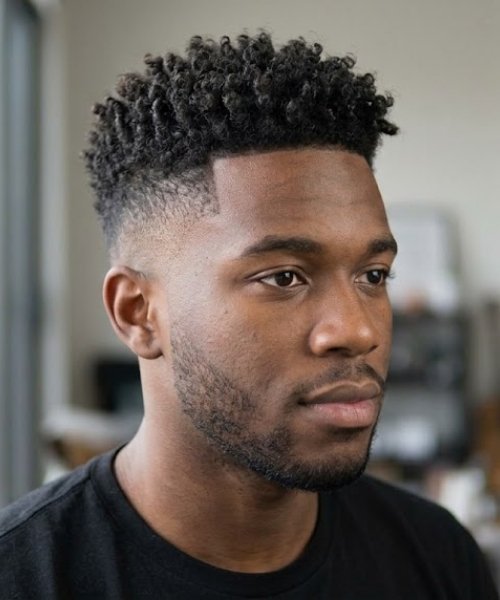
Sponge curls create small, separated curls or coils across the top. Combined with a high taper, the style has a clean perimeter while the top has a distinctly textured appearance.
The hair should have enough length for the sponge technique to create visible coils. Apply a small amount of curl cream or styling product to damp hair before using the sponge in gentle circular motions.
Don’t press the sponge aggressively. Excessive friction can create unnecessary tangling and frizz.
This style is particularly popular for short, tightly textured hair because it gives the top a defined pattern without requiring long curls.
Best for: 3C, 4A, 4B, and 4C hair.
Ask your barber: “Give me a high taper around the temples and leave enough length on top for sponge curls.”
5. High Taper Fade with Curly Crop
A curly crop combines a relatively short textured top with a clean high taper. It is a practical option if you want your curls to remain visible but don’t want a long hairstyle.
The top should be shaped rather than simply buzzed down. The goal is to leave enough length for the natural curls to create texture.
A short curly crop can also be easier to maintain than longer curly styles. After washing, apply a small amount of curl product and allow the curls to settle naturally.
The front can be worn slightly forward for a fringe-like appearance or left textured across the forehead.
Best for: Short 3A–3C curls and short coily textures.
Ask your barber: “Keep the top short and curly with a textured shape, and make the taper high and clean around the temples.”
6. High Taper Fade with Long Curly Top
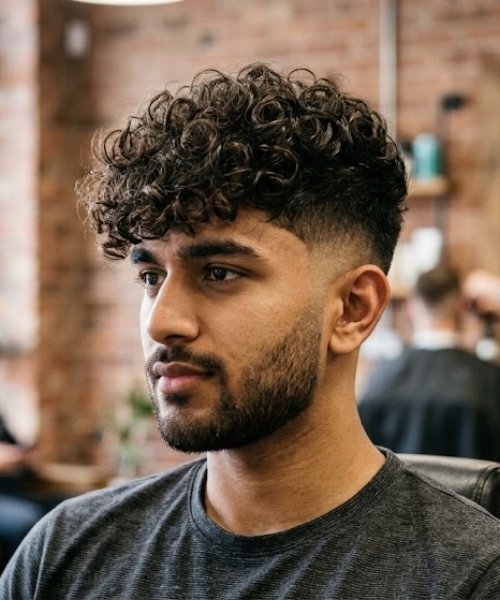
If you want maximum curl volume, keep the top significantly longer while using the high taper to control the sides. The contrast between the long curls and short tapered area makes the hairstyle immediately noticeable.
The exact top length depends on how your curls behave. Loose curls may need several inches before they form a strong shape, while tightly coiled hair can create substantial volume with less measured length.
Longer curls also require more conditioning and styling than a short curly crop. A leave-in conditioner followed by curl cream can help maintain definition.
Best for: 2C through 4A curls, depending on the desired shape.
Ask your barber: “Keep the top long and natural. I want the high taper mainly around the temples and sideburns without taking away my curl volume.”
7. High Taper Fade with Curly Mohawk
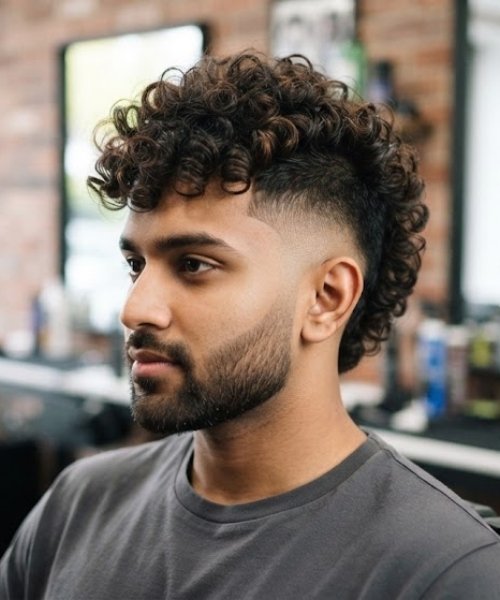
A curly mohawk keeps the center section of the hair fuller while the sides become significantly shorter. Adding a high taper around the temples gives the front of the hairstyle a cleaner transition.
You can make this style dramatic by keeping considerable height or choose a softer version with moderate curls through the center.
The back can also be left longer if you want the mohawk to flow into a subtle mullet shape. For a less aggressive look, keep some hair between the tapered area and the central curls.
Best for: Dense 3B, 3C, 4A, and coily textures.
Ask your barber: “Keep the curly hair concentrated through the center and taper the temples high without cutting into the main mohawk shape.”
8. High Taper Fade with Curly Mullet
A curly mullet combines shorter sides and front areas with longer hair toward the back. The high taper makes the temple area cleaner while allowing the curls at the back to remain longer.
This style works particularly well if your curls naturally create movement rather than sitting completely flat. The back can be kept loose and textured instead of being heavily shaped.
The transition between the tapered temple and longer back should look intentional. Tell your barber if you want a subtle mullet or a more noticeable contrast.
Best for: 2C, 3A, 3B, and 3C curls.
Ask your barber: “Give me a high taper around the temples, keep the back longer and curly, and blend the sides into the overall mullet shape.”
9. High Taper Fade with Curly Caesar
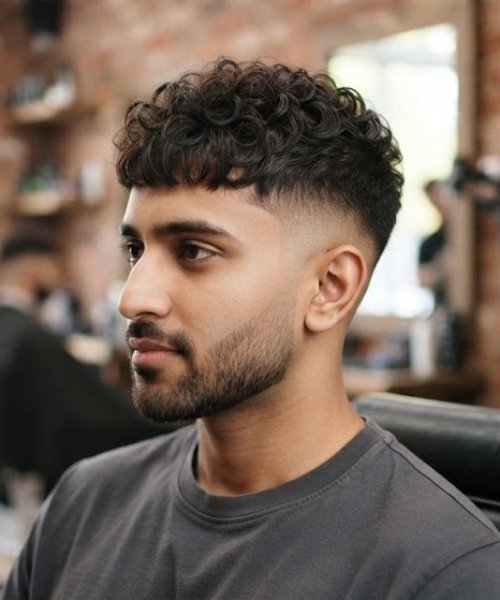
A curly Caesar keeps the top short with the curls directed toward the front. The high taper gives the temples and sideburns a crisp, controlled appearance.
The defining feature is the short forward-facing fringe. Because curly hair shrinks as it dries, your barber should account for the natural curl length before creating the front line.
This style is useful if you prefer a compact haircut that doesn’t require a large amount of styling. A small amount of curl cream can bring out the texture without making the hair look wet.
Best for: 3A, 3B, and 3C curls.
Ask your barber: “Keep the top short and curly with a forward fringe, then give me a high taper around the temples.”
10. High Taper Fade with Curly Afro
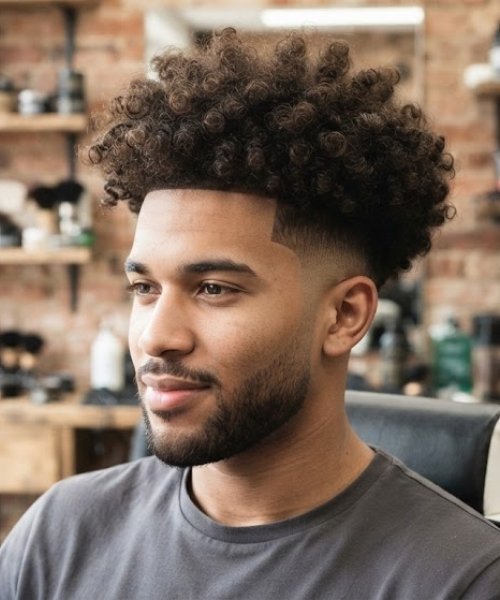
A curly afro with a high taper allows you to preserve substantial natural volume while creating a cleaner outline around the temples. The taper visually separates the fuller top from the shorter sides.
The afro can be rounded, slightly squared, or shaped according to your natural growth pattern. Don’t assume both sides need exactly the same amount of hair if your growth is naturally uneven.
For a softer appearance, keep the taper slightly longer. For a sharper contrast, the tapered section can be taken closer to the skin.
Best for: 3C, 4A, 4B, and 4C hair.
Ask your barber: “Keep the natural afro volume on top and shape it, but give me a high taper around the temples and sideburns.”
11. High Taper Fade with Curly Side Part
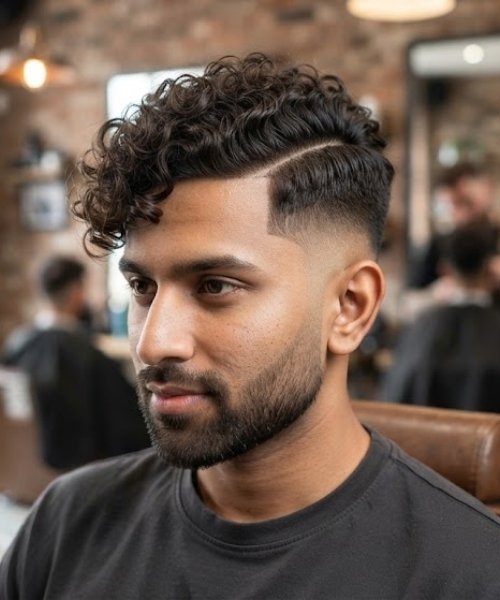
A curly side part adds direction to naturally textured hair. Instead of allowing the curls to fall randomly, the top is encouraged to move toward one side while the high taper creates a clean foundation.
A natural side part is usually the easiest option if your hair already separates in a particular direction. If you want a more obvious part, your barber can create a defined line.
Keep the curls relatively soft instead of brushing them completely flat. The goal is to combine structure with visible texture.
Best for: 2C, 3A, 3B, and 3C curls.
Ask your barber: “Keep my natural curls on top and create a side part, with a high taper around the temples.”
12. High Taper Fade with Curly Comb Over
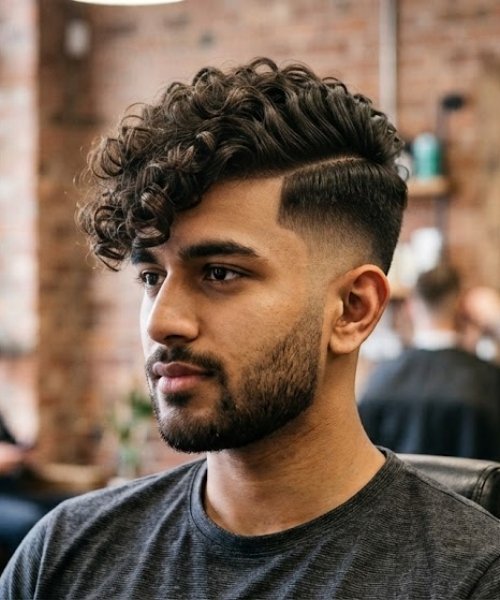
The curly comb over directs the top toward one side while preserving the natural curl pattern. It is more structured than simply wearing the curls loose but still keeps the hairstyle textured.
The barber should leave enough length on top to move the curls in one direction. Cutting the top too short can make it difficult to create the desired sweep.
Use a lightweight styling cream or mousse if your curls need help holding their direction. Avoid heavy waxes that can flatten the curl pattern.
Best for: Medium-length 2C–3C curls.
Ask your barber: “Keep enough length on top to sweep my curls to one side, and give me a high taper around the temples.”
13. High Taper Fade with Curly Slick Back
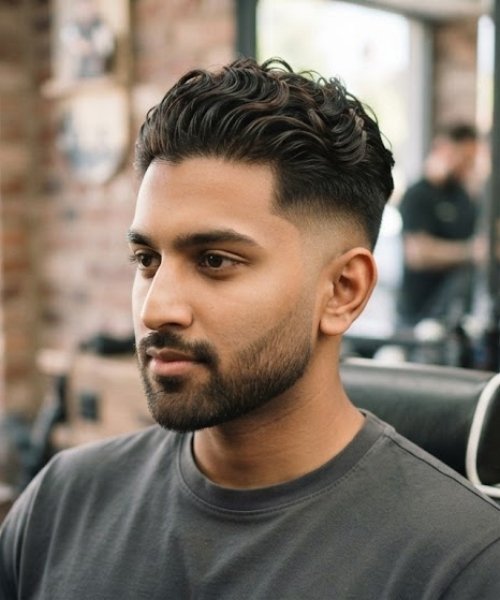
A curly slick back pushes longer curls away from the forehead and toward the back of the head. The high taper adds contrast around the sides and temples.
Unlike a straight-hair slick back, curly hair should not necessarily be combed completely flat. Leaving some natural curl movement gives the style a fuller and more relaxed appearance. A lightweight styling cream or flexible gel can help direct the curls while keeping them touchable. This style works best when the top has enough length to move backward naturally.
Best for: Medium to long 3A, 3B, and 3C curls.
Ask your barber: “Keep the top long enough to push my curls back, and use a high taper to clean up the temples and sideburns.”
14. High Taper Fade with Textured Curly Top
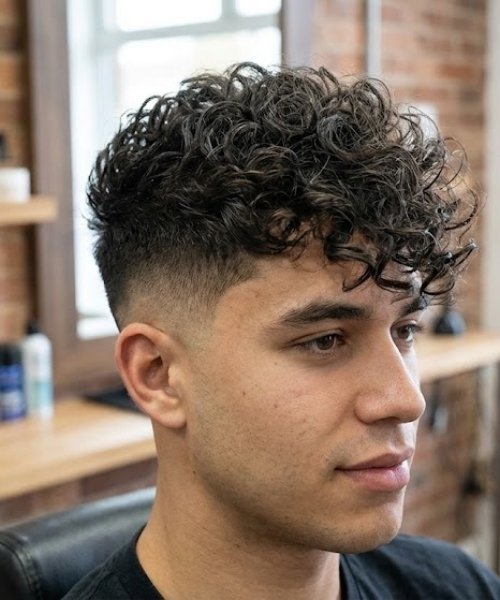
A textured curly top focuses on natural movement rather than a perfectly uniform curl pattern. The barber keeps enough length and density for the curls to create an uneven, layered-looking texture.
This is a flexible style because you can make it neat for work or allow it to become more relaxed on casual days. To style it, apply curl cream to damp hair and separate a few sections with your fingers. Let the rest of the curls form naturally instead of trying to make every curl identical.
Best for: Most curly textures, especially 3A–3C.
Ask your barber: “Keep the top textured and natural with enough length for my curls, and give me a high taper around the temples.”
15. High Taper Fade with Curly Edgar
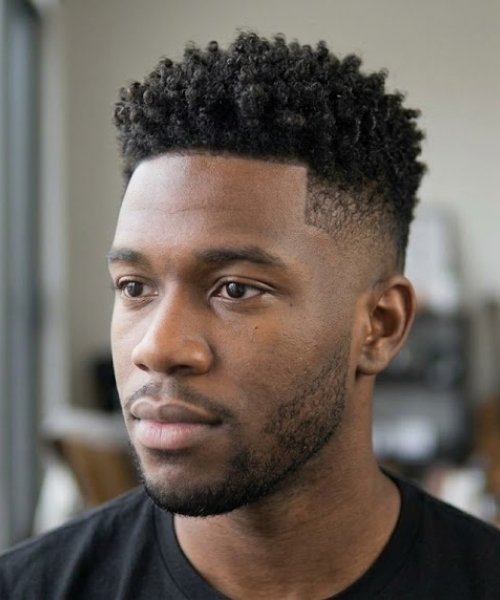
A curly Edgar combines a short, clearly defined front with textured curls behind it. The high taper reinforces the sharp appearance around the sides.
The front line needs careful attention because even a small change in its position can alter the appearance of the entire haircut. Don’t allow the hairline to be pushed back simply to make the front perfectly straight. The curly section behind the fringe can remain soft and natural.
Best for: Short to medium 3A–3C curls and some coily textures.
Ask your barber: “I want a curly Edgar with a defined front, but keep the top textured and give me a high taper around the temples.”
16. High Taper Fade with Curly Quiff
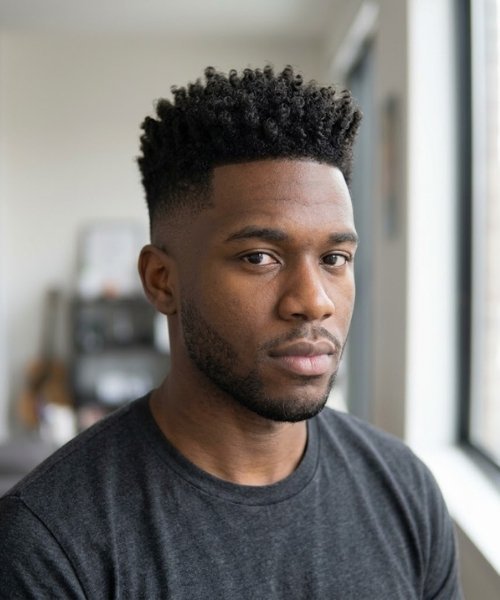
A curly quiff lifts the front of the hair upward and slightly backward while preserving curl texture. The high taper removes visual weight around the temples and creates a stronger contrast with the elevated front.
The amount of height should match your face shape. If your face is already long, keep the quiff wider and moderately high rather than creating excessive vertical height. A flexible curl product is usually better than a stiff gel because it allows the curls to retain movement.
Best for: 2C, 3A, and 3B curls.
Ask your barber: “Keep enough length at the front for a curly quiff and taper the temples high without making the top too narrow.”
17. High Taper Fade with Curly Twists
Curly twists can be paired with a high taper to create a sharp contrast between the textured top and clean temple area. The twists can be short and compact or longer depending on your hair length.
Before getting the taper, tell your barber how much space you need around the top for your preferred twist style. Taking the taper too far upward can reduce the amount of hair available for the twists.
Keep the edges clean but avoid cutting into the main twist pattern.
Best for: Coily and tightly textured hair.
Ask your barber: “Keep enough hair on top for my twists and take the taper high only around the temples and sideburns.”
18. High Taper Fade with Curly Design
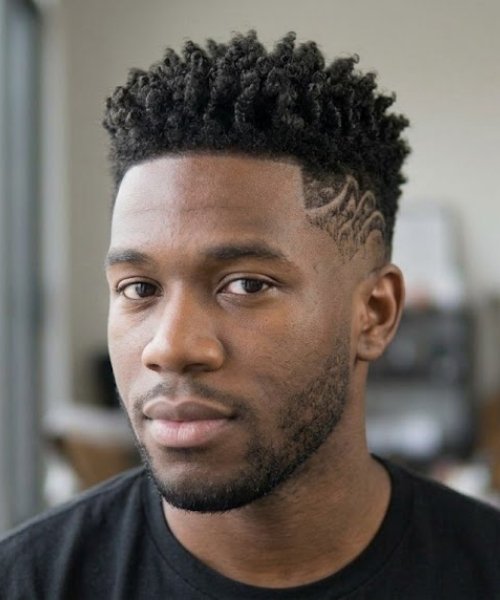
Adding a design to a high taper creates an extra detail without changing the main curly hairstyle. Because the tapered area is relatively limited, simple designs usually remain clearer than very complicated patterns.
A single diagonal line, curved slash, double line, or small geometric shape can work well. Your barber can place the design where the hair is short enough for the line to remain visible. Remember that the design is temporary. As the tapered hair grows, the line will gradually become less defined.
Best for: Almost any curl pattern.
Ask your barber: “Keep my curly top natural and add a simple design inside the high tapered area. Don’t let the design cut too far into the curls.”
19. High Taper Fade with Curly Burst-Inspired Shape
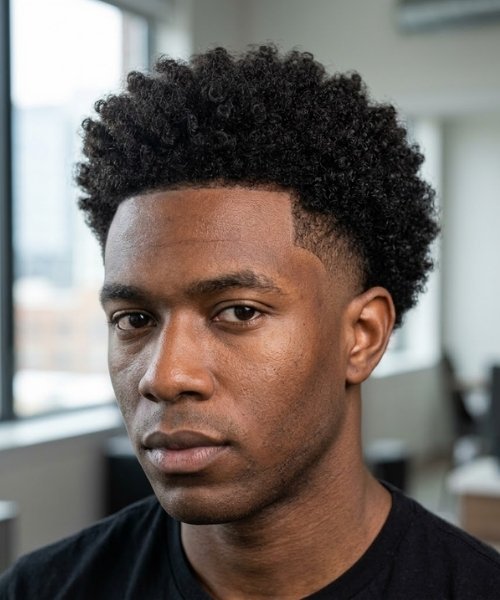
A high taper can be combined with a rounded, burst-inspired shape around the ear area to create a more distinctive silhouette. The curly top remains full while the shorter area curves around the ear.
This style works especially well with dense curls because the shorter perimeter creates a clear contrast against the fuller texture.
Because “high taper” and “burst fade” can be interpreted differently by different barbers, use a reference photo and point directly to the area you want shortened.
Best for: 3B, 3C, 4A, and dense coily textures.
Ask your barber: “Keep my curly top full, clean the temple area high, and create a rounded transition around the ear rather than removing all the side hair.”
20. High Taper Fade with Natural Curly Volume
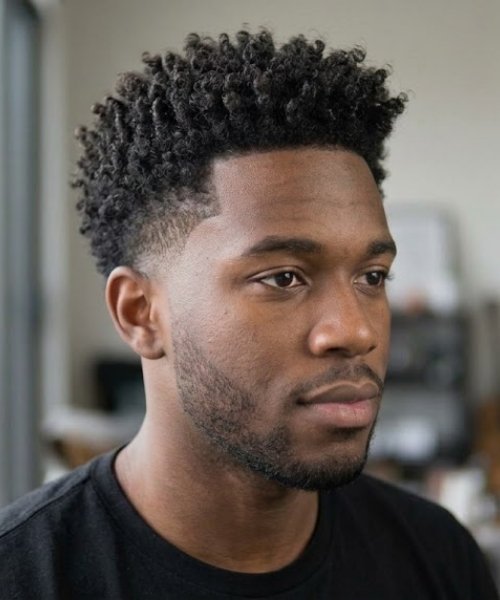
The natural-volume version is designed for people who don’t want their curls to look heavily sculpted. The barber focuses on cleaning the temples and sideburns while leaving the top close to its natural shape.
This can be one of the easiest curly styles to maintain because you don’t have to create a precise curl pattern every morning. After washing, you can apply a small amount of leave-in conditioner or curl cream and allow the curls to settle naturally.
The haircut works particularly well when your curls already have good shape and density.
Best for: Almost all curl patterns, including 3A through 4C.
Ask your barber: “I want to keep my natural curl volume. Just clean and taper the temples and sideburns high without over-shaping the top.”
How Do You Style a High Taper Fade with Curly Hair?
Start with clean, damp hair rather than soaking-wet hair. Apply a small amount of curl cream or leave-in conditioner, distribute it through the curls, and then shape the curls with your fingers.
For tighter curls and coils, a curl-defining product can help separate individual sections. Let the hair air-dry or use a diffuser on a gentle setting if you need faster drying.
A simple routine is:
- Wash or rinse your hair according to your normal schedule.
- Gently squeeze out excess water.
- Apply leave-in conditioner if your hair needs extra moisture.
- Add a small amount of curl cream or defining product.
- Scrunch the curls upward with your hands.
- Shape the front and top with your fingers.
- Allow the hair to dry without repeatedly touching it.
- Finish with a small amount of lightweight product if necessary.
Avoid brushing dry curls repeatedly. This can separate the curl pattern and make the hair appear much frizzier.
What Products Work Best for This Cut?
The best product depends on your curl type and the finish you want. A lightweight curl cream is usually suitable when you want soft definition, while stronger gels or mousses can provide more hold.
| Product | Best for | Finish |
|---|---|---|
| Leave-in conditioner | Dry or thirsty curls | Soft and moisturized |
| Curl cream | Everyday curl definition | Natural |
| Curl gel | Stronger definition | Medium to firm hold |
| Styling mousse | Fine curls and volume | Lightweight |
| Curl custard | Defined curls/coils | More controlled |
| Light hair oil | Finishing and reducing dryness | Soft shine |
Don’t use large amounts of product simply because your curls are thick. Start with a small amount and add more only if needed.
For 3C and tighter curls, product distribution matters. Work it through sections rather than putting everything on the surface.
For fine curly hair, avoid heavy products that flatten the roots. A lightweight mousse or curl cream may preserve more volume.
What Should You Tell Your Barber?
The easiest way to get the haircut you want is to give your barber specific instructions instead of simply saying “high taper.”
You can say:
“I want a high taper around the temples and sideburns, but I want to keep my natural curls and most of the length on top. Blend the taper gradually and don’t take the taper farther into the top than necessary. Keep the curl shape natural and clean up the hairline.”
Then specify the finish you want.
For example:
For a subtle taper:
“Keep some hair around the tapered area. I don’t want a very exposed skin finish.”
For a sharper taper:
“Take the taper higher and closer around the temples, with a clean blend.”
For curly volume:
“Keep enough length on top for my curls to form naturally. Shape the top without making it too short.”
For a natural hairline:
“Clean up the edges but keep the hairline natural rather than pushing it back.”
Barber measurements
Clipper numbers can vary slightly between tools and barbers, so use them as a starting point rather than a guarantee of the final appearance.
A typical taper may transition through shorter guards such as:
- #3 or #2 for the upper transition
- #1 or #1.5 for the shorter section
- 0 or trimmer work near the edge when a very close finish is wanted
If you want the taper to reach the skin, say so clearly. If you don’t want visible scalp, ask for a shadow taper or a slightly longer finish.
Most importantly, show a reference photo of a person with a similar curl pattern and similar hair density.
How Is a High-Taper Fade Different from a Mid- or Low-Taper Fade?
The main difference is where the taper begins. A high taper starts higher around the temples and creates more visible contrast between the upper hair and the shorter area. A mid taper starts lower, while a low taper stays closer to the natural lower edge of the sideburn and temple.
| Taper type | Starting area | Effect on curly hair | Best if you want |
|---|---|---|---|
| Low taper | Lower temple/sideburn | Keeps more side fullness | Subtle cleanup |
| Mid taper | Middle temple area | Balanced contrast | Versatile shape |
| High taper | Higher temple area | Stronger contrast | A sharper, cleaner look |
High taper vs low taper
A low taper leaves more hair around the temples. This can be useful if you want your curls to look fuller around the sides. A high taper removes more visual weight higher up, producing a stronger contrast.
High taper vs mid taper
A mid taper sits between the two. It is a good option if you aren’t sure whether a high taper will be too aggressive for your head shape. If you’re transitioning from a low taper to a high taper, consider increasing the height gradually.
How Do You Maintain a High Taper Fade with Curly Hair?
A high taper generally needs regular edge and fade maintenance because the short sections show growth quickly.Many people refresh the tapered areas roughly every 2–3 weeks, while the exact schedule depends on how quickly their hair grows and how sharp they want the haircut to remain. The curly top usually needs a different maintenance routine.
Every day
- Refresh curls with a little water if needed.
- Add a small amount of curl product.
- Avoid repeatedly touching dry curls.
- Shape the front with your fingers.
Every few days
Depending on your hair type, refresh moisture without completely washing the hair. Tight curls and coils may need more moisture than loose curls.
Every 2–3 weeks
Consider cleaning up the taper if you want the sharp blended appearance to remain.
Every 4–8 weeks
The top may need reshaping depending on its length, curl pattern, and desired hairstyle.
You don’t necessarily need to cut the entire head every time you refresh the taper.
Does a High Taper Fade Reduce Bulk?
Yes, a high taper can reduce bulk around the temples, sideburns, and selected side areas, but it does not automatically remove bulk from the entire head.
If your curly hair feels heavy, tell your barber exactly where the excess weight is located. Removing too much hair from the top can make curls lose their shape or make the hairstyle look thinner than intended.
For dense curly hair, controlled shaping is often more useful than aggressively thinning everything.
A useful distinction is:
- Tapering: shortens specific areas and creates a clean transition.
- Shaping: controls the overall silhouette.
- Removing bulk: reduces excess density where necessary.
- Thinning: reduces density through specialized cutting techniques.
These are not interchangeable techniques.
Common Mistakes to Avoid
Taking the taper too high
A high taper already starts high. If it is pushed farther upward than intended, you may lose more side volume than you wanted.
Point to the area where you want the taper to begin before the barber starts.
Cutting curly hair too short
Curly hair can shrink substantially after it dries. A length that looks acceptable when stretched can appear much shorter in its natural state.
Ask your barber to consider your dry curl length.
Ignoring the curl pattern
A haircut designed for loose 3A curls may not translate directly to tightly coiled 4C hair.
The barber should work with your actual texture rather than treating every curly head the same way.
Making the taper perfectly symmetrical at all costs
Hair growth is not always symmetrical. One temple may naturally be higher or denser than the other.
Trying to force both sides to exactly match can sometimes push the hairline farther back.
Overusing heavy styling products
Heavy products can weigh down loose curls and create buildup. Start with a small amount and increase it only when necessary.
Brushing curls when dry
Dry brushing can disturb the natural curl pattern and increase frizz. Use your fingers, a suitable wide-tooth comb, or another method appropriate for your curl type.
Forgetting the neckline
The neckline affects the entire haircut from the side and back. Ask whether you want a natural neckline, rounded finish, or another shape that complements the haircut.
Copying a style without considering your hair density
A reference photo can show the general idea, but your result will depend on your curl pattern, density, growth direction, and head shape.
Use the picture to communicate the style rather than expecting an identical copy.
Frequently Asked Questions
Is a high taper fade good for curly hair?
Yes. A high taper can work very well with curly hair because it cleans the temple and sideburn areas while allowing the natural curl pattern to remain prominent on top.
How high should a taper fade be for curly hair?
There is no single measurement that works for everyone. A high taper generally begins higher around the temple and sideburn area than a low or mid taper. Your barber should position it according to your hairline, face shape, and desired amount of side volume.
Is a high taper better than a low taper for curls?
Neither is universally better. A high taper creates more contrast and removes more visual weight around the upper temple, while a low taper preserves more fullness around the sides.
Can you get a high taper with 4C hair?
Yes. A high taper can be combined with 4C hair, including short coils, sponge curls, a natural afro shape, twists, or other textured styles. The barber should account for shrinkage and your natural growth pattern.
How often should I get a high taper fade?
If you want the tapered edges to stay sharp, you may want a cleanup approximately every 2–3 weeks. People who prefer a more grown-in appearance can wait longer.
Does a high taper make curly hair look thinner?
It can make the sides look less bulky because those areas are shortened. However, the taper does not necessarily make the top look thinner. Keeping enough length and density on top can preserve your natural curl volume.
Should curly hair be cut wet or dry?
It depends on the technique, curl pattern, and desired result. Because curls can shrink significantly, many barbers pay close attention to the hair’s natural dry shape when determining the final length.
Can I add a design to a high taper fade?
Yes. A simple line, curve, or geometric design can be incorporated into the tapered area. Remember that designs grow out relatively quickly, so they require more frequent touch-ups if you want them to remain sharp.
Key Takeaways
A high taper fade for curly hair gives you a clean, defined appearance while allowing your natural curls to remain the main feature. The taper can be paired with almost any curly top, from short defined curls and a curly crop to a high top, curly fringe, afro, mohawk, or longer textured style.
Keep these points in mind before your next appointment:
- A high taper starts higher around the temples and sideburns than a low taper.
- Your curl pattern should influence the cutting and styling technique.
- Tell your barber exactly how high you want the taper.
- Consider your face shape when choosing the height and volume of the curly top.
- Don’t cut curly hair too short without considering shrinkage.
- Use lightweight products when possible and add more only when needed.
- Avoid brushing dry curls aggressively.
- A taper cleanup every few weeks can keep the sides looking sharp.
- Show your barber a reference photo with a similar curl pattern.
- Decide whether you want a natural, shadow, or skin-close finish before the cut.
- The best version of the haircut is the one that fits your curl pattern, density, face shape, and daily styling routine.
With the right taper height and enough length to let your curls form naturally, this haircut can give you a clean outline without taking away the texture that makes curly hair stand out.