

What is a blowout taper haircut, and who should get it?
A blowout taper is a men’s haircut built from two moves working together: a clean, gradually shortening taper around the ears, sideburns, and neckline, and a top section left long enough to be blow-dried into height and movement. It’s the cut behind most of the “effortless volume” looks you see on barbershop Instagram pages and TikTok right now, and it works because it splits the job in two the sides do the tidying, the top does the styling.
It suits almost anyone willing to spend two or three minutes with a hairdryer each morning. If you want a cut that looks sharp at the barbershop and stays interesting at home, rather than one you set once and forget, this is a strong candidate. If you have zero interest in styling your hair daily, you’ll want to read the maintenance sections below before booking.
What Is a Blowout Taper? The Two-Part Haircut Explained
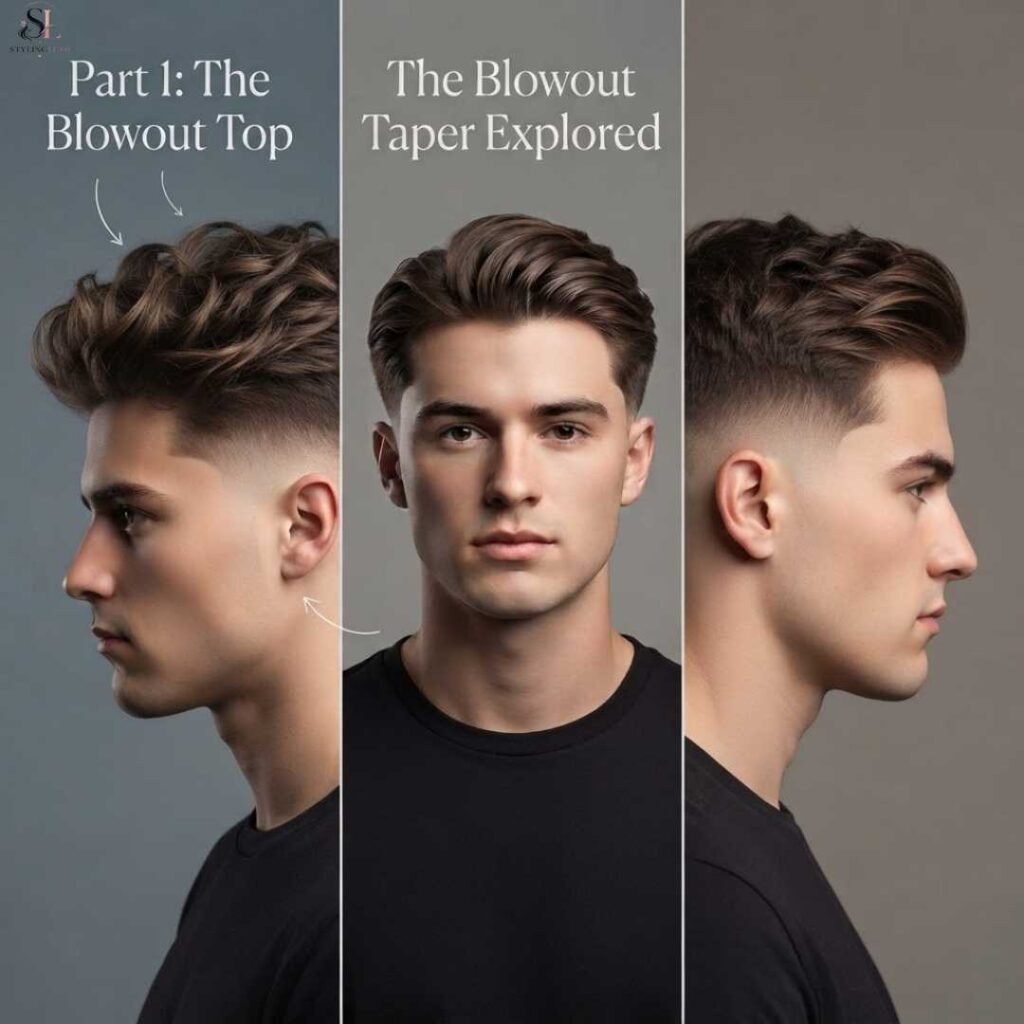
Strip away the branding and a blowout taper is just two decisions stacked on top of each other. The bottom half is a taper: hair graduates from very short near the hairline, ears, and neckline up to noticeably longer higher on the head, with no hard line where one length meets the next. The top half is length usually somewhere between two and five centimeters, enough that a round brush and a hairdryer can actually lift it rather than just push it around.
The “blowout” is the part people skip and then wonder why their haircut looks flat. Wet or damp hair on top gets dried while being pulled upward and back (or forward, depending on the variant), which builds the roots up and gives the style its shape. Skip that step and a blowout taper reads as an ordinary medium-length cut with short sides — the shape simply isn’t there without the drying.
Blowout Taper vs. Other Cuts
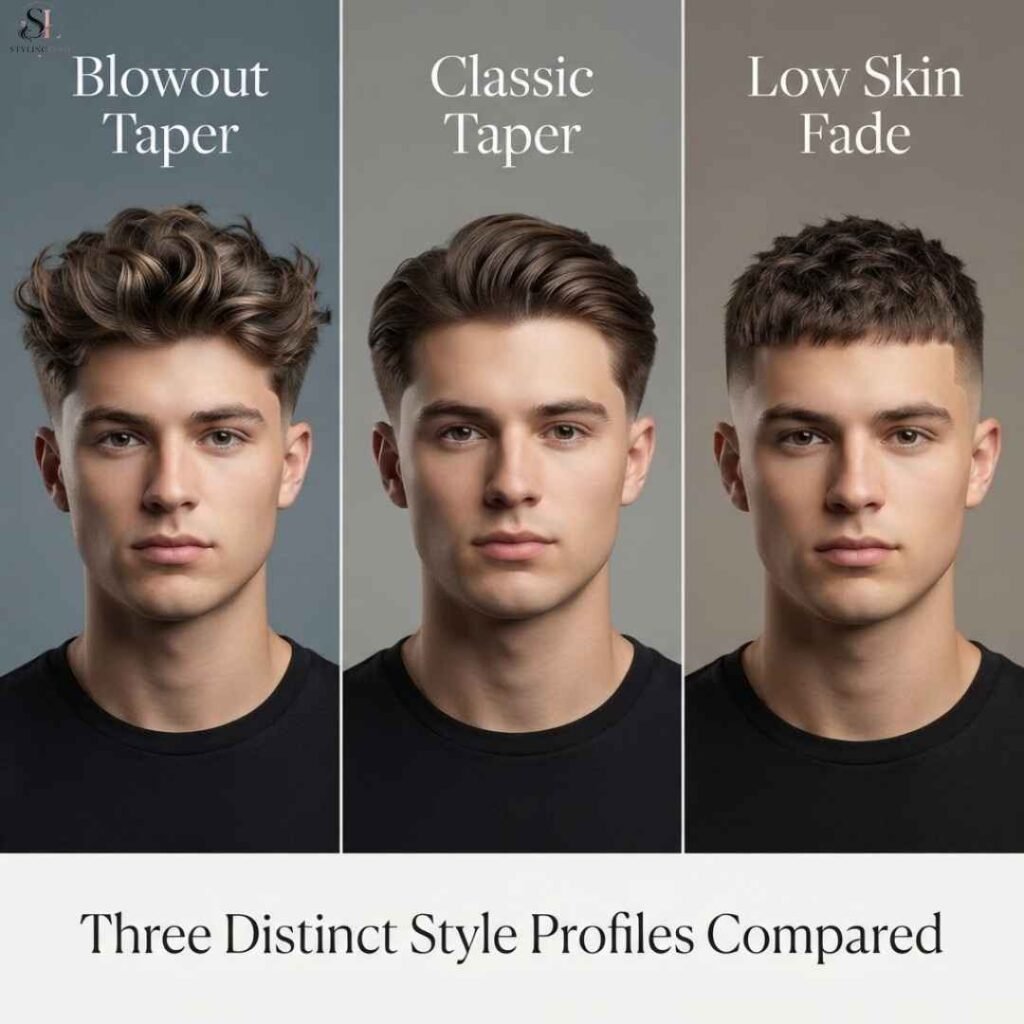
The comparison people ask about most is blowout taper versus fade. A taper never fully exposes skin; it thins hair gradually and keeps a soft transition, which is part of why it grows out politely instead of looking patchy after three weeks. A fade, by contrast, blends much higher up the head and can go down to skin at the bottom, giving a sharper, higher-contrast line. A blowout taper can be paired with either finish you can ask for a “taper” bottom that stays soft, or a “fade” bottom that goes cleaner but the defining feature, the long, styled top, is the same either way.
Compared to a standard taper haircut with no styling requirement, the blowout taper asks more of you day-to-day but gives you a fuller, more dynamic silhouette in return. Compared to a pompadour or quiff, which rely on a hard part or a single directional sweep, the blowout taper is looser and more textured, closer to “styled but not fussy.”
Historical Context
Versions of this cut have circulated for decades, with roots often traced back to voluminous, tapered styles that gained popularity in urban barbershops in the 1990s, where the combination of a tight, tapered fade and a fuller, textured top became a signature look before spreading more broadly. What’s changed recently isn’t the haircut itself so much as the visibility short-form video turned the styling routine into content, and a whole generation of guys started asking for it by name instead of by description.
The 5 Main Blowout Taper Styles: Low, Mid, High, Textured Fringe & Beyond
Every blowout taper is a combination of taper height and top styling. Below are the five variants worth knowing, ranked roughly from lowest-maintenance to most attention-grabbing.
Low Blowout Taper: The Easiest Entry Point
The taper starts right at the hairline, ears, and neckline and barely climbs the head, so from a few feet away it can look like a longer, natural haircut that simply has a bit of extra shape on top. It’s the most forgiving option for first-timers, for workplaces that lean conservative, and for anyone who doesn’t want to explain their haircut to their grandmother. Growth is gentle, which means fewer trips to the barber.
Mid Blowout Taper: The Balanced Sweet Spot
The taper begins around the temples rather than right at the hairline, giving noticeably more contrast than the low version without tipping into “look at my haircut” territory. This is the variant most barbers recommend when someone can’t decide, because it photographs well, suits most hair textures, and still grows out reasonably gracefully between visits.
High Blowout Taper: The Bold Statement
Here the taper climbs well above the temples, sometimes close to the crown, leaving a much smaller, denser area of length on top to work with. The payoff is drama: strong contrast between the short sides and the voluminous top, and a silhouette that reads as intentional from across a room. The trade-off is upkeep, a high taper grows out visibly within two to three weeks and needs more frequent trims to stay sharp.
Textured Fringe Blowout Taper: The Viral TikTok Version
This is the variant most people picture when they picture “the blowout taper.” The sides stay tapered as usual, but the top is left with extra weight through the fringe and cut with texturizing shears so it falls forward with movement instead of sitting flat. Styling leans messy on purpose a bit of texture powder or clay worked through with fingers rather than a comb and the result is the tousled, slightly undone look that’s dominated barbershop reels for the last couple of years.
Also read: Blowout Taper Textured Fringe – Low, Mid & High: What to Ask For and How to Style It
Blowout Taper Perm or Curly Variant: For Natural Curl
For guys with straight or barely-wavy hair who want the fuller, curlier look without waiting years for their texture to change, some barbers pair the taper with a light perm on top, adding curl pattern that a blow-dry then lifts into volume. For guys who already have natural curl or coil, this variant is less about adding texture and more about cutting the top length carefully so the curls have room to spring upward instead of just downward.
Variant Comparison Table
| Variant | Taper Height | Maintenance | Best For |
|---|---|---|---|
| Low Blowout Taper | Starts at hairline/neckline | Low — trim every 4-5 weeks | First-timers, conservative settings |
| Mid Blowout Taper | Starts at temples | Moderate — every 3-4 weeks | Most people, most occasions |
| High Blowout Taper | Climbs toward crown | High — every 2-3 weeks | Bold looks, don’t mind upkeep |
| Textured Fringe | Any height, textured top | Moderate — daily styling | Casual, trend-forward looks |
| Perm/Curly Variant | Any height | Moderate-high | Straight hair wanting curl, or curly hair keeping curl |
Does a Blowout Taper Work for My Hair? A Guide by Hair Type
The taper part of this cut works on any hair type. The blowout part is where texture changes the equation, because straight, wavy, curly, and coily hair all hold volume differently once a hairdryer gets involved.
Straight Hair: This Requires the Most Styling Effort
Straight hair has the least natural grip, so it also falls flattest without help. Getting lift usually means drying against gravity with a round brush, working in a volumizing product at the roots before drying, and possibly finishing with a light hold spray so the shape survives the day. The upside is that straight hair takes texture powder and clay beautifully once it’s dry, so the textured fringe variant tends to look especially crisp on this hair type.
Wavy Hair: The Goldilocks Texture
Wavy hair already has some natural bend, which means it holds a blow-dried shape longer than straight hair and needs less daily effort to look intentional. Many guys with wavy hair can get away with a quick tousle-dry or even air-drying with a bit of product, rather than a full round-brush routine every morning.
Curly Hair: Maximize Natural Volume
Curly hair is arguably the best-suited texture for this cut, because the curl pattern itself does a lot of the volume work that straight hair needs a hairdryer to fake. The key adjustment is length management on top — leave enough length for the curl to have shape, and use a diffuser rather than a direct-heat blast so the curl pattern stays defined instead of frizzing out.
Afro/Coily Hair: The Confidence Cut
On afro and coily textures, the blowout taper can look striking because the natural coil already creates height and volume without much intervention. Styling usually centers on a pick to lift the roots and a light mousse or curl cream to define shape and control frizz, rather than heat styling at all. Many barbers who specialize in this texture treat the “blowout” as a picked-out, rounded shape rather than a directional, brushed one.
Hair-Type Styling Comparison Table
| Hair Type | Daily Styling Time | Key Tool | Main Challenge |
|---|---|---|---|
| Straight | 5-7 minutes | Round brush + dryer | Getting lift that lasts |
| Wavy | 2-3 minutes | Fingers + light product | Avoiding over-styling |
| Curly | 5-8 minutes | Diffuser | Preventing frizz, keeping definition |
| Afro/Coily | 3-5 minutes | Pick + mousse | Balancing shape and control |
Which Taper Height Works Best for Your Face Shape? A Decision Framework
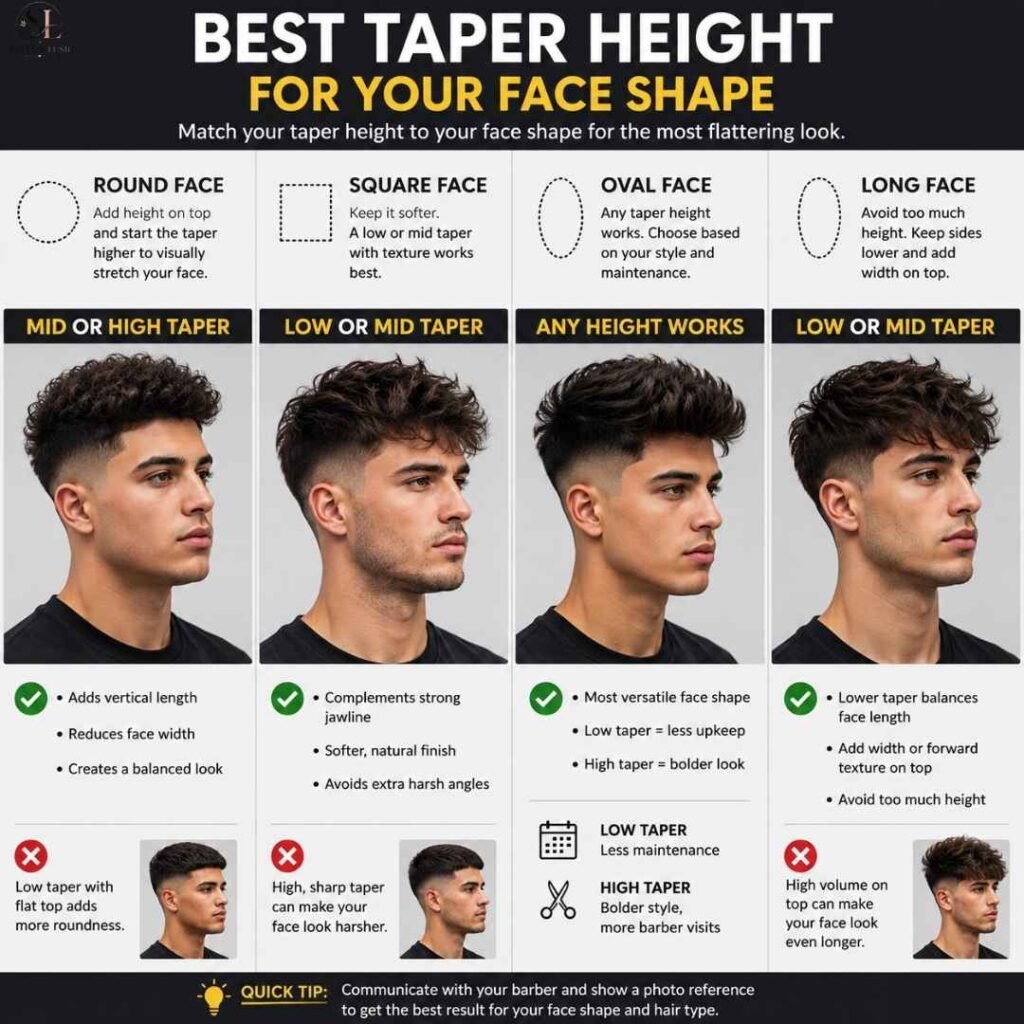
Taper height changes how much vertical versus horizontal emphasis your haircut adds to your face, which is why the same variant can look completely different on two people.
Round Faces: Go Mid or High to Add Vertical Length
Round faces benefit from height on top and a taper that starts higher on the sides, since the combination visually stretches the face and reduces the impression of width. A low taper with a flat top tends to reinforce roundness rather than balance it.
Square Faces: Low or Mid Taper with Soft Texture
Square faces already have strong angles, so a low or mid taper with a softer, more textured top complements the jawline instead of competing with it. A very high, sharp taper can make an already angular face look harder than intended.
Oval Faces: Any Height Works; Pick by Maintenance
Oval is the most forgiving face shape for this cut, since the proportions balance almost any taper height and top volume. If your face shape falls here, the real decision is lifestyle: pick low for less upkeep, high if you want the boldest possible look and don’t mind the extra barber visits.
Long Faces: Stay Low or Mid; Keep Some Width
Long faces generally look better with a lower taper and a top that’s styled with some width or forward texture rather than pure height, since added vertical volume can make the face look even longer.
What to Tell Your Barber: 5 Blowout Taper Scripts by Height & Hair Type
Essential Communication Elements
A good barber request covers four things: the taper height (low, mid, or high), how much length to leave on top (in centimeters or inches, not just “a bit”), the finish on the sides (taper that fades into skin, or one that stays soft), and whether you want it blow-dried and styled before you leave so you can see the actual shape.
Barber Scripts by Variant
- Low: “Low blowout taper keep the taper close to my hairline and neckline, don’t take the sides high. Leave about two inches on top so I can blow it out for volume.”
- Mid: “Mid blowout taper — start the taper around my temples. Leave two to three inches on top, textured, so I have volume without it looking heavy.”
- High: “High blowout taper — take the taper up toward the crown for strong contrast. Keep three-plus inches on top so there’s enough to style.”
- Textured fringe: “Taper the sides at [height], but leave extra weight in the front fringe and texturize the top so it has movement, not a clean line.”
- Curly/perm variant: “Keep my curl pattern intact on top, just clean up the length so the curls have room to sit up rather than fall flat. Taper the sides at [height].”
Reference Photo Guidance
Bring two photos rather than one: a front-on shot showing the top volume and shape you want, and a side or back shot showing exactly how high the taper should start. Photos of your own hair type styled in the look you want are more useful than photos of a model with a completely different texture, since your barber can then adjust the cut for how your hair actually behaves rather than guessing.
Optional Clipper Guard Reference
If you want extra precision, most barbers can translate “low/mid/high” into a guard number for the sides commonly something like a #1 or #2 fading up into scissor-over-comb work higher on the head but treat guard numbers as a starting conversation, not a fixed spec, since blending technique matters more than the number itself.
What NOT to Say
Avoid vague requests like “just a taper” with no height specified, since that leaves the top length entirely up to the barber’s judgment and you may end up with too little to style. Also avoid asking for a taper and a fade in the same sentence without clarifying which finish you actually want on the sides they’re related but distinct, and mixing the terms can lead to a result you didn’t expect.
How to Style a Blowout Taper at Home: Step-by-Step Blow-Dry Guide
General Blow-Dry Principles (All Hair Types)
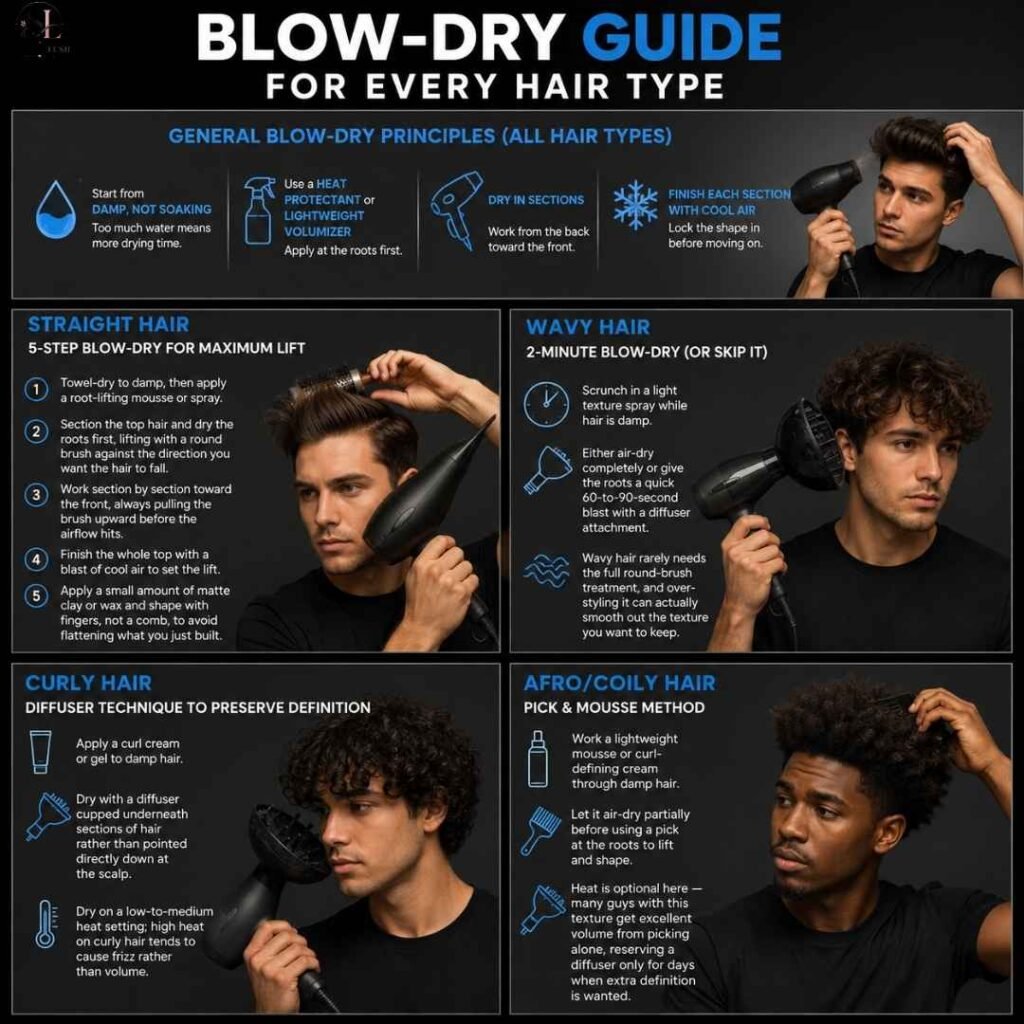
Start from damp, not soaking, hair too much water means more time spent drying before you can even shape it. Apply a heat protectant or lightweight volumizer at the roots first. Dry in sections, working from the back toward the front, and always finish each section with a burst of cool air to lock the shape in place before moving on.
Straight Hair: 5-Step Blow-Dry for Maximum Lift
- Towel-dry to damp, then apply a root-lifting mousse or spray.
- Section the top hair and dry the roots first, lifting with a round brush against the direction you want the hair to fall.
- Work section by section toward the front, always pulling the brush upward before the airflow hits.
- Finish the whole top with a blast of cool air to set the lift.
- Apply a small amount of matte clay or wax and shape with fingers, not a comb, to avoid flattening what you just built.
Wavy Hair: 2-Minute Blow-Dry (or Skip It)
Scrunch in a light texture spray while hair is damp, then either air-dry completely or give the roots a quick 60-to-90-second blast with a diffuser attachment. Wavy hair rarely needs the full round-brush treatment, and over-styling it can actually smooth out the texture you want to keep.
Curly Hair: Diffuser Technique to Preserve Definition
Apply a curl cream or gel to damp hair, then dry with a diffuser cupped underneath sections of hair rather than pointed directly down at the scalp, which preserves curl clumps instead of blasting them apart. Dry on a low-to-medium heat setting; high heat on curly hair tends to cause frizz rather than volume.
Afro/Coily Hair: Pick & Mousse Method
Work a lightweight mousse or curl-defining cream through damp hair, then let it air-dry partially before using a pick at the roots to lift and shape. Heat is optional here many guys with this texture get excellent volume from picking alone, reserving a diffuser only for days when extra definition is wanted.
Styling Troubleshooting Reference
| Problem | Likely Cause | Fix |
|---|---|---|
| Top looks flat by midday | Not enough root lift, wrong product | Add root-lifting product, use cool-air finish to set shape |
| Frizzy instead of voluminous | Too much heat, no diffuser | Lower heat setting, add diffuser attachment |
| Style falls apart within hours | No hold product | Add light hold spray or wax after drying |
| Top looks greasy quickly | Too much product | Use half the amount, focus product at roots only |
How Long Does a Blowout Taper Stay Fresh? The 4-Week Timeline
Day 1–3: Fresh & Sharp
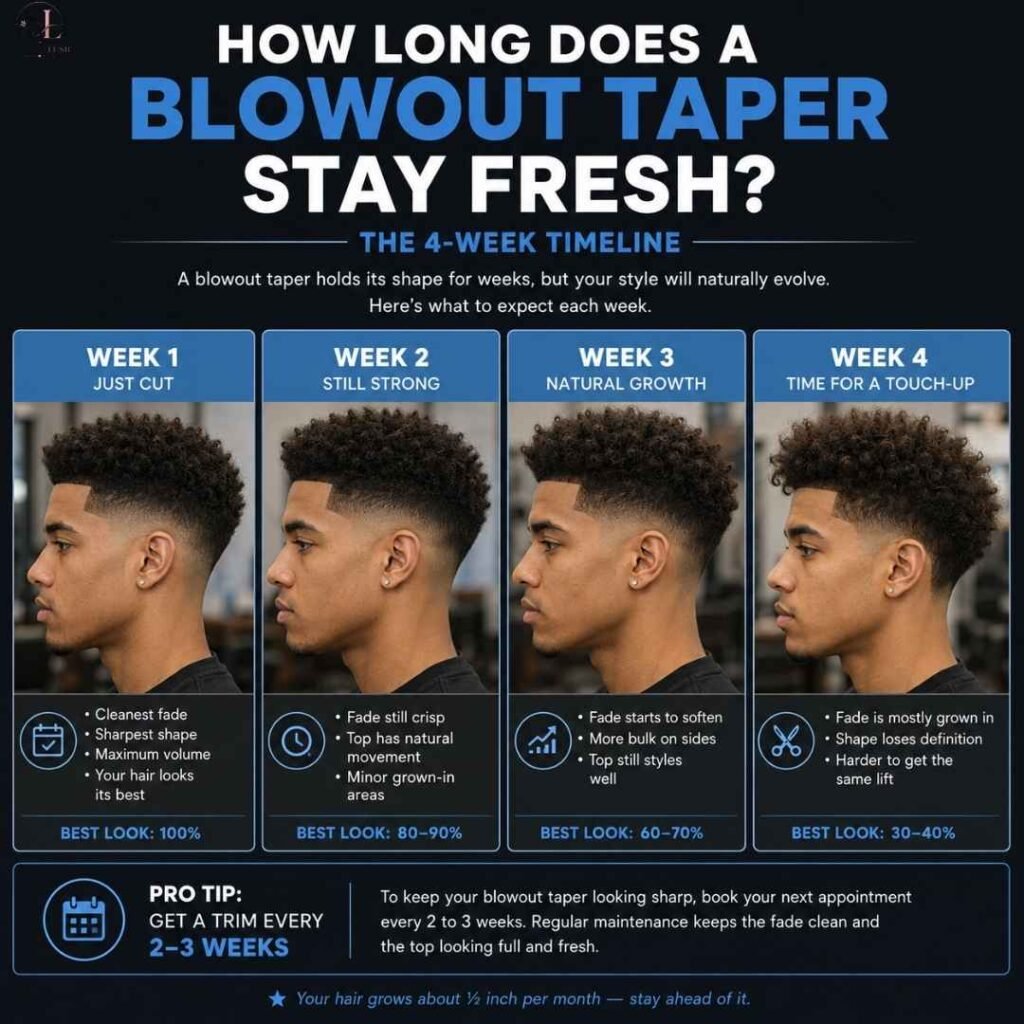
Right after the cut, the taper lines are crisp and the top styles easily since it was just shaped by the barber. This is the “reference photo” window if you want to remember exactly how it should look.
Week 1: Still Sharp
The taper still looks clean and the top has settled into a styling routine that should feel easier than day one, since you’ve had a few days to practice the blow-dry.
Week 2: Edges Start Softening
The line between the tapered sides and the longer top begins to blur slightly as hair grows, especially on high and mid tapers. Low tapers hold their shape longest here since there’s less contrast to maintain.
Week 3: Visible Softening
Growth is now noticeable enough that the taper looks more like a gradient and less like a defined shape, and the top may need slightly more product to hold the same volume it had in week one.
Week 4: Blend-Out / Time for Full Refresh
By week four, most blowout tapers have grown out enough that the original shape is mostly gone, especially high variants. This is the natural point for a full re-cut rather than a quick touch-up.
Touch-Up vs Full Cut: Quick Reference
| Timeframe | Low Taper | Mid Taper | High Taper |
|---|---|---|---|
| Week 2 | No action needed | Optional light touch-up | Touch-up recommended |
| Week 3 | Optional touch-up | Touch-up recommended | Full cut recommended |
| Week 4 | Full cut recommended | Full cut recommended | Overdue for full cut |
Regional & Personal Factors
Hair grows faster for some people than others, and factors like humidity, hair density, and even how often you wash your hair can shift this timeline by several days in either direction. Treat the four-week window as a general guide, not a fixed rule, and adjust your booking based on how your specific hair grows out.
Common Maintenance Mistakes
Waiting too long between cuts is the most common one, since a high taper that grows out for six weeks stops looking like a taper at all. The opposite mistake — trimming too aggressively too often can also prevent the top from ever reaching enough length to style properly, so it’s worth being patient with top growth even while keeping the sides maintained.
Putting It All Together: Choose Your Blowout Taper by Hair Type AND Face Shape
Master Decision Matrix
| Hair Type | Round Face | Square Face | Oval Face | Long Face |
|---|---|---|---|---|
| Straight | Mid/High, extra lift | Low/Mid, soft texture | Any height | Low/Mid, add width |
| Wavy | Mid | Low/Mid | Any height | Low |
| Curly | Mid/High | Low/Mid | Any height | Low/Mid |
| Afro/Coily | Mid/High | Low/Mid | Any height | Low/Mid |
Example Personas: Decision Stories
A guy with straight hair and a round face who wants a low-maintenance office-friendly cut lands on a mid blowout taper: enough taper height to add vertical balance, but not so much that it needs constant upkeep. A guy with curly hair and an oval face who wants maximum visual impact can comfortably go high, since the face shape can carry it and the curl pattern will supply natural volume with minimal styling effort. A guy with coily hair and a square jaw who wants something professional but still stylish is well served by a low or mid taper with the pick-and-mousse styling method, keeping the look polished without fighting his face shape.
Your 5-Step Decision Process
- Identify your hair type honestly — not the type you wish you had.
- Identify your face shape using the categories above.
- Cross-reference both against the decision matrix to get a taper height range.
- Factor in how much daily styling time you’re actually willing to spend.
- Pick the specific variant (textured fringe, curly/perm, or straight blowout) that matches your desired maintenance level and occasion.
Is a Blowout Taper OK for Work? A Quick Guide by Variant & Industry
Acceptability by Variant & Setting
| Variant | Corporate/Legal | Creative/Tech | Trade/Outdoor |
|---|---|---|---|
| Low Blowout Taper | Yes | Yes | Yes |
| Mid Blowout Taper | Usually yes | Yes | Yes |
| High Blowout Taper | Case-by-case | Yes | Usually yes |
| Textured Fringe | Case-by-case | Yes | Yes |
| Curly/Perm Variant | Usually yes | Yes | Yes |
Variant Assessments
The low blowout taper is the safest choice in nearly any workplace, since from a distance it reads as a well-groomed, slightly styled cut rather than a “trend” haircut. The mid variant is close behind and fits comfortably in most offices. The high and textured fringe variants carry more personality and are best judged against your specific workplace culture rather than assumed to be fine everywhere — a bold high taper that’s celebrated at a design agency might raise eyebrows at a courtroom.
Industry-Specific Guidance
Client-facing corporate and legal roles tend to favor the low or mid variants with minimal texture. Creative, tech, and hospitality environments generally have more room for high tapers and textured fringe looks. Trade and outdoor jobs usually care less about the taper height and more about practicality a high taper that needs a hairdryer every morning may simply be inconvenient given the schedule, regardless of workplace dress norms.
5 Blowout Taper Mistakes (And How to Avoid Them)
Mistake 1: Not Enough Length on Top to Begin With
If the barber leaves less than about two centimeters on top, there’s nothing substantial for a blow-dry to lift. Always specify a minimum top length in your barber script rather than leaving it to guesswork.
Mistake 2: Taper Taken Too High Without Intent
Going high because it “looks cool in photos” without considering maintenance commitment or workplace fit often leads to regret two weeks later when the shape has already grown out. Match the height to your actual lifestyle, not just the photo that inspired you.
Mistake 3: Wrong Product for Your Hair Type
Using a heavy pomade meant for straight hair on curly or coily hair, or a light mousse meant for curls on straight hair, tends to produce the opposite of the intended effect. Match the product category (root-lifter, texture powder, curl cream, mousse) to your actual texture using the styling guide above.
Mistake 4: Skipping Daily Blow-Dry and Expecting the Cut to Carry Itself
This is the single most common reason people feel disappointed by a blowout taper. The cut is designed around the styling step; skipping it most days means you’re essentially wearing a different haircut than the one you asked for.
Mistake 5: Not Scheduling Maintenance Ahead
Waiting until the taper has fully grown out before booking the next appointment means spending a chunk of each cycle looking less sharp than intended. Book your next appointment on the way out of the barbershop, timed to the maintenance window for your specific variant from the timeline above.
Frequently Asked Questions
Q1: What’s the difference between a blowout taper and a low taper fade?
A blowout taper is defined by the long, styled top; a low taper fade is defined by where and how tightly the sides blend. You can actually combine the two terms, a blowout taper can have a low taper fade on the sides — since they describe different parts of the same haircut.
Q2: Does a blowout taper work on straight hair?
Yes, though it requires the most daily styling effort of any hair type, typically a round-brush blow-dry with a root-lifting product to build the volume that straight hair doesn’t hold naturally.
Q3: How often do I need to trim a blowout taper?
Roughly every four to five weeks for a low taper, every three to four weeks for a mid taper, and every two to three weeks for a high taper, based on how quickly the contrast at the sides softens.
Q4: How do I ask my barber for a blowout taper?
Specify the taper height (low, mid, or high), the amount of length to leave on top in inches or centimeters, and ask for it to be blow-dried and styled before you leave so you can see the finished shape.
Q5: Can I get a blowout taper if I have curly hair?
Yes curly hair is arguably the best-suited texture for this cut, since the natural curl pattern supplies much of the volume that other hair types need heat styling to achieve.
Q6: Is a blowout taper professional enough for an office job?
The low and mid variants are generally considered office-appropriate in most industries. High tapers and textured fringe versions are more workplace-dependent and worth judging against your specific office culture before booking.
Key Takeaways
A blowout taper is really just two decisions, a taper height on the sides and a styled, voluminous top and every variant from low to high to textured fringe is a different combination of those two elements. Your hair type determines how much daily styling effort the cut will need, your face shape helps narrow down which taper height will look most balanced, and your lifestyle and workplace should guide how bold you’re willing to go. Get specific with your barber about top length and taper height, commit to the blow-dry (even a quick one), and book your next trim before the shape fully grows out. Do those three things and the blowout taper earns its reputation as one of the most versatile men’s haircuts going right now.