


A high blowout taper is a haircut where the sides and back are cut very short near the ear and hairline, then gradually blend upward into longer hair that’s pushed up and out on top for volume and height. The “high” part refers to where the taper starts up near the temples instead of lower down which is what gives this cut its sharp, high-contrast look.
This guide breaks down exactly what a high blowout taper is, how it’s different from a fade, which face shapes and hair types it works best on, what to say to your barber, and how to style it at home so it actually looks like the photo you showed up with.
What Is a High Blowout Taper and Who Should Get One?
A high blowout taper works best for anyone who wants noticeable height and volume on top without going as extreme or high-maintenance as a full fade. It’s a good pick for guys with straight to wavy hair who want a polished, put-together look for work or everyday wear, and it also suits curly hair when it’s cut and styled the right way.
It’s less ideal if you have very fine, thin hair with low density, since the “blowout” part relies on having enough hair to actually stand up and hold shape. If that’s you, a lower taper with less height on top will usually look fuller and more natural.
What Is a High Blowout Taper?
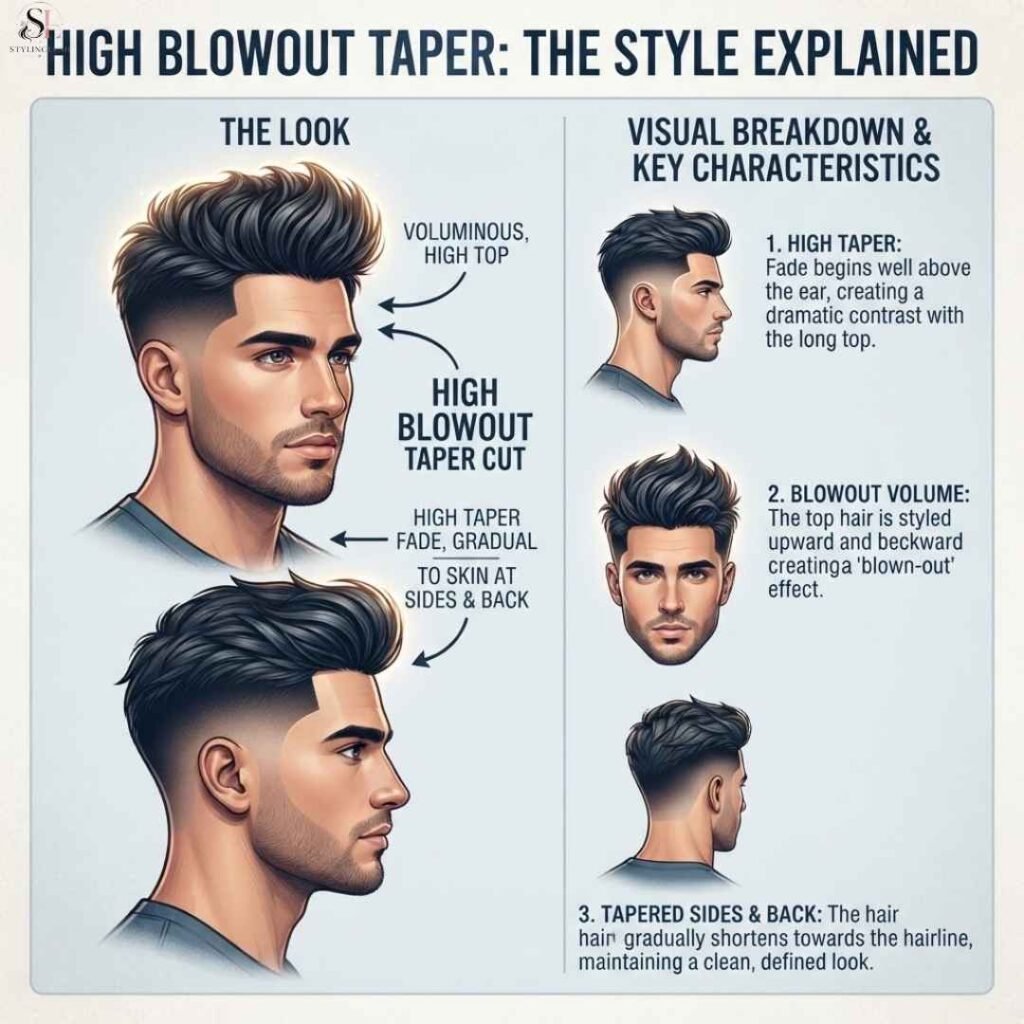
A high blowout taper combines two things: a taper (short sides that gradually get longer as they move up the head) and a blowout (top hair that’s dried and styled upward and outward for volume, rather than laid flat).
The result is a haircut with tight, clean sides that rises quickly into noticeably longer hair on top, which is then styled up and away from the face using a blow dryer, round brush, and light product. It reads as sharp and modern, but the length on top keeps it soft enough for a professional setting.
Also read: Blowout Taper Textured Fringe – Low, Mid & High: What to Ask For and How to Style It
Taper vs. Fade: What’s the Difference?
A taper keeps some length at the bottom of the sides, no matter how short it gets, the hair gradually gets shorter but never disappears completely. A fade takes the hair all the way down to skin or near-skin at some point, usually around the ear or neckline.
| Feature | Taper | Fade |
|---|---|---|
| Shortest point | Never reaches skin | Often reaches skin (0 guard) |
| Transition | Gradual, subtle | Can be gradual or sharp (“hard fade”) |
| Maintenance | Every 4–6 weeks | Every 2–3 weeks |
| Look | Softer, more natural | Sharper, more defined |
| Best for | Work settings, low upkeep | Bold, high-contrast styles |
A high blowout taper leans on the “taper” side of this comparison. The sides get short, but they keep a bit of length so the cut looks clean without the stark skin-to-hair line you’d see on a fade.
Where Does the “High” in High Taper Start?
The “high” in a high taper means the blending starts up near the temple, roughly at or above the top of the ear, instead of lower down near the ear itself. This is what separates a high taper from a low or mid taper, it’s purely about the starting point of the gradual length change, not the length itself.
Here’s how the three heights compare:
| Taper Type | Starting Point | Best For |
|---|---|---|
| Low taper | Just above the ear, near the neckline | Conservative workplaces, subtle change |
| Mid taper | Roughly at ear level | Balanced, versatile everyday look |
| High taper | At or above the top of the ear, near the temple | Bold contrast, more length on top to style |
Because a high taper starts higher, it exposes more of the head with shorter hair, which creates a bigger contrast between the sides and the longer top. That contrast is part of what makes the blowout on top look bigger and more dramatic.
Is a High Fade the Same Cut?
A high fade and a high blowout taper share the same starting point for the blend, but a high fade drops all the way to skin somewhere on the sides, while a high taper stops short of skin and keeps a bit of length throughout. Visually, a high fade looks more aggressive and requires more frequent trims to keep the skin-close section from growing out and looking patchy.
If you like the height and contrast of a high fade but don’t want to visit the barber every two weeks, a high taper gives you a similar shape with noticeably less upkeep.
What Does a High Blowout Taper Look Like?
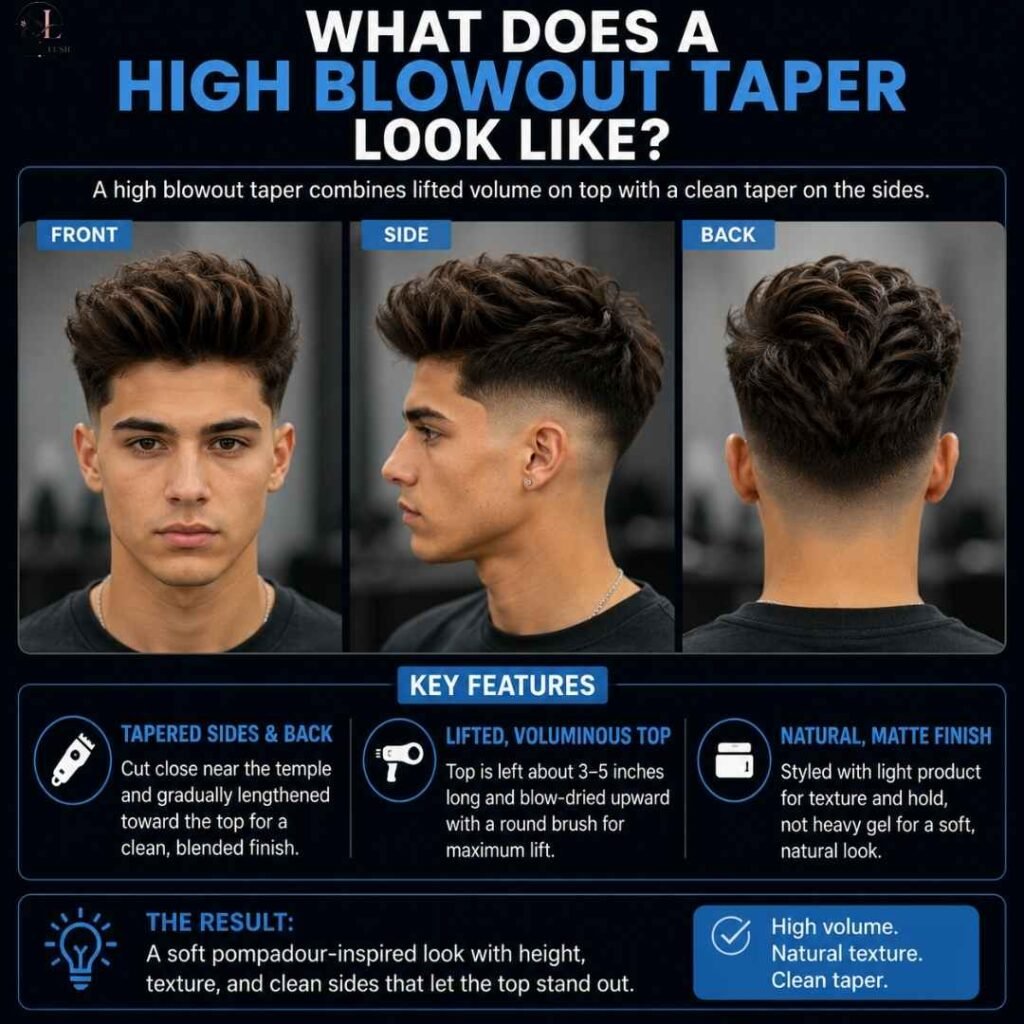
Picture the sides and back cut close near the temple, gradually lengthening as they move up, then opening into a top section that’s around 3 to 5 inches long. That top length is dried upward with a round brush, giving it lift at the root and a slight forward or side sweep at the ends, depending on personal preference.
Think of it like a soft pompadour that skips the heavy gel and slicked-back finish — the volume comes from air-drying technique and light product, not from a hard, shiny hold. The finished look has noticeable height, a natural texture on top, and short, clean sides that don’t compete for attention.
What Beard Pairs Best with a High Taper?
A high blowout taper pairs well with a beard that has clean, defined edges, since the sharpness of the taper looks best when the facial hair around it is just as neat. A short boxed beard or a stubble beard with crisp cheek and neck lines usually works best because it echoes the same clean-cut, high-contrast feel as the haircut.
Longer, fuller beards can still work, but ask your barber to keep the neckline and cheek lines tight so the beard doesn’t look disconnected from the tapered sides. A patchy or unshaped beard tends to clash with this cut because it undercuts the polished look the taper is going for.
Does a High Blowout Taper Suit All Hair Types?
A high blowout taper can work on straight, wavy, curly, and coily hair, but the styling approach and expected outcome change depending on your hair type. Straight and wavy hair blow out the most easily and hold the classic swept-up shape with the least effort, while curly and coily hair need more targeted diffusing and product to get lift without frizz.
| Hair Type | How It Works With a High Blowout Taper | Styling Notes |
|---|---|---|
| Straight | Easiest to blow out; holds shape well | Use a light cream or mousse for texture |
| Wavy | Great volume, natural movement | Round brush enhances natural wave pattern |
| Curly | Needs more length on top to blow out smoothly | Diffuse instead of round brush; use curl cream |
| Coily | Works best as a textured top rather than a slicked blowout | Twist-outs or braid-outs before styling can help |
If you have very fine or thin hair, a high blowout taper is still possible, but the top may need to stay a bit shorter (around 3 inches) so it doesn’t fall flat under its own weight.
How Long Does Hair Need to Grow First?
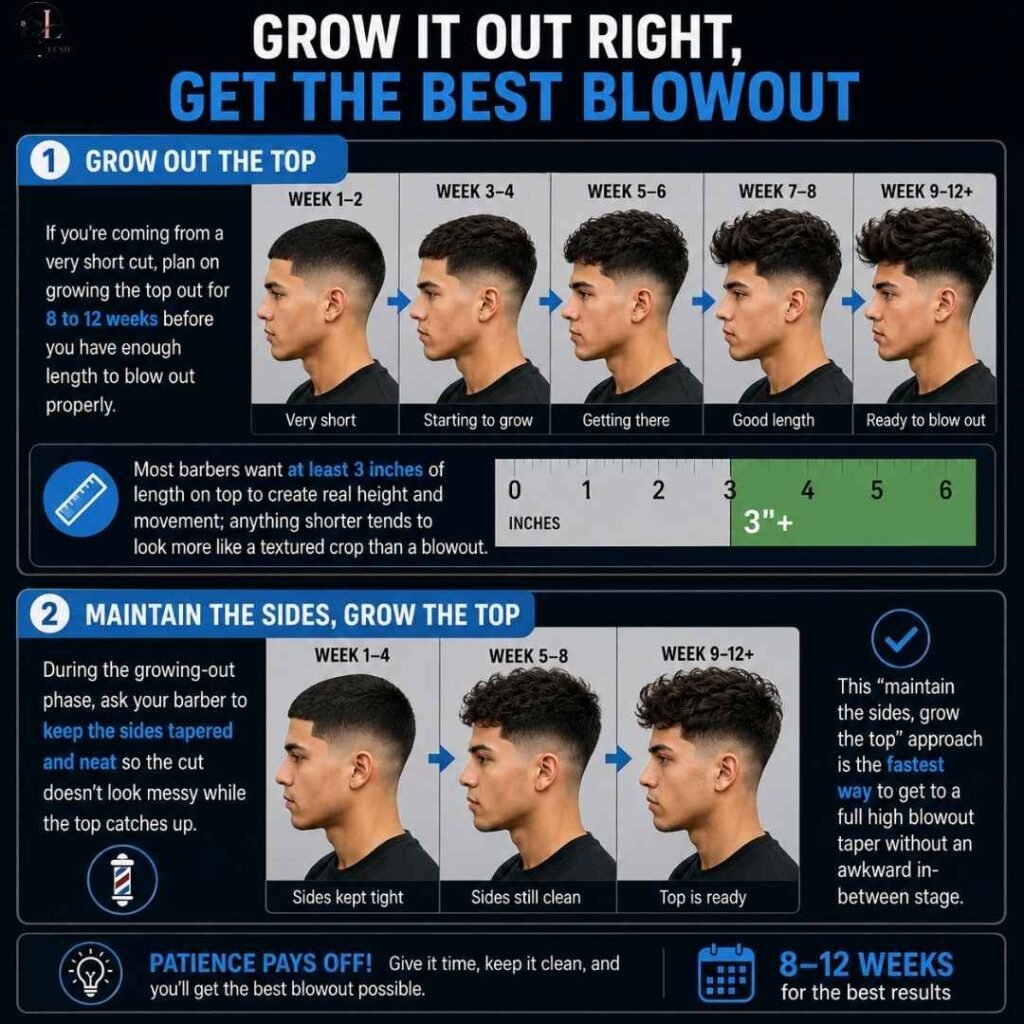
If you’re coming from a very short cut, plan on growing the top out for at least 8 to 12 weeks before you have enough length to blow out properly. Most barbers want at least 3 inches of length on top to create real height and movement; anything shorter tends to look more like a textured crop than a blowout.
During the growing-out phase, ask your barber to keep the sides tapered and neat so the cut doesn’t look messy while the top catches up. This “maintain the sides, grow the top” approach is the fastest way to get to a full high blowout taper without an awkward in-between stage.
Does Your Face Shape Fit a High Taper?
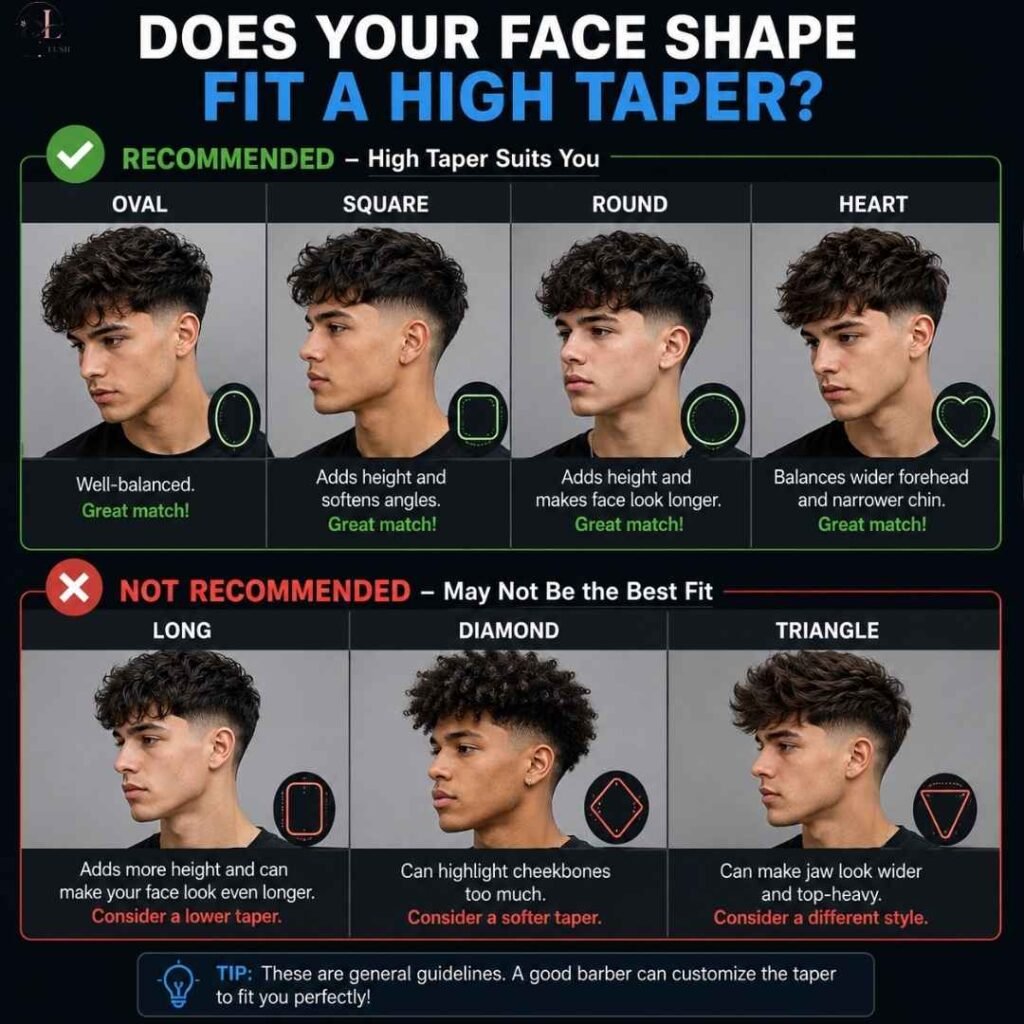
A high taper suits most face shapes because the height it adds on top can be used to balance out width or length in the face. The key is adjusting how much height and volume you ask for based on your specific shape.
- Round faces: A high taper with strong upward volume adds visual length, making the face look less wide.
- Square faces: Works well since the sharp taper lines echo the strong jawline; keep the top slightly softer to balance the angles.
- Oval faces: Nearly any version of this cut works, since oval faces have balanced proportions already.
- Long faces: Go for a slightly lower “high” starting point and less top height, so you’re not adding extra vertical length.
- Heart-shaped faces: A high taper with volume kept more toward the back (rather than straight up) helps balance a narrower chin.
If you’re unsure, bring a photo of your face type paired with this cut to your consultation and ask the barber to adjust height and volume specifically for your proportions.
What Do You Tell Your Barber?
Tell your barber you want a “high taper” (not a high fade) and specify that you want a blowout on top, meaning enough length to style up and back rather than a flat crop or spiky texture. Being specific about these two things taper vs. fade, and blowout vs. flat top — avoids the most common miscommunication with this cut.
It also helps to describe:
- Where you want the taper to start (temple height vs. slightly lower)
- How much length you want left on top (in inches, if you know it)
- Whether you want a hard part line or a soft, blended part
- How you plan to style it day-to-day, since that affects how they cut the top
Which Clipper Guard Should You Ask For?
For a high taper, most barbers start with a shorter guard near the temple (often a 1 or 1.5) and blend upward using clippers-over-comb or a longer guard until it meets the top length. You don’t need to memorize exact guard numbers, the more useful thing is telling your barber how short you want the shortest point to look and how gradual you want the blend.
| Section | Typical Guard Range | What It Looks Like |
|---|---|---|
| Nape/lowest point | #1 to #2 | Short but not skin |
| Mid-blend zone | #2 to #3, then scissor-over-comb | Gradual lengthening |
| Top | Scissors, left long (3–5 inches) | Full length for blowout styling |
What Should You Never Say to Your Barber?
Never just say “give me a taper” without specifying high, mid, or low, since barbers will default to whatever height they consider standard, which varies from shop to shop. Also avoid saying “surprise me” with a cut this specific — a high blowout taper depends on precise choices about height, length, and styling that are hard to guess correctly.
Another mistake is not mentioning your hair type or how you actually style your hair daily. If you tell your barber you use a round brush and diffuser every morning, they can cut the top length and layers to make that routine easier and faster.
How Do You Style a High Blowout Taper?
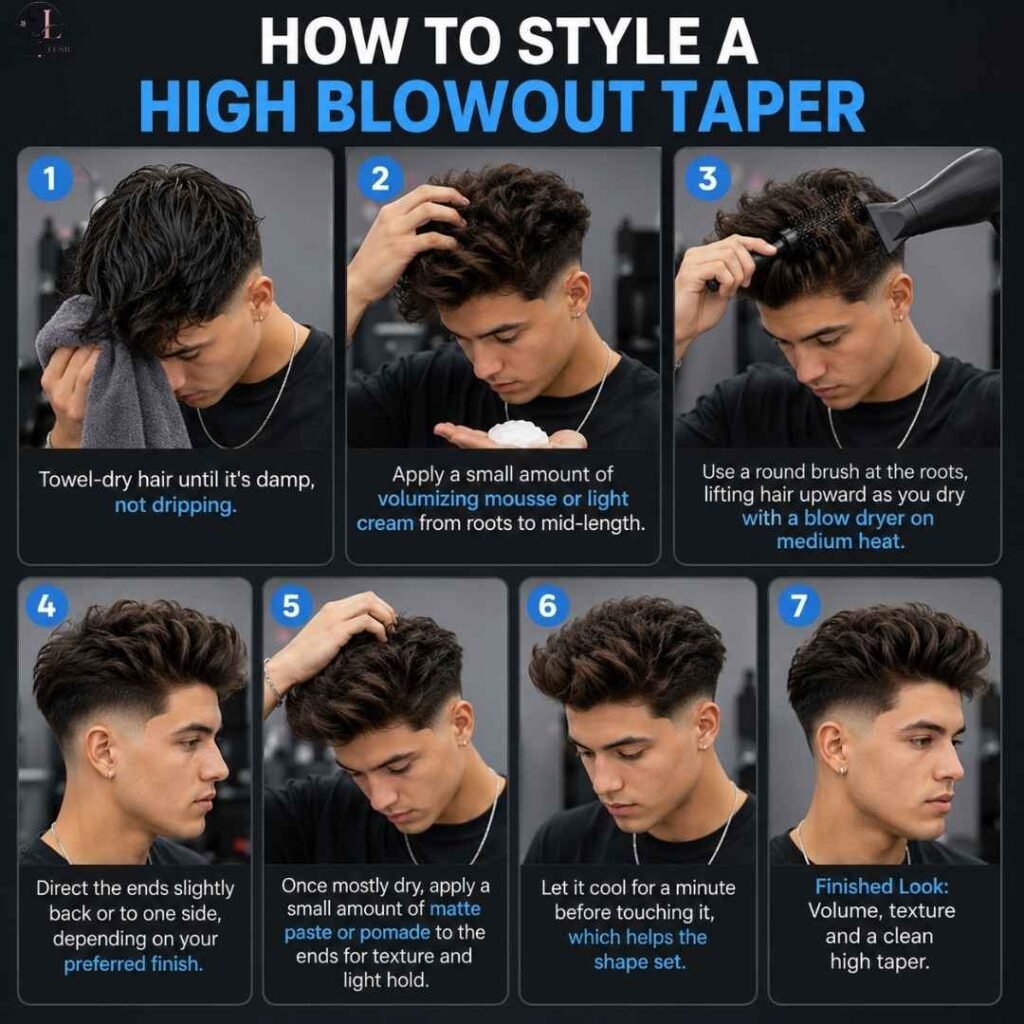
To style a high blowout taper, apply product to damp hair, then use a round brush and blow dryer to lift the roots and direct the hair up and slightly back or to the side. The whole process usually takes 5 to 10 minutes once you get the technique down.
Here’s a simple step-by-step approach:
- Towel-dry hair until it’s damp, not dripping.
- Apply a small amount of volumizing mousse or light cream from roots to mid-length.
- Use a round brush at the roots, lifting hair upward as you dry with a blow dryer on medium heat.
- Direct the ends slightly back or to one side, depending on your preferred finish.
- Once mostly dry, apply a small amount of matte paste or pomade to the ends for texture and light hold.
- Let it cool for a minute before touching it, which helps the shape set.
Which Product Matches Your Hair Type?
The right product depends on how much hold and texture you need, and using the wrong one is a common reason blowouts fall flat or look greasy.
| Hair Type | Recommended Product | Why |
|---|---|---|
| Straight/fine | Volumizing mousse | Adds lift without weighing hair down |
| Wavy | Light cream + sea salt spray | Enhances natural texture and movement |
| Thick/coarse | Matte clay or paste | Controls bulk while keeping a natural finish |
| Curly | Curl cream + light-hold gel | Defines curls without stiffness |
Does Humidity Affect the Style?
Yes, humidity is one of the biggest reasons a blowout falls or frizzes during the day, especially on wavy or curly hair. Using a product with humidity resistance (often labeled “anti-frizz” or “humidity-resistant”) and finishing with a light-hold spray helps the style survive humid weather.
On especially humid or rainy days, it also helps to add a little extra product at the roots before drying, since that’s usually where volume drops first.
What Mistakes Ruin a High Blowout Taper?
The most common mistake is using too much product, which weighs the top down and kills the volume the whole cut depends on. A close second is skipping the round brush and just air-drying, which leaves hair flat instead of lifted.
Other frequent mistakes:
- Not letting hair cool in place before touching it, causing the shape to collapse
- Applying product to fully dry hair instead of damp hair, which reduces how well it distributes
- Letting the sides grow out too long between trims, which blurs the taper and makes the top look disconnected from the sides
- Using high heat without a heat protectant, which can dry out hair over time and make it harder to style
How Often Does a High Taper Need a Trim?
A high blowout taper needs a trim every 3 to 4 weeks to keep the taper crisp, since the shorter sides grow out faster than the longer top and start to blur the clean lines. The top itself can usually go 8 to 12 weeks between trims, since it only needs occasional shaping to maintain length and remove split ends.
| Area | Recommended Trim Frequency |
|---|---|
| Sides/taper | Every 3–4 weeks |
| Top length | Every 8–12 weeks |
| Full cut refresh | Every 6–8 weeks |
If you can’t get to the barber every 3–4 weeks, ask for a slightly less aggressive taper height at your last visit so the regrowth is less noticeable in between appointments.
Frequently Asked Questions
Is a high blowout taper hard to maintain? It’s moderate maintenance. The sides need trimming every 3 to 4 weeks to stay sharp, and the top needs daily styling with a blow dryer, but it’s less demanding than a full fade that needs trims every two weeks.
Can I get a high blowout taper with curly hair? Yes. Curly hair works well with this cut, but it usually needs a bit more length on top and a diffuser instead of a round brush to get lift without frizz.
How much does a high blowout taper cost? Prices vary by location and barber experience, but expect to pay similar to a standard men’s haircut, often with a small upcharge if the barber spends extra time on precise blending or styling.
Do I need a blow dryer at home to maintain this style? Yes, a blow dryer and round brush are essential for recreating the blowout look daily. Without them, the top will likely sit flatter and lose the height that defines this cut.
Is a high taper too much for an office job? No, a high taper is generally considered professional and polished, especially compared to a high fade or an undercut. The soft, natural volume on top reads as put-together rather than edgy.
What’s the difference between a taper and a blowout on top? The taper refers to the sides and back gradually shortening; the blowout refers to how the top is styled — dried upward with a round brush for volume, rather than left flat or spiked.
Can thin hair handle a high blowout taper? Yes, but keep the top slightly shorter (around 3 inches) and use lightweight volumizing products, since longer, heavier hair can flatten thin strands and reduce the lift.
How is a high taper different from a high fade? A high taper never reaches skin on the sides, while a high fade does. This makes the taper lower maintenance and slightly softer-looking, while the fade offers a sharper, more dramatic contrast.
Key Takeaways
- A high blowout taper combines short, tapered sides that start blending near the temple with longer top hair styled up for volume using a blow dryer and round brush.
- Unlike a fade, a taper never reaches skin, making it lower maintenance while still offering sharp contrast.
- It works on straight, wavy, curly, and coily hair, though styling technique and expected top length vary by hair type.
- Most face shapes suit this cut, with small adjustments in height and volume placement for round, long, or heart-shaped faces.
- Be specific with your barber about “high taper” (not fade), your desired top length, and your daily styling habits.
- Trim the sides every 3–4 weeks and the top every 8–12 weeks to keep the cut looking sharp between visits.
1 thought on “High Blowout Taper Haircut Guide: Low vs Mid vs High, Every Hair Type”