

A mid taper design combines a clean mid-level taper around the temples and neckline with a shaved or clipped design. The easiest way to get the haircut you actually want is to tell your barber where you want the taper, where you want the design, how bold it should be, and how much length you want left on top.
If you simply say “give me a mid taper with a design,” your barber may still need more information. A better request is something like: “I want a mid taper, keep the top about three inches, leave some weight at the back, and add one clean curved line behind the right ear.”
This guide breaks down the terminology, design placements, back-of-head ideas, hair-type compatibility, maintenance, cost, and the exact script you can use in the barber chair.
What is a mid taper design?
A mid taper design is a haircut where the taper sits around the middle of the temple and sideburn area, while a decorative line, shape, or freestyle pattern is shaved into a selected area.
The taper itself keeps the haircut relatively natural compared with a full fade. The design adds personality without requiring you to change the entire haircut.
Common design options include:
- Single curved lines
- Double lines
- Diagonal slashes
- Arched patterns
- Geometric shapes
- Small stars or symbols
- V-shaped nape designs
- Freestyle razor patterns
The design can be subtle enough for everyday wear or large enough to become the main feature of the haircut.
What Is a Mid Taper (and How Is It Different from a Mid Fade)?
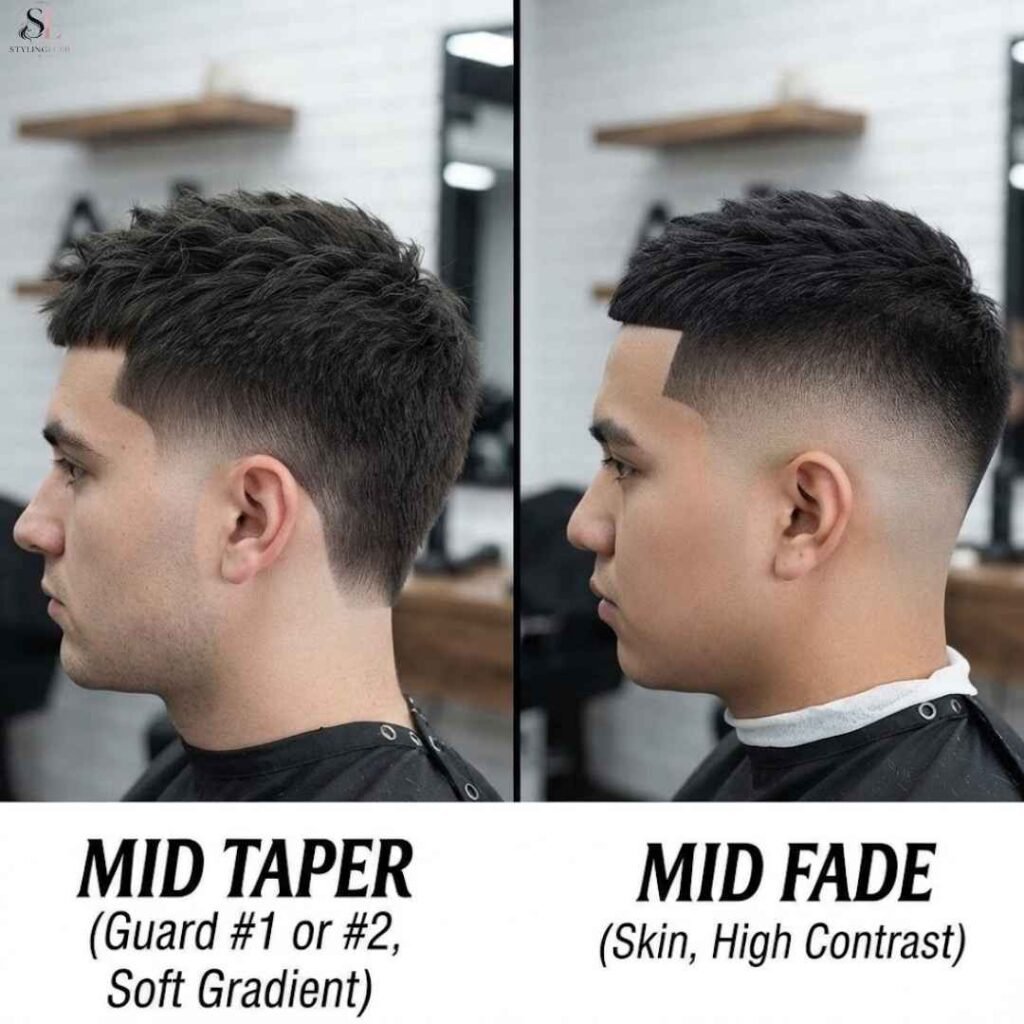
A mid taper gradually removes hair around the temples, sideburns, and neckline while leaving more hair around the sides and back.
A mid fade generally brings the fading effect farther around the sides and back, creating a more obvious transition from short hair into the longer hair above.
| Feature | Mid Taper | Mid Fade |
|---|---|---|
| Main focus | Temples and neckline | Sides and back |
| Overall look | More natural | More dramatic |
| Hair left at sides | More | Less |
| Design compatibility | Excellent | Excellent |
| Best for | Clean but versatile styles | Sharper, high-contrast looks |
| Maintenance | Moderate | Usually more frequent |
Neither is automatically better. Your choice depends on how much contrast you want. A taper is particularly useful if you want a design but do not want the sides of your haircut to look extremely exposed.
Also read: Low Taper Fade Long Hair: 35 Best Styles for Every Face Shape & Hair Type
Mid Taper Design Ideas (Categorized by Placement & Complexity)
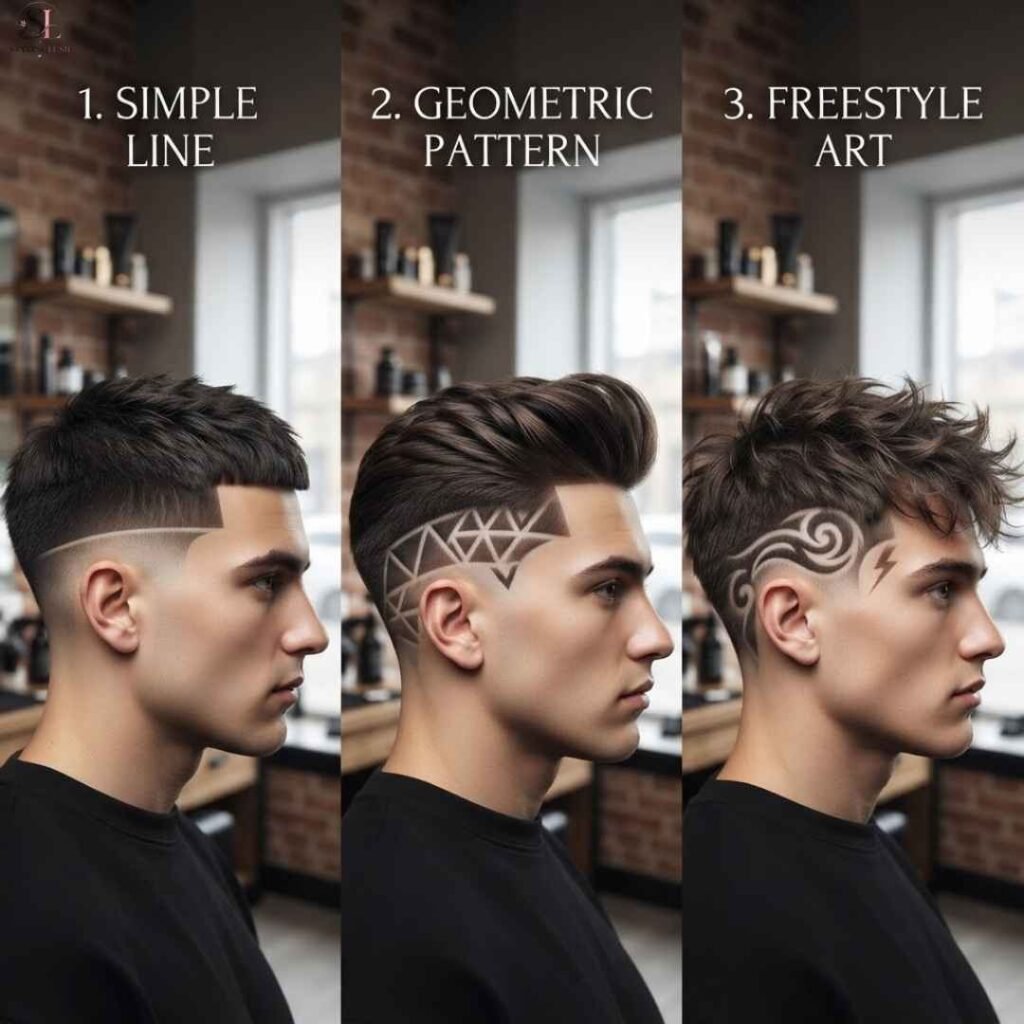
The best design depends on where it sits and how much attention you want it to attract. Think about the haircut as three design zones: the temple/side, behind the ear, and the nape.
Simple Designs (Office-Safe)
Simple designs are ideal when you want something noticeable up close but not overwhelming from a distance.
Good choices include:
- One thin curved line
- A short diagonal slash
- A single arc
- Two small parallel lines
- A subtle V near the nape
- A short line following the natural head shape
A single razor line is one of the easiest options to explain to a barber. You can also ask for a soft or thin line if you do not want the design to look too aggressive.
For professional settings, keep the pattern small and away from the most visible front-facing areas.
Geometric Designs (Statement Styles)
Geometric designs use clean angles and shapes rather than freehand curves.
Popular ideas include:
- Double slashes
- Triangles
- V shapes
- Parallel lines
- Intersecting angles
- Small diamonds
- Symmetrical patterns
These designs look best when the barber has enough space to create clean edges.
If your hair is very short around the design, even a tiny mistake can become obvious. That is why a complicated geometric pattern is better handled by a barber who regularly performs razor designs.
Freestyle Designs (Maximum Creativity)
Freestyle designs give the barber more freedom to create a pattern based on the shape of your head and haircut.
You might say:
“Keep the mid taper clean and give me a freestyle design around the back-right side. Keep it medium-sized and sharp, but don’t make it too busy.”
This approach works particularly well if you trust your barber’s design skills. One important point: freestyle does not mean random or careless. A good design should still follow the natural curves of the head and work with the taper.
What Are the Best Mid Taper Design Ideas for the Back of the Head?
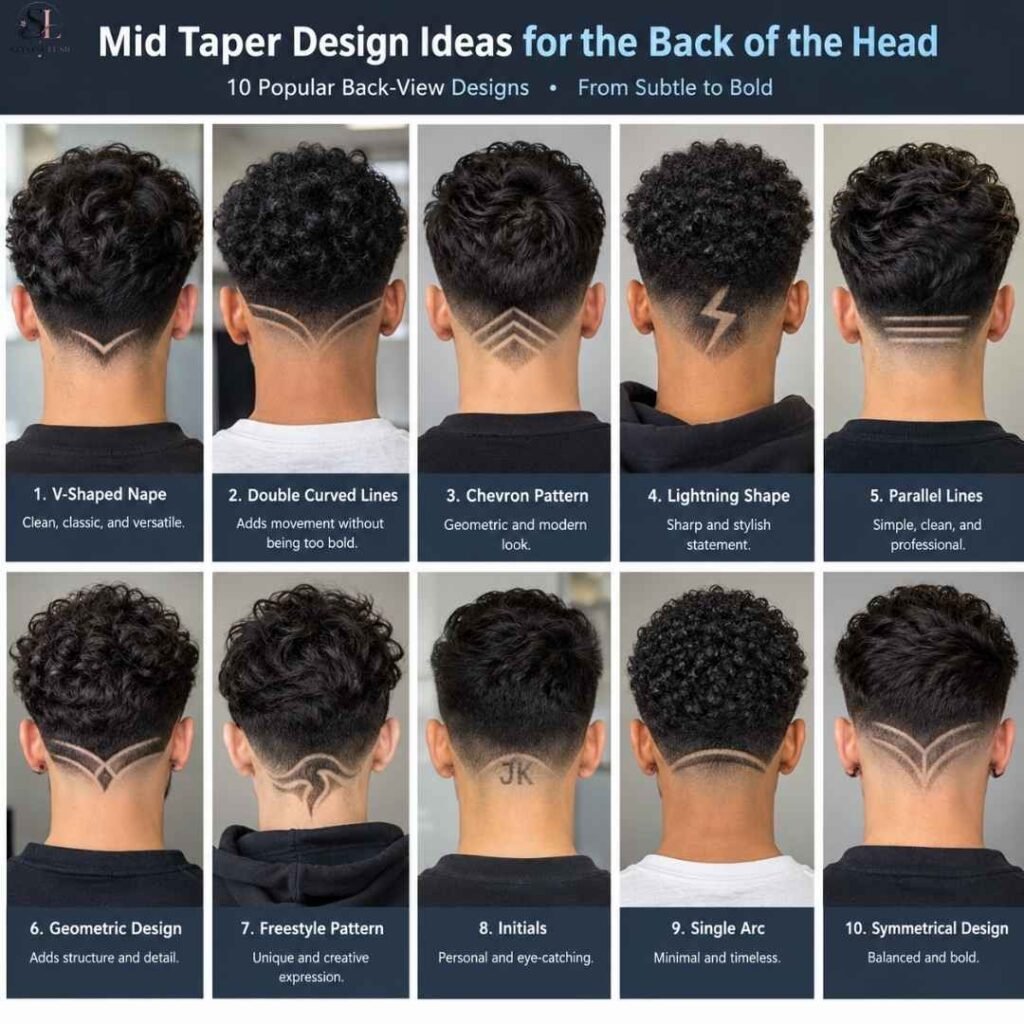
For the back of the head, the most useful designs are usually compact enough to remain visible as the hair grows.
Good options include:
- V-shaped nape design
- Single curved nape line
- Double chevron
- Small lightning-style shape
- Parallel horizontal lines
- Curved geometric pattern
- Small symmetrical design
- Freestyle arc
The back is also a good location if you want a design that is less noticeable from the front.
Nape-Specific Design Types
The nape is the lowest part of the back of your head, directly above the neck. Because this area is relatively narrow, designs need to be scaled correctly.
A large design can quickly become crowded when placed directly into the neckline. Instead, ask your barber to consider the width of the nape and create a pattern that follows it.
For example:
Subtle: “Add one small curved line just above the neckline.”
Medium: “Give me a clean V-shaped design centered at the nape.”
Bold: “Create a wider geometric pattern across the lower back, but keep the neckline clean.”
If you want the design to last visually for longer, avoid putting extremely fine details in an area that grows out quickly.
Mid-Taper Side Designs (Temple & Sideburn Placement)
Side designs are among the most visible options because they can be seen from the front and side.
The temple area works particularly well with:
- Short diagonal lines
- Curved arcs
- Double slashes
- Small lightning shapes
- Lines that follow the taper
A side design should complement the taper rather than fight against it.
Side Design Placement Options
| Placement | Visibility | Best design style |
|---|---|---|
| Temple | High | Small slash or curve |
| Above sideburn | Medium-high | Parallel lines |
| Behind ear | Medium | Curves or geometric shapes |
| Lower side | Medium | Larger freestyle design |
| Nape | Low from front | V or curved design |
If you are getting your first design, the temple or behind-ear area is a good place to start because the pattern can remain relatively simple.
What Should I Tell My Barber to Get a Mid-Taper Design?
The best barber request includes four basic details: taper level, top length, design location, and design style. Instead of showing a photo and saying “I want this,” explain what you like about it. A photo gives your barber visual information, while your words clarify what you want changed.
The 4-Part Barber Communication Script
Use this formula:
1. Taper:
“I want a mid taper around the temples and neckline.”
2. Top:
“Keep the top about three inches and don’t take too much length off.”
3. Design:
“I want one clean curved razor line behind my right ear.”
4. Finish:
“Keep the line thin and sharp, and keep the overall look natural.”
Put together, it becomes:
“I want a mid taper around the temples and neckline. Keep the top about three inches. Add one clean curved razor line behind my right ear, and keep it thin and sharp.”
That is much easier for a barber to interpret than simply saying, “Give me a cool taper design.” Also tell your barber whether you want the design temporary and subtle or bold and highly visible.
Do Mid Taper Designs Work with My Hair Type?
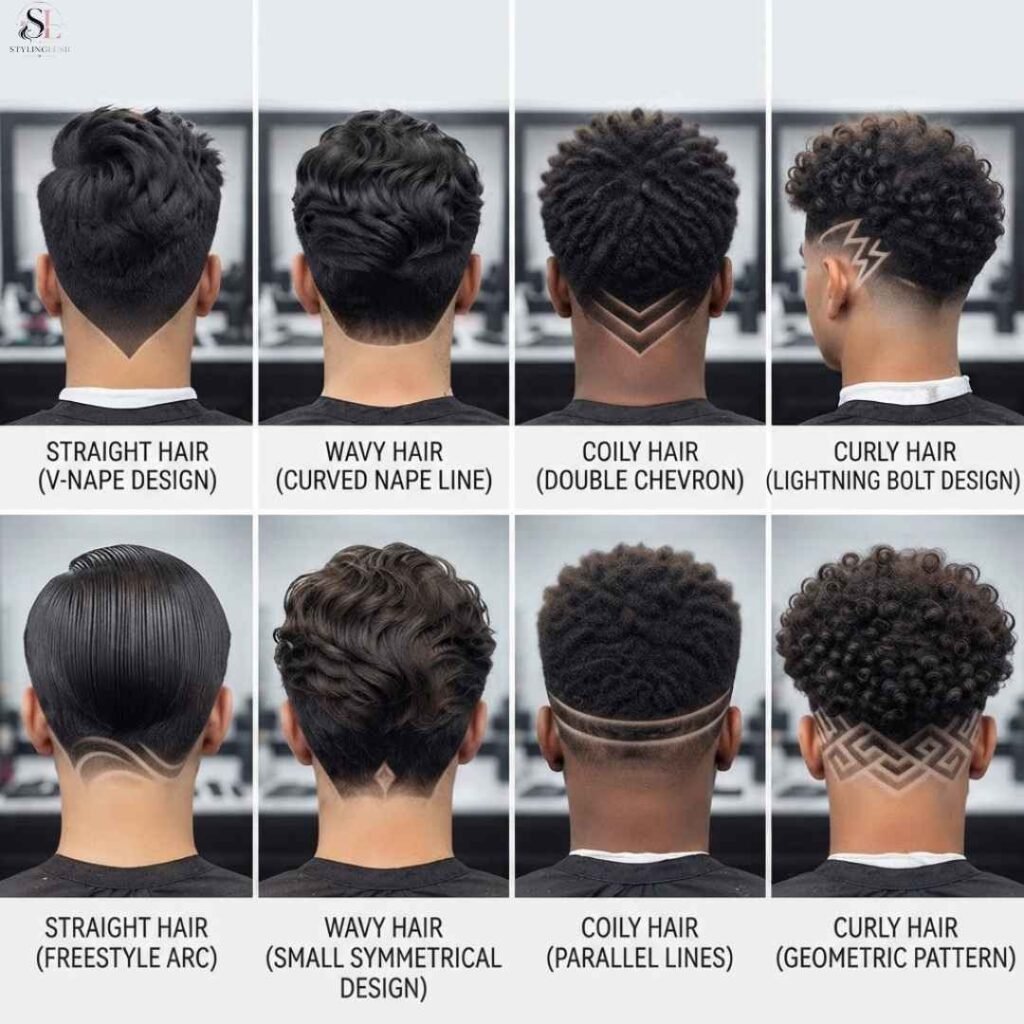
Yes. A mid taper design can work with straight, wavy, curly, coily, and thick hair. The main consideration is how much contrast exists between the design and the surrounding hair.
Very dense hair can make shaved designs stand out clearly. Curly and coily hair can also create excellent contrast when the design is cut into the shorter areas.
Mid Taper Design Compatibility by Hair Type
| Hair type | Works well? | Helpful approach |
|---|---|---|
| Straight | Yes | Sharp geometric lines |
| Wavy | Yes | Curves and flowing patterns |
| Curly | Yes | Medium-sized designs |
| Coily | Yes | Bold, simple patterns |
| Thick | Yes | Detailed designs can stand out |
| Fine/thin | Yes, with care | Keep designs simple |
If your hair is fine, your barber should avoid removing unnecessary surrounding density just to make the design bigger.
Top Style Pairings
A mid taper design can be paired with many top styles, including:
- Textured crop
- Short curls
- Curly top
- Messy quiff
- Short afro
- Sponge curls
- Waves
- Side-swept top
- Longer textured hair
- Short pompadour
The top does not need to be extremely short. In fact, keeping some length can create a stronger contrast between the textured top and clean taper.
How Do I Choose a Design for Work vs. a Bold Statement?
Choose the design according to how visible and permanent you want it to feel.
For work, school, interviews, or conservative environments, a small line is usually easier to live with. For weekends, parties, vacations, or personal style, you can experiment with larger patterns.
Design Appropriateness Scale
| Style | Visibility | Good for |
|---|---|---|
| Single thin line | ★ | Professional settings |
| Small curve | ★★ | Everyday wear |
| Double line | ★★★ | Casual settings |
| Geometric shape | ★★★★ | Statement haircut |
| Large freestyle | ★★★★★ | Maximum creativity |
There is no universal “appropriate” design. Workplace expectations differ, so consider your own environment before choosing a highly visible pattern. A useful trick is to start small. You can always try a more complicated design during a future appointment.
How Long Does a Mid Taper Design Last?
A mid taper design usually looks sharpest during the first several days after the cut. As the hair grows, the taper becomes less defined and thin razor details gradually disappear.
For many people, roughly 1–2 weeks is a reasonable period for the design to remain clearly defined, while the overall taper can remain present longer. Growth rate, hair texture, design depth, and the contrast between your hair and skin all affect how long it looks fresh.
Mid Taper Design Growth Timeline
| Time after haircut | Typical appearance |
|---|---|
| Days 1–3 | Sharpest and most defined |
| Days 4–7 | Still very crisp |
| Week 2 | Design begins softening |
| Week 3 | Fine details less obvious |
| Week 4+ | Taper and design need refreshing |
If you want the design to look consistently fresh, a barber visit every 2–3 weeks can work better than waiting until the entire haircut has grown out.
What Mistakes Should I Avoid?
The biggest mistake is choosing a design without considering the shape and available space around the taper.
5 Common Mid Taper Design Mistakes
1. Choosing a design that is too complicated
Tiny details can disappear quickly as the hair grows. Start with a pattern that remains recognizable even when it becomes slightly softer.
2. Putting the design in the wrong location
A design should work with the taper’s shape. Your barber can help determine whether the temple, side, behind-ear area, or nape gives enough space.
3. Asking for an unrealistic copy
A design that looks great on another person’s head may not translate exactly to your head shape, hair density, or haircut length. Use the reference as inspiration rather than expecting an identical result.
4. Making the design too large
More lines do not automatically make a haircut better. A clean single curve can look more intentional than five crowded shapes.
5. Forgetting about grow-out
Ask yourself how the haircut will look after one or two weeks, not just immediately after leaving the barbershop. A design that looks fantastic on day one may become messy if it relies on extremely fine details.
Frequently Asked Questions
What’s the difference between a taper and a fade?
A taper generally focuses on gradually shortening the hair around specific areas such as the temples, sideburns, and neckline. A fade usually creates a more extensive transition from very short or nearly skin-level hair into longer hair on the sides and back.
How much does a mid taper with design cost?
The price varies by location, barber, shop, haircut complexity, and whether the design requires detailed razor work. A basic taper with a simple line will generally take less time than a detailed freestyle or geometric design. The best approach is to ask for the price before the service, especially if the design is complicated.
Can I get a mid taper design if I have a cowlick?
Yes. A cowlick does not automatically prevent you from getting a mid taper design. However, your barber should work around the direction in which the hair naturally grows. A design placed directly through a difficult growth pattern may not sit as cleanly as one positioned slightly to the side.
Do mid-taper designs work for thinning hair?
They can, but the design should be chosen carefully. If your hair is thinning, avoid unnecessarily removing large areas of surrounding hair. A small, clean design can create visual interest without making the thinner areas appear more exposed.
What’s the best mid-taper design for a flathead?
A design that follows the natural shape of the back of the head can help create a more intentional appearance. Curved lines, V-shaped patterns, and designs that sit slightly lower on the nape can work well. Your barber should judge the placement in person rather than using a fixed design position for every head shape.
How do I maintain a mid-taper design between barber visits?
Keep the top styled as intended and avoid trying to recreate the razor design yourself unless you have the skill and equipment to do it safely. You can maintain the general cleanliness around the haircut, but detailed lines are best refreshed professionally. Tell your barber that you want to preserve the original shape when the design is redone.
Key Takeaways
A mid taper design is a versatile choice if you want a clean haircut with a little more personality. The taper keeps the temples and neckline controlled while the design adds a distinctive detail.
Before sitting in the barber chair, decide:
- Where you want the design.
- How large you want it.
- How bold you want it.
- What shape you prefer.
- How much hair you want left on top.
- How often you are willing to maintain it.
For a first attempt, a single curved line, small slash, or simple geometric pattern is an excellent starting point. If you want something more dramatic, move toward double lines, larger geometric patterns, or freestyle work.
Most importantly, don’t rely on the phrase “mid taper design” alone. Give your barber a clear description, show a reference photo when possible, and explain what you want kept or changed. That small amount of communication can make the difference between a haircut you simply like and one that genuinely suits you.