

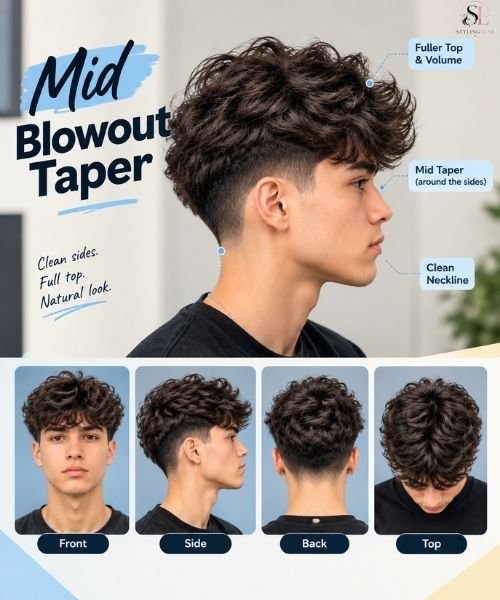
A mid blowout taper combines two things: a taper that rises to the middle area around the sides and back of the head, and a blowout shape that keeps the hair fuller and pushed outward. The result is clean around the ears and neckline while the upper sides and top still have noticeable volume.
It sits between a low blowout taper and a high blowout taper, making it a useful choice if you want visible tapering without removing too much of the hair’s natural shape. You can wear it with straight, wavy, curly, or coily hair, but the barber needs to adjust the technique to your texture.
The most important part is telling your barber where you want the taper to sit and how much volume you want to keep. A simple script can prevent the cut from turning into a regular fade or a much higher taper than you wanted.
What Is a Mid Blowout Taper?
A mid blowout taper is a hairstyle where the taper begins around the middle section of the sides and back rather than sitting very low or climbing high toward the parietal ridge.
The hair around the sideburns and behind the ears is gradually shortened, while the hair above and around the taper remains fuller. The top and upper sides are then shaped outward to create the characteristic blowout effect.
Think of the haircut as having two separate jobs:
- The taper cleans the perimeter.
- The blowout creates volume and direction.
This is what separates a mid blowout taper from a simple mid taper. A mid taper can be styled in many ways, including flat, combed, or textured. A blowout taper is specifically designed to make the hair look fuller and more lifted.
The exact appearance depends heavily on your hair texture. Straight hair may need a blow dryer and volumizing product to create the outward shape, while curly and coily hair may already have enough natural volume.
Where Does the Taper Actually Start?
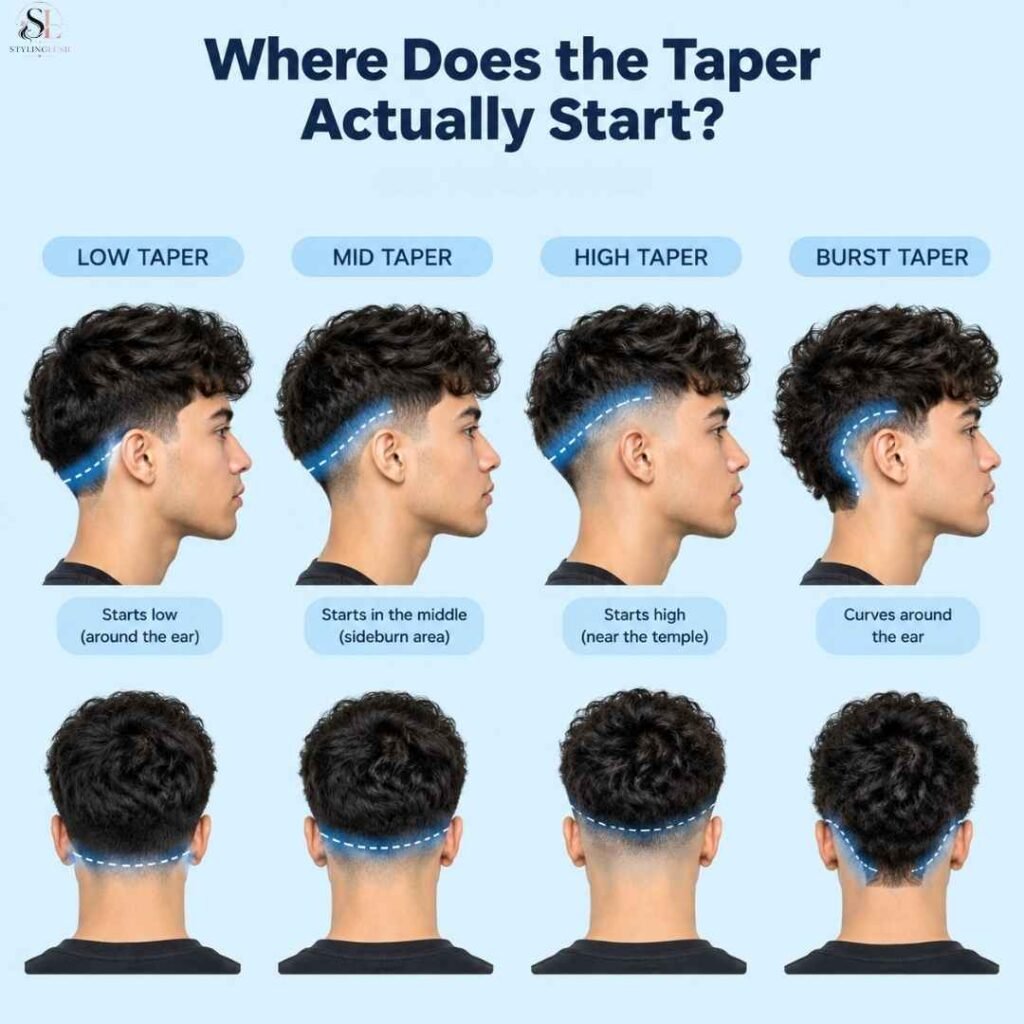
The taper generally begins around the middle portion of the sideburn and temple area, then continues around the area behind the ear and toward the neckline.
There is no universal measurement that works for every head. Your barber should use your head shape, hair density, desired style, and side profile to determine the exact height.
A useful way to explain it is:
“Keep the taper around the middle of the sideburn and behind the ear. I don’t want it climbing too high into the upper sides.”
The key phrase is “don’t take it too high.” If the barber pushes the taper substantially upward, you may end up with something closer to a high taper or fade.
The taper should also blend gradually. You should not see an obvious horizontal line where the short hair suddenly meets the longer hair.
What Does a Mid Blowout Taper Look Like?
A finished mid blowout taper has a clean perimeter with more visible volume above the tapered section. From the front, the top can look full and textured. From the side, the hair usually expands outward instead of lying completely flat against the head. From the back, the taper creates a cleaner area around the neckline while the hair above it maintains the blowout shape.
The overall silhouette can range from subtle to dramatic.
| Feature | Typical Mid Blowout Taper |
|---|---|
| Taper height | Middle |
| Sideburns | Gradually shortened |
| Area around ears | Clean and blended |
| Upper sides | Fuller |
| Top | Medium to long, depending on style |
| Volume | Moderate to high |
| Finish | Natural, textured, or polished |
| Maintenance | Moderate |
The haircut can look especially balanced when the barber leaves enough length above the taper. Taking too much weight from the upper sides can remove the very volume that makes a blowout taper recognizable.
For example, if you have thick wavy hair, your barber may leave considerable length around the upper sides and use texture to control bulk. If you have fine straight hair, keeping some strategic weight can make the hair appear fuller.
What Are the Mid Blowout Taper Variations?
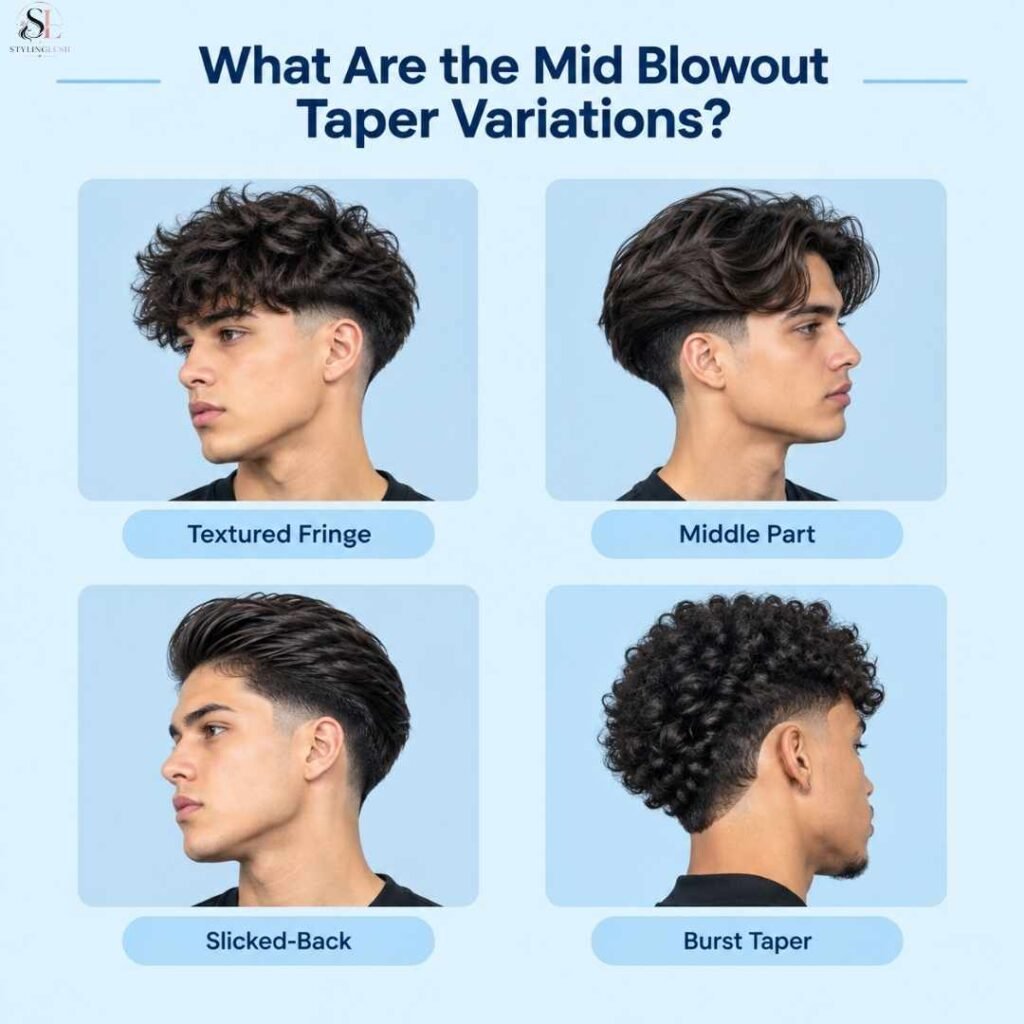
The basic haircut can be customized in several ways. Your choice should depend on your hair texture, styling habits, and how noticeable you want the blowout to be.
Adding a Textured Fringe
A textured fringe gives the mid blowout taper a more modern and casual appearance. Instead of pushing all the top hair backward or upward, the front is brought slightly forward. The barber can use point cutting or another texturizing technique to create separation between the strands.
This works particularly well with straight and wavy hair. For straight hair, texture prevents the fringe from looking like one solid block. For wavy hair, the natural bends can create movement without requiring heavy styling.
If your hair is curly, don’t ask for an extremely short fringe simply because you want texture. Curly hair shrinks as it dries, so your barber should account for its natural curl pattern.
Adding a Middle Part
A middle-part blowout taper combines a center part with volume on both sides. The top needs enough length to separate naturally down the middle. Your barber can create a subtle parting area while preserving the blowout around the sides.
This style is best if you are comfortable spending a few minutes styling your hair. The part does not have to be razor-sharp. A softer natural part often looks better with a blowout because it keeps the haircut relaxed rather than overly structured.
The Slicked-Back Version
If you prefer a cleaner appearance, style the top backward while keeping the blowout taper around the sides and back. This variation needs enough length on top to move backward. A blow dryer can create the initial direction, while a lightweight styling product controls the finish.
Avoid using too much heavy pomade if your goal is a true blowout appearance. Excessively heavy products can flatten the volume. For a modern finish, use a lightweight cream, styling paste, or mousse depending on your hair type.
The Burst Taper Variation
A burst taper concentrates the taper around the ear and creates a curved transition rather than following a simple straight taper pattern. Combining a burst-style taper with a blowout can create more visible volume around the upper sides.
The distinction matters:
- Mid taper: the taper follows the sideburn and back area.
- Burst taper: the taper curves around the ear.
- Mid blowout taper: combines a mid-level taper with outward volume.
- Burst blowout: emphasizes the rounded area around the ear and can create a more dramatic silhouette.
If you specifically want the burst variation, tell your barber instead of assuming “mid taper” means the same thing.
How Do You Ask Your Barber for This Cut?
The safest approach is to describe three things separately: taper height, top length, and styling direction. Don’t simply say “give me a blowout taper.” Different barbers can interpret that request differently.
Use this script:
“I want a mid blowout taper. Keep the taper around the middle of the sideburns and behind the ears, and blend it gradually into the longer hair. Don’t take the taper too high. Keep enough length and weight on the top and upper sides so I can create volume and push the hair outward. I want the neckline clean but not overly high. I’ll show you the shape I want before you start.”
Then explain your preferred finish:
“For the top, I want [textured fringe/middle part/slicked back/natural volume]. Please keep enough length for that style.”
If you have curly or coily hair, add:
“Please work with my natural curl pattern and don’t cut it too short because of shrinkage.”
A photo is also extremely useful. Use it to show the overall silhouette, not just the front.
Natural Edge or Sharp Edge-Up?
Both can work, but they create different results. A natural edge-up keeps the hairline softer and usually looks less severe as it grows out. A sharp edge-up gives the haircut a more defined, freshly lined appearance. It can make the temples and forehead look more structured.
Choose a natural edge if:
- You prefer a relaxed appearance.
- You want less obvious regrowth.
- Your natural hairline has irregularities you don’t want exaggerated.
Choose a sharp edge-up if:
- You like crisp barbered lines.
- You want a cleaner, more defined finish.
- You regularly maintain your haircut.
If your hairline is naturally uneven, don’t ask the barber to force a perfectly straight line. A skilled barber can clean it without making the shape look artificial.
Consultation or Walk-In?
A walk-in can work for a simple mid blowout taper, but a short consultation is better when you want a specific shape.
Before the clippers touch your hair, confirm:
- Where the taper will start.
- How much length will remain on top.
- How much volume will remain on the upper sides.
- Whether the neckline will be natural or squared.
- Whether you want an edge-up.
- How you normally style your hair.
If you have never had this haircut before, take a photo showing the side and back profile. The back is especially important because many people focus only on the front when choosing a haircut.
Does This Haircut Work With Your Hair Type?
Yes. A mid blowout taper is adaptable, but the barber’s approach should change according to your texture.
| Hair Type | How It Behaves | Best Approach |
|---|---|---|
| Straight | Can lie flat | Blow-dry for lift and texture |
| Wavy | Naturally creates movement | Enhance waves without overloading product |
| Curly | Naturally creates volume | Preserve curl pattern and control shape |
| Coily | Dense and highly textured | Shape carefully while respecting shrinkage |
| Fine/thin | Less natural volume | Use lightweight products and strategic length |
Straight Hair
Straight hair can produce a clean, controlled mid blowout taper, but it often needs help creating volume. The biggest mistake is leaving the hair completely flat and expecting a blowout appearance to happen automatically.
After washing, towel-dry until the hair is damp. Apply a lightweight volumizing product and use a blow dryer while lifting the roots with your fingers or a vent brush.
Direct the airflow up and slightly away from the head. Once the shape is created, use a small amount of styling paste or cream. Avoid heavy oil-based products if your hair becomes flat easily.
Wavy Hair
Wavy hair is naturally suited to a blowout taper because the texture already creates movement.
Your goal should be to enhance the wave rather than fight it.
Ask your barber to preserve enough length for your waves to form. Excessive thinning can sometimes make wavy hair lose the fuller shape you want.
For styling, apply a lightweight curl cream or mousse to damp hair. You can either air-dry for a softer result or use a diffuser if you want more controlled volume.
Curly Hair
Curly hair can make a mid blowout taper look especially full. The important issue is shrinkage. A curl that appears several inches long when wet can look much shorter once it dries. Your barber should assess your curls in their natural state before removing too much length.
A good request is:
“Keep the curls full on top and around the upper sides. I want a mid taper around the edges, but I don’t want the taper to remove the natural volume.”
Use curl cream or a lightweight leave-in product. Scrunch the curls instead of repeatedly brushing them.
Coily Hair
Coily hair can create a strong, distinctive blowout silhouette. The taper should clean the perimeter while preserving enough density above it. Your barber should consider how much your hair shrinks and how the shape will look once completely dry.
If you want a defined finish, your styling routine may include a leave-in conditioner followed by a curl-defining or shaping product. Don’t judge the final length only while the hair is wet. Coily hair can change considerably as it dries.
Fine or Thin Hair
Fine or thin hair can still work with a mid blowout taper, but the haircut should be designed around creating the appearance of fullness. Avoid removing too much hair from the upper sides.
A barber may use subtle texture rather than aggressive thinning. Over-texturizing fine hair can make it appear even less dense. For styling, choose lightweight products such as mousse, volumizing spray, or a light styling cream. Apply product mainly where you need control instead of coating the entire head.
How Do You Style This Cut at Home?
Styling a mid blowout taper is mostly about creating the right direction before adding product. Start with clean, damp hair rather than soaking-wet hair.
Basic styling routine
- Wash or wet your hair.
- Towel-dry gently until damp.
- Apply the right styling product.
- Lift the roots while blow-drying.
- Push the hair outward and slightly upward.
- Shape the top according to your chosen variation.
- Finish with a small amount of product.
For straight hair, use a blow dryer with a nozzle and direct the airflow from the roots toward the desired direction. For wavy, curly, or coily hair, a diffuser can reduce excessive disturbance while helping preserve natural texture. The important thing is not to flatten the upper sides. The taper is supposed to remain clean underneath the fuller blowout shape.
Match Your Product to Your Hair Type
The right product can completely change the finished haircut.
| Hair Type | Good Product Direction | Finish |
|---|---|---|
| Straight | Volumizing mousse or light cream | Lifted |
| Wavy | Mousse or curl cream | Natural movement |
| Curly | Curl cream or lightweight gel | Defined |
| Coily | Leave-in plus shaping product | Controlled volume |
| Fine | Lightweight mousse or volume spray | Fuller appearance |
Use less product than you think you need. You can always add more, but removing too much product usually means starting over. If your hair looks greasy, heavy, or flat, the product is probably too heavy or you’re using too much.
How Long Between Touch-Ups?
Most people will need a taper cleanup roughly every 2–4 weeks, depending on how quickly their hair grows and how sharp they want the edges. The taper itself may still look acceptable after four weeks, but the clean contrast around the sideburns and ears will gradually become less defined.
A practical maintenance schedule is:
| Time | What You Can Expect |
|---|---|
| 1 week | Fresh and defined |
| 2 weeks | Still clean for most people |
| 3 weeks | Taper begins looking softer |
| 4 weeks | Noticeable growth around edges |
| 5+ weeks | Usually ready for a full cleanup |
You don’t necessarily need a complete haircut every time. If the top still has the length you want, you can ask for a taper cleanup around the sideburns, ears, and neckline.
Mid vs. Low vs. High Taper: Which Wins?
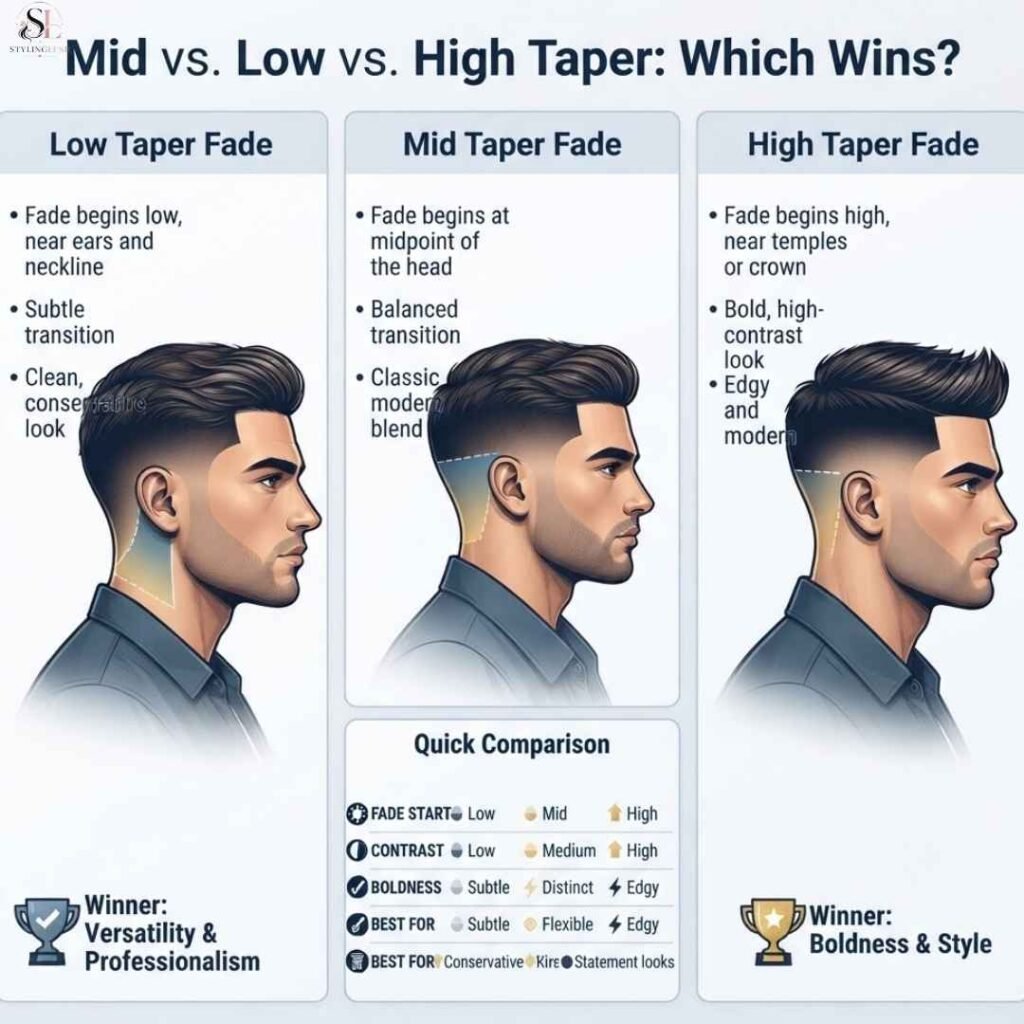
| Taper Height | Where It Starts | Maintenance | Best For |
|---|---|---|---|
| Low taper | Just above the ear | Low (every 5–6 weeks) | Conservative workplaces, subtle style |
| Mid taper | Middle of the ear/temple | Medium (every 3–4 weeks) | Most versatile, everyday choice |
| High taper | Near the temple/crown | High (every 2–3 weeks) | Bold looks, more grooming time |
Common Mid Blowout Taper Mistakes to Avoid
Even a good haircut can look wrong if the proportions are off.
1. Taking the taper too high
This is probably the most common mistake when someone specifically wants a mid taper. If too much hair is removed from the upper sides, the haircut can start looking like a high taper.
Fix: Tell your barber exactly where you want the taper to stop and show a reference photo.
2. Removing too much upper-side volume
A blowout needs enough hair to create its shape. If the barber aggressively removes weight from the upper sides, you may lose the outward silhouette.
Fix: Say, “Keep the upper sides full. I want the taper underneath the volume.”
3. Treating every hair type the same
Straight, curly, and coily hair cannot always be cut using the same measurements or techniques.
Fix: Explain how your hair behaves when dry, not just how it looks immediately after washing.
4. Ignoring shrinkage
Curly and coily hair can look significantly shorter after drying.
Fix: Your barber should account for your natural shrinkage before deciding how much length to remove.
5. Using too much product
A blowout depends on volume. Heavy product can flatten the hair.
Fix: Start with a small amount of lightweight product and build gradually.
6. Overdoing the edge-up
An extremely sharp line can change the entire character of the haircut.
Fix: Decide beforehand whether you want a natural finish or a crisp lineup.
7. Forgetting the back
A haircut may look excellent from the front but poorly balanced from behind.
Fix: Show your barber a reference with a clear back view or ask them to check the rear silhouette before finishing.
8. Confusing a burst taper with a mid taper
The two can look similar around the ear, but their shapes are different.
Fix: If you want the taper to curve around the ear, specifically ask for the burst variation.
Frequently Asked Questions
Is a mid blowout taper the same as a mid taper?
No. A mid taper describes the position of the taper, while a blowout taper also focuses on maintaining and styling volume around the upper sides and top.
How high is a mid blowout taper?
There is no universal inch measurement because head shape and hairstyle change the ideal position. Generally, the taper sits around the middle portion of the sideburn and side/back area without climbing as high as a high taper.
How long should the hair be on top?
It depends on the variation. A textured fringe can work with moderate length, while a middle part or slicked-back blowout usually needs more length. Your barber should preserve enough hair to create your chosen shape.
Can you get a mid blowout taper with curly hair?
Yes. Curly hair can work extremely well with this haircut because curls naturally provide volume. The barber should account for curl shrinkage and preserve the natural curl pattern.
Is a mid blowout taper good for straight hair?
Yes, but straight hair may require more styling to create volume. Blow-drying from the roots upward and outward can help produce the blowout shape.
How often should I get a mid blowout taper?
A cleanup every 2–4 weeks works for many people who want the taper to remain sharp. If you prefer a softer appearance, you can wait longer.
Can I get a mid blowout taper with a middle part?
Yes. Keep enough length on top for the hair to separate naturally. Tell your barber that the middle part is part of the final style before they begin cutting.
What’s the difference between a mid blowout taper and a burst taper?
A mid taper generally follows the sideburn and back area at a medium height. A burst taper curves around the ear, creating a more rounded taper pattern. A blowout can be incorporated into either style.
Does a mid blowout taper work with thin hair?
It can. The key is avoiding excessive thinning on the upper sides and using lightweight styling products to create lift. A barber can also shape the haircut to make the existing density look fuller.
Should I get a sharp lineup with a blowout taper?
It’s a personal choice. A sharp lineup creates a crisp, freshly cut appearance, while a natural hairline looks softer and tends to grow out more naturally.
1 thought on “Mid Blowout Taper: Definition, Variations & the Exact Barber Script to Get It Right”