

A mid taper fade for curly hair combines a gradual taper around the temples and neckline with natural curls on top. It gives you clean edges without removing too much length from your curls, making it a versatile choice for men who want a haircut that looks sharp but still shows their natural texture. You can wear it with short curls, a curly fringe, a blowout, a textured afro, or a longer curly top.
The best style depends on your curl pattern, face shape, preferred length, and daily routine. Men with 2C waves may prefer a layered, textured top, while men with 3A, 3B, or 3C curls can keep more length for definition and movement. Men with 4A, 4B, or 4C coils can also wear a mid taper, provided the barber understands shrinkage and preserves the desired shape. This guide covers 15 styles, barber instructions, styling products, and maintenance tips to help you choose the right cut.
What Is a Mid Taper Fade for Curly Hair and Which Curl Types Does It Suit?
A mid taper fade for curly hair is a haircut that gradually shortens the hair around the temples and neckline while leaving the curls on top longer. The taper sits around the middle of the temple area, creating more visible definition than a low taper but usually preserving more hair around the sides than a broader mid fade.
This haircut can work with many textures, from loose waves to tight coils. The main difference is how the top should be shaped. Loose curls may need layers to prevent the sides from looking bulky, while tightly coiled hair may need extra length to account for shrinkage after drying. A good barber adjusts the cut to your natural curl pattern instead of treating every head of curly hair the same way.
Mid Taper Fade vs. Mid Fade: What Is the Real Difference?
A mid taper fade focuses on the temple area and neckline, while a mid fade usually reduces the hair across a wider section of the sides and back. Although barbers sometimes use these terms differently, the main distinction is how much of the head receives the shorter blend.
With a mid taper, the hair above and around the ears can retain more of its natural fullness. This works well when you want your curls to remain the main feature of the haircut. A broader mid fade creates more contrast between the top and sides, which can make a curly top appear fuller by comparison.
| Feature | Mid taper fade | Mid fade |
|---|---|---|
| Main focus | Temples and neckline | Wider area of the sides and back |
| Side fullness | Usually preserves more hair | Usually removes more side bulk |
| Overall appearance | Natural and controlled | More noticeable contrast |
| Best suited to | Curls, coils, waves, and longer tops | Shorter sides and stronger contrast |
| Grow-out | Often looks softer as it grows | The changing blend may be more noticeable |
If you want a moderate cleanup without making the sides look extremely short, a mid taper is a sensible starting point. If you prefer a stronger separation between the top and sides, ask your barber whether a mid fade would better match your reference photo.
Taper vs. Fade: A Simple Explanation
A taper gradually shortens selected areas, usually around the temples, sideburns, and neckline. A fade describes a gradual transition from very short hair into longer hair and may cover a larger area of the head. In everyday barbering, the terms overlap, so the name alone doesn’t always tell you exactly what you’ll receive.
For example, a mid taper can leave much of the side hair intact while cleaning up the edges. A mid skin fade may remove the hair down to bare skin across a broader section of the sides. Both can work with curls, but they produce different silhouettes.
When booking your haircut, explain where you want the blend to begin, how short you want the lowest section, and how much side fullness you want to keep. A reference photo showing the front, side, and back can prevent confusion.
Also read: Mid Taper Fade for Long Hair: 20+ Best Styles +Expert Barber Guide (2026)
Why the Mid Taper Fade Works Perfectly for Curly Hair
Curly hair naturally creates movement and volume, but it can be difficult to control when the sides and neckline grow out unevenly. A mid taper adds structure around the perimeter while allowing the top to keep its curl pattern. The result can look tidy without making the entire haircut feel overly short.
Another advantage is flexibility. You can style the curls forward, upward, or toward the side, depending on their length and your preferred shape. The same taper can support a casual curly top for everyday wear or a more polished style for work, school, and formal occasions.
Solves the Pyramid Shape Problem
The pyramid shape happens when curly hair becomes wider toward the bottom, creating a triangular silhouette. It can occur when the sides grow outward while the top remains relatively flat or when the haircut doesn’t follow the natural direction of the curls.
A mid taper can help reduce that bulky appearance around the temples and above the ears. The barber cleans up the sides while leaving enough hair on top to preserve the natural curl pattern. If the sides are especially dense, the barber may also need to shape the upper sections carefully rather than relying on the taper alone.
Be clear about how much volume you want to keep. If you like a rounded afro or intentionally wide curls, you don’t need to remove all the fullness. The goal is to create the shape you prefer, not to force every curly haircut into a narrow silhouette.
Works for Every Curl Type From 2C Waves to 4C Coils
A mid taper can be adapted to different curl patterns, but the cutting and styling methods should change with the hair. Type 2C hair often has strong waves with some curl formation, while Type 3 hair generally forms more defined curls. Type 4 hair has tighter coils and may shrink considerably when it dries.
For 2C and 3A hair, a layered top can create movement without making the sides look heavy. Type 3B and 3C curls may need extra length to preserve definition, while Type 4A, 4B, and 4C hair often benefits from a barber who understands how the hair’s shape changes after drying.
Curl type is only one part of the decision. Hair density, strand thickness, growth direction, and styling habits also affect the result. If you usually wear your hair in its natural state, show your barber how it looks when dry rather than relying only on a wet reference photo.
Professional and Casual Versatility
A mid taper fade can look professional without removing the personality from your curls. A short natural top with a subtle blend works well if you prefer a simple appearance, while a curly fringe or textured blowout creates a more noticeable style.
The haircut can also adapt to different daily routines. If you prefer minimal styling, keep the top short enough to manage with a small amount of leave-in conditioner. If you enjoy defining each curl, leave more length and use a curl cream or gel that suits your hair.
For a workplace where grooming needs to remain conservative, ask for a clean taper without a shaved design or exaggerated height. You can still maintain natural texture while keeping the overall shape neat.
15 Best Mid Taper Fade Curly Hair Styles for Men
1. Classic Mid Taper Fade with Natural Curls
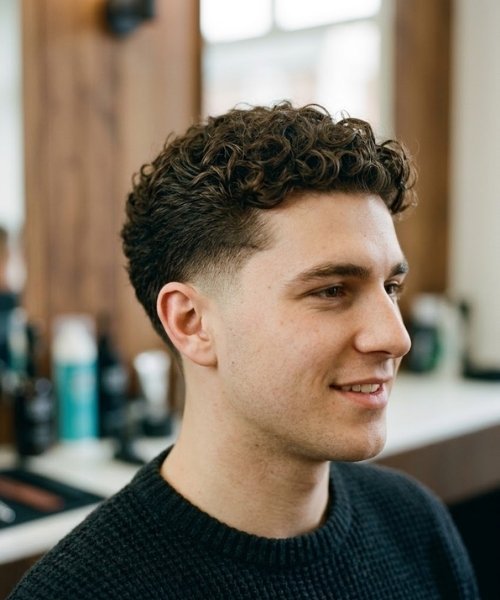
The classic mid taper fade with natural curls is a versatile choice if you want a clean haircut without losing your hair’s natural texture. The barber gradually shortens the hair around the temples and neckline while leaving the curls on top at their natural length. This creates a neat outline and keeps the focus on your curls instead of making the entire haircut look too short. You can wear this style with short, medium, or longer curls, depending on how much volume you prefer.
This haircut works especially well for men with 3A, 3B, 3C, and 4A hair, although men with thick 2C waves can also wear it. If your hair tends to puff out around the sides, ask your barber to remove excess bulk without cutting too deeply into the curl pattern. For styling, apply a small amount of leave-in conditioner to damp hair, distribute a curl cream through the top, and let your curls air-dry or use a diffuser on low heat. To keep the taper looking sharp, schedule a cleanup every two to three weeks, depending on how quickly your hair grows.
What to tell your barber: “Give me a mid taper around the temples and neckline, keep my natural curls on top, and blend the sides smoothly without taking away too much volume.”
2. Blowout Mid-Taper Fade Curly Hair
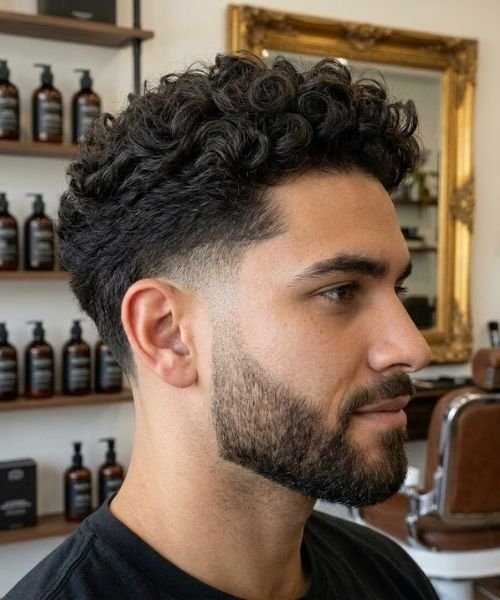
The blowout mid-taper fade is ideal if you want your curls to look fuller, taller, and more noticeable. The hair on top is left longer and styled upward and outward to create a rounded, lifted silhouette. Meanwhile, the mid taper cleans up the temples and neckline, preventing the extra volume from making the haircut look bulky around the edges. The result is a bold, modern style that combines height with a clean finish.
This look is particularly suitable for men with dense 3B, 3C, and 4A curls because these textures can hold noticeable volume. Men with 4B or 4C hair can also achieve a similar shape by using a suitable moisturizing routine and carefully shaping the top. Start with damp hair, apply a lightweight leave-in conditioner, and use a curl-defining product that supports your desired volume. If you want extra lift, use a diffuser while gently lifting the roots with your fingers. Avoid applying too much heavy product because it can weigh down the curls and reduce the blowout effect.
The key to this haircut is controlling the silhouette. Ask your barber to leave enough length at the front and crown to create height while keeping the sides balanced with your head shape. A blowout taper can require more daily styling than a classic curly taper, especially if you want the top to remain lifted throughout the day.
What to tell your barber: “I want a mid taper with a high-volume curly blowout on top. Keep enough length for lift, shape the curls naturally, and taper the temples and neckline without making the sides too high.”
3. Curly Mohawk with Mid Taper Fade
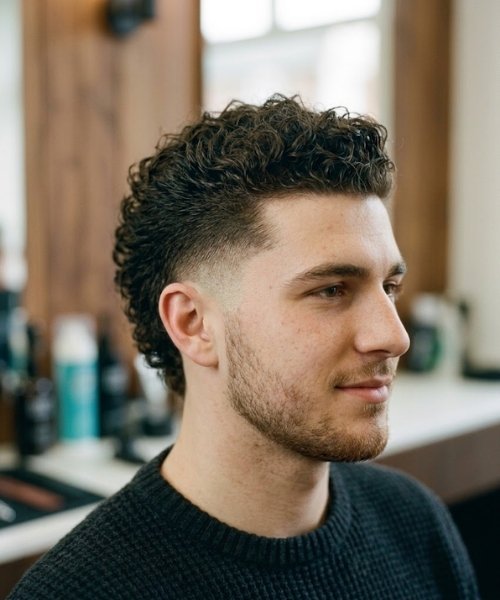
A curly mohawk with a mid taper fade gives you a more adventurous look while allowing you to keep your natural curls. The hair remains longer through the center of the head, from the front toward the crown, while the sides are shortened to emphasize the central shape. The mid taper cleans up the temples and neckline, creating a sharp outline without requiring the sides to be completely shaved. Depending on your preference, the mohawk can be subtle and rounded or more pronounced with extra height.
This haircut works well with tight curls and coils because their natural texture helps the center section maintain its shape. If you have 3C or 4A hair, your curls can create a defined, textured mohawk without needing excessive styling. Men with 4B or 4C hair can choose a fuller, more sculpted version, while looser 2C or 3A curls may need additional length to make the central section stand out. A curl cream or lightweight styling gel can help define individual curls and reduce frizz.
Tell your barber how dramatic you want the mohawk to look before the cutting begins. A narrow strip creates a sharper contrast, while a wider central section produces a fuller, less aggressive shape. Avoid letting the sides become too bulky, as this can reduce the mohawk effect. Regular shaping is important to keep the center section distinct and the taper clean.
What to tell your barber: “Keep the curls longer through the center like a mohawk, taper the temples and neckline at a mid height, and blend the sides so the central section stays clearly defined.”
4. Mid Taper Fade with Curly Fringe
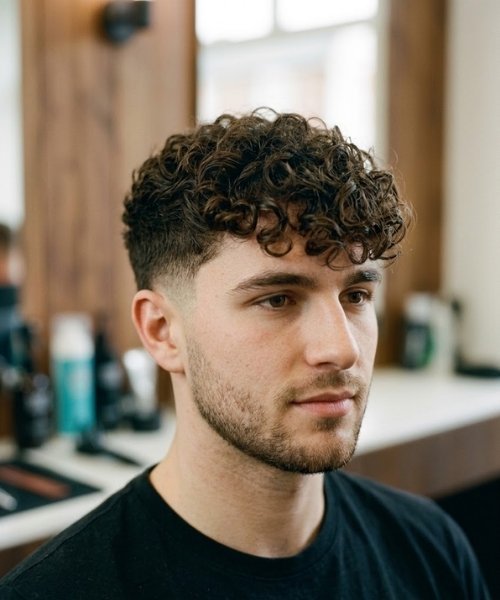
The mid taper fade with a curly fringe is a great option if you prefer a relaxed, youthful haircut that does not require you to push your hair backward. The curls are left longer at the front and styled forward over the forehead, creating a soft fringe. The mid taper keeps the temples and neckline neat while allowing the front to remain the main feature. You can choose a short, textured fringe for a low-maintenance look or a longer fringe for more movement and coverage.
This style is especially useful for men with 2C, 3A, 3B, or 3C hair because the curls can naturally fall forward and form a textured edge. If you have tighter coils, your barber should account for shrinkage so the fringe does not become much shorter than expected once the hair dries. A curl-defining cream helps separate the curls, while a light gel can provide additional hold if your fringe tends to lose its shape during the day.
Face shape can influence how the fringe should be cut. A longer fringe can visually shorten a long face, while a lighter, less crowded fringe may suit a round face better. Ask your barber to create texture rather than cutting the front into an unnecessarily thick, straight line. Your natural curl pattern should determine how the fringe sits.
What to tell your barber: “Give me a mid taper with a curly fringe that falls naturally over my forehead. Keep the front long enough to show the curl pattern and blend the temples smoothly.”
5. Curly Quiff with Mid Taper Fade
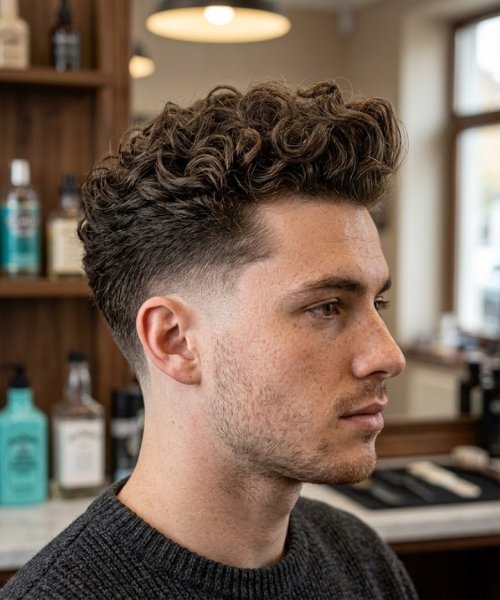
The curly quiff with a mid taper fade combines a lifted front with natural curls and clean sides. Unlike a curly fringe, which falls toward the forehead, a quiff directs the front upward and slightly backward to create height. The taper around the temples and neckline keeps the haircut structured and prevents the fuller top from looking untidy. It is a good option for men who want a hairstyle that works with casual outfits but can also look polished for work or formal occasions.
The style is easiest to shape when the front has enough length to lift without being weighed down. Men with 2C waves and 3A curls may find that a lightweight mousse or curl cream provides enough definition and movement. Tighter 3B and 3C curls can create a more compact quiff with noticeable texture. Start with damp hair, apply a small amount of styling product, and lift the front using your fingers while drying with a diffuser. Avoid brushing the curls aggressively, as this can disrupt their definition and create frizz.
Ask your barber to preserve extra length at the front and gradually reduce the length toward the crown if you want a clear quiff shape. The top should still connect naturally with the sides rather than appearing like a separate block of hair. If your hair is very thick, light internal shaping can reduce weight while keeping the visible curl pattern intact.
What to tell your barber: “I want a curly quiff with a mid taper. Keep extra length at the front so I can lift it upward and backward, and keep the taper clean without cutting the top too short.”
6. Textured Afro Mid Taper Fade
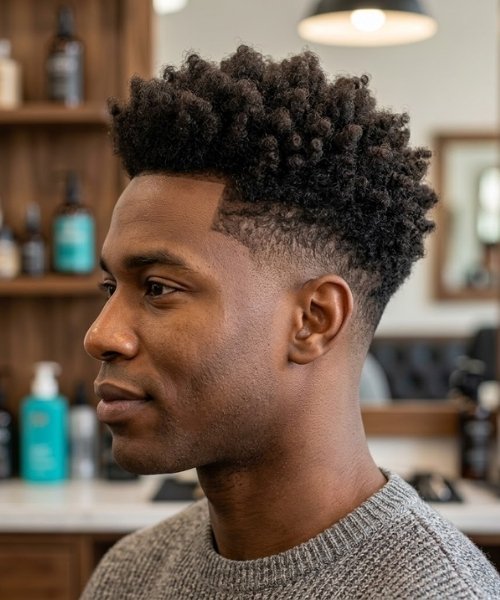
The textured afro mid taper fade celebrates natural volume while giving the haircut a cleaner outline. The top is shaped into a rounded or slightly angular afro, while the mid taper reduces the hair around the temples and neckline. This combination gives you a defined silhouette without requiring you to straighten, flatten, or dramatically change your natural texture. You can wear the top relatively short for a compact look or keep more length for a fuller shape.
This style is particularly suitable for men with 4A, 4B, and 4C hair, though other curl patterns can also be shaped into a textured afro. The barber should work with the natural density of your hair and avoid removing too much bulk from the top. Depending on your preferred finish, a sponge can help create visible coils, while a pick can lift the roots and add volume. Use a moisturizing leave-in conditioner and avoid excessive manipulation, which can lead to dryness and breakage.
The shape of the afro makes a major difference to the finished result. A rounded top gives a softer appearance, while a more squared shape creates a stronger outline. Your barber should consider your forehead, head shape, and preferred height before cutting the top. A mid taper can frame the face neatly, but the taper should not climb so high that it removes the visual balance between the afro and the sides.
What to tell your barber: “Shape my natural afro while keeping the texture and fullness on top. Give me a mid taper at the temples and neckline, and make the overall shape even without cutting the top too low.”
7. Long Curly Top with Mid Taper Fade
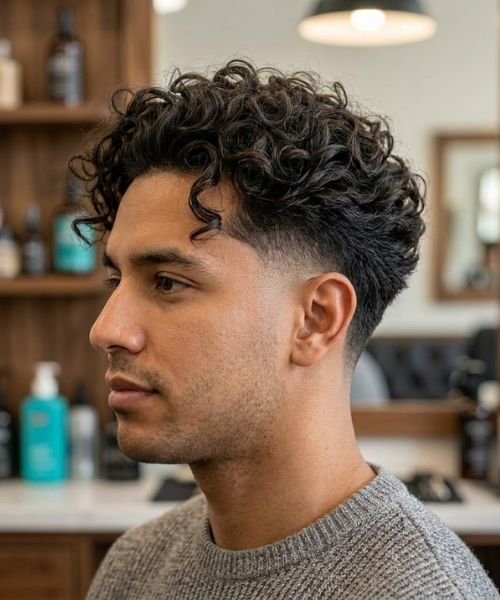
The long curly top with a mid taper fade is ideal if you want to keep your length while making the haircut look more structured. The top remains long enough for your curls to move freely, fall in different directions, or form a loose, rounded shape. The mid taper reduces bulk around the temples and neckline, creating contrast between the longer curls and the shorter edges. This gives you a modern appearance without sacrificing the personality of your natural hair.
This haircut can work with 2C waves, 3A curls, 3B curls, and tighter textures, provided the barber understands how your hair behaves at its current length. Longer curls may stretch when wet and shrink noticeably as they dry, so the finished shape should be planned around your dry hair pattern. Apply leave-in conditioner after washing, follow with curl cream if needed, and gently scrunch the hair to encourage definition. If your curls are heavy, use a diffuser on low heat or allow them to air-dry without repeatedly touching them.
Long curls need a little more maintenance than shorter styles. Regularly condition your hair, detangle gently with your fingers or a wide-tooth comb, and avoid cutting too much from the top during routine taper cleanups. Tell your barber whether you want the curls to fall forward, sit loosely around the crown, or remain lifted. This helps them shape the top without removing length you have spent months growing.
What to tell your barber: “Keep my curls long on top and remove only the bulk needed to shape them. Give me a mid taper around the temples and neckline, and preserve enough length for my curls to fall naturally.”
8. Short Curly Top with Mid Taper Fade
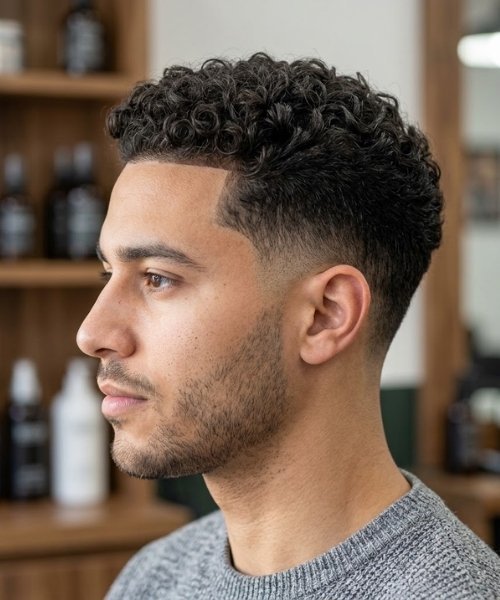
A short curly top with a mid taper fade is a practical choice if you want natural texture without spending a long time styling your hair every morning. The curls are cut short enough to stay manageable, while the taper cleans up the temples and neckline. Although the top is shorter than in a long-curly style, the barber should leave enough length for your natural curl pattern to remain visible. The finished haircut looks clean, balanced, and suitable for everyday wear.
This style works for a wide range of textures, including 3A, 3B, 3C, 4A, 4B, and 4C hair. However, the right cutting length will vary because tightly coiled hair often appears shorter after drying due to shrinkage. If your curls are loose, a little extra length can prevent the top from looking flat. If your coils are tight, a carefully shaped short top can create a dense, even appearance without requiring much product.
Styling is straightforward. Apply a small amount of leave-in conditioner or lightweight curl cream to clean, damp hair, then use your fingers to arrange the curls. You generally do not need a heavy styling product unless you want additional hold. The main maintenance task is keeping the taper neat; many men prefer a cleanup every two to three weeks, while the top can be trimmed less often if you are growing it out.
What to tell your barber: “Keep the curly top short but defined, and give me a mid taper around the temples and neckline. Please leave enough length for my natural curls to show instead of cutting everything down to the same length.”
9. Drop Fade with Curly Top
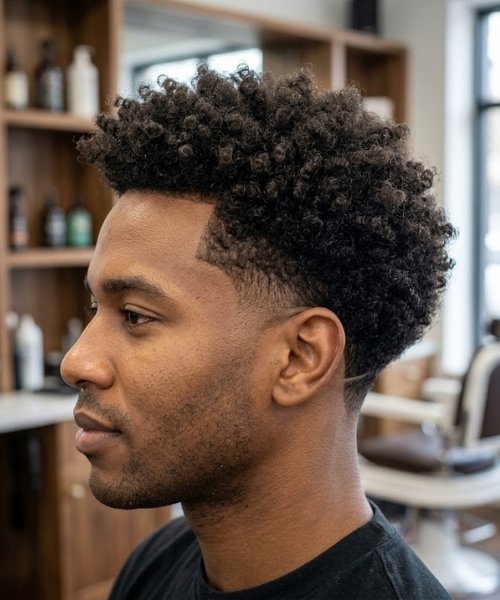
A drop fade with a curly top is a useful variation if you want the fade to follow the shape of your head rather than run in a straight line around the sides. The faded section curves downward behind the ears toward the back of the head, giving the haircut a distinctive profile. The curls remain longer on top, creating contrast between the textured upper section and the closely cut sides. This style can look particularly sharp from the side and back.
It is important to understand that a drop fade and a classic mid taper are not exactly the same haircut. A taper generally concentrates on the temples and neckline, while a drop fade usually extends farther around the sides and curves behind the ears. If you want the appearance of both, ask your barber for a drop-shaped fade with a restrained finish around the temples and nape. This distinction helps prevent a misunderstanding that could result in a much shorter cut than you intended.
The curly top can be short, medium, or long, depending on the silhouette you prefer. Use a curl cream to define the texture and keep the top balanced with the curved fade. Men with thick curls may benefit from light shaping at the crown so the back does not become too bulky. Because the fade covers a larger area than a traditional taper, you may need more frequent visits to maintain its sharp contrast.
What to tell your barber: “I want a drop fade that curves behind my ears, with defined curls left on top. Keep the shape balanced and show me how low the drop will sit before you begin.”
10. Disconnected Mid Taper with Curly Top
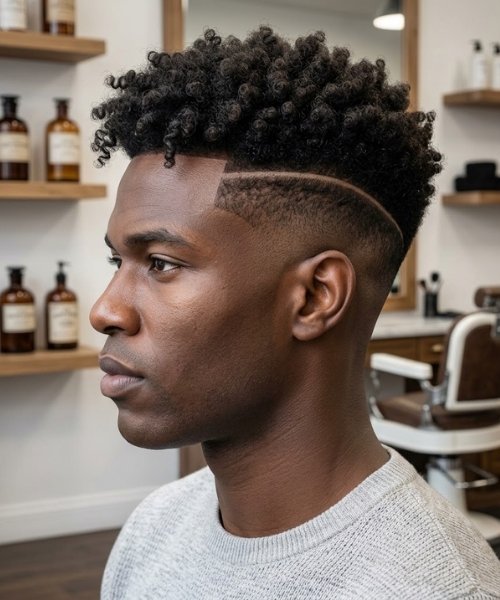
The disconnected mid taper with a curly top creates a stronger contrast between the length on top and the shorter hair around the sides. Instead of blending every section into a seamless gradient, the barber keeps a more noticeable separation between the fuller top and the shorter sides. The mid taper adds a clean finish at the temples and neckline, while the longer curls become the main feature. This style is suitable for men who prefer a bold, contemporary haircut rather than a traditional blended look.
The amount of disconnection can be subtle or dramatic. A softer version keeps some visual connection between the top and sides, while a more pronounced version creates a clear change in length. Men with dense 3B, 3C, or 4A curls can use the natural volume of their hair to make the separation more visible. If your curls are looser, keeping sufficient length on top can help maintain the contrast without making the haircut appear thin.
Before the cut, decide whether you want the top to sit forward, upward, or in a rounded shape. This matters because the direction of the curls changes how the disconnection looks from different angles. A lightweight curl cream can improve definition, while a small amount of gel can help maintain the shape. Avoid asking for a disconnected style if you actually prefer a smooth, traditional blend; the two finishes have different appearances.
What to tell your barber: “Keep my curly top noticeably longer than the sides, with a deliberate but balanced disconnection. Finish the temples and neckline with a mid taper, and leave enough length for the curls to hold their shape.”
11. Side Part Curly Mid Taper Fade
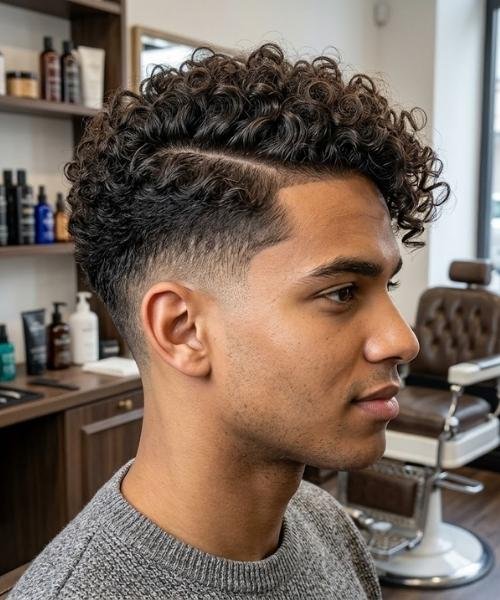
The side-part curly mid taper fade gives natural curls a more organized shape without making them look overly formal. The barber creates a natural separation on one side and shapes the top so the curls fall slightly to either side. The mid taper keeps the temples and neckline clean, while the side part adds direction and structure. Depending on your hair density and length, the part can be subtle and natural or more clearly defined.
This haircut works particularly well for men with 2C waves and 3A or 3B curls, since these textures can often be guided into a side-swept shape. Men with tighter curls can also wear it, although the part may be more visible when the hair is long enough to separate naturally. If you want a sharp shaved part, tell your barber beforehand; a natural part and a razor-defined line are different finishes, and the latter will need regular upkeep.
To style the haircut, begin with damp hair and apply a lightweight curl cream. Use your fingers to guide the curls away from the part, then allow them to dry without repeatedly combing through them. If you prefer a more polished appearance, use a small amount of flexible-hold gel rather than a stiff product that makes the curls look hard. Keep the part in a position that suits your natural growth pattern, because forcing the hair in the opposite direction can make it difficult to style.
What to tell your barber: “Give me a mid taper with a natural side part and defined curls on top. Keep enough length to sweep the curls to one side, and avoid making the part too deep unless I ask for a shaved line.”
12. Curly Mullet with Mid Taper Fade
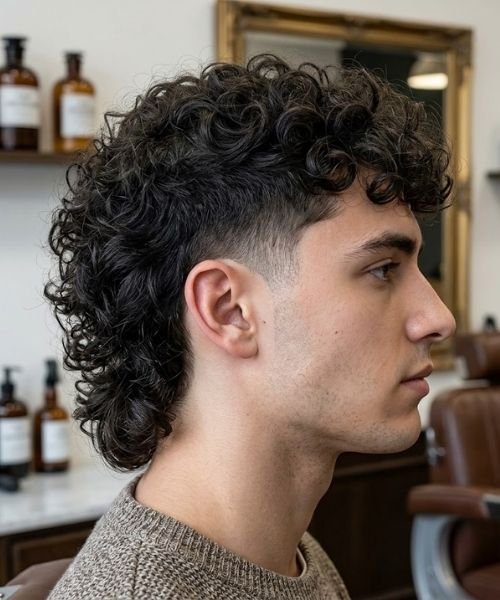
The curly mullet with a mid taper fade combines a shorter, cleaner front and sides with extra length at the back. The curls create movement and texture, while the mid taper around the temples and neckline can make the overall shape look more controlled. Depending on how much length you keep at the back, the haircut can appear subtle and modern or more dramatic and fashion-forward. It is a good option if you want something different from a standard curly top.
This style can work with 2C, 3A, 3B, and tighter curl patterns, but the back should be shaped according to how your hair grows and shrinks. Looser curls may create a flowing, layered mullet, while tight coils can produce a fuller, more compact shape. Ask your barber to blend the transition between the crown and back carefully so the haircut does not look like two unrelated sections. You should also decide whether you want the back to sit close to the neck or extend farther down.
For daily styling, apply a moisturizing product to damp curls and arrange the top and back in the directions you want them to fall. A lightweight curl cream can reduce frizz while maintaining movement. Because the mullet depends on its shape, avoid trimming the back during every taper cleanup. Instead, ask for the temples and edges to be refreshed while preserving the length at the back.
What to tell your barber: “I want a modern curly mullet with a mid taper around the temples and a clean neckline. Keep the back longer than the sides, blend the crown into it, and preserve the natural curl texture.”
13. Textured Fringe Mid Taper Fade
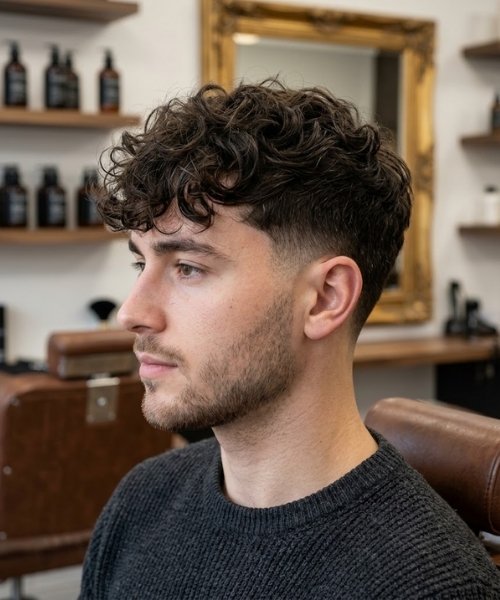
The textured fringe mid taper fade is a slightly more layered alternative to a traditional curly fringe. Instead of having all the curls fall forward in a uniform shape, the front is cut and arranged to create varied lengths, movement, and separation. The mid taper provides a clean outline around the temples and neckline, while the textured top keeps the haircut relaxed. This makes it a strong choice if you want a fashionable style that does not look too carefully arranged.
The style is suitable for men with loose waves, defined curls, and tighter coils, but the fringe should be designed around the individual curl pattern. If you have 2C waves or 3A curls, layered shaping can add movement and prevent the front from looking heavy. For 3C or 4A hair, your barber may need to account for shrinkage and preserve enough length so the texture remains visible after drying. The goal is to create separation between curls without making the front appear thin or uneven.
At home, apply curl cream to damp hair and gently scrunch the front with your fingers. Let the curls settle naturally rather than brushing them into a straight line. If you need extra hold, a small amount of lightweight gel can help maintain the textured finish. You can also ask your barber to adjust the fringe length to your forehead and face shape, particularly if you do not want the curls to cover your eyebrows.
What to tell your barber: “Give me a textured curly fringe with varied lengths and natural movement. Add a mid taper around the temples and neckline, and make sure the front works with my curl shrinkage.”
14. Mid Taper Fade with Beard Integration
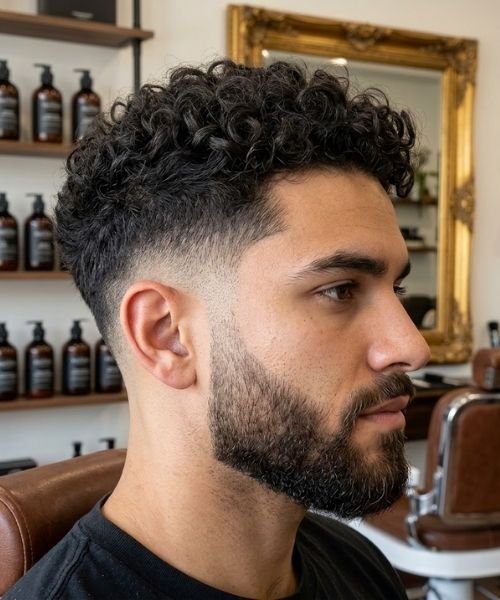
A mid taper fade with beard integration brings the haircut and facial hair together into one balanced look. The barber tapers the temples and neckline while shaping the sideburn area so it transitions neatly into the beard. The curls remain the focus on top, but the beard adds structure around the lower face. This combination can look clean and mature without requiring an extremely short haircut or a dramatic fade.
The best beard connection depends on your facial hair density and face shape. If you have a thick beard, the barber can create a smooth transition from the sideburns into the beard without making the cheek area look too bulky. If your beard is shorter or grows unevenly, a more subtle blend can help the entire style look intentional. Men with round faces may prefer a beard shape with a little more length at the chin, while men with longer faces may prefer a fuller appearance at the sides. These are styling options rather than strict rules, so your comfort and natural growth pattern should guide the final shape.
Keep the curls moisturized and defined, and maintain the beard with a suitable beard wash and conditioner if needed. The temple area is particularly important because an overly high or sharply cut transition can make the haircut look disconnected from the beard. Ask the barber to show you the planned sideburn length before blending. This is especially useful if you want to preserve a fuller beard rather than create a very tight skin fade.
What to tell your barber: “Give me a mid taper with natural curls on top, and blend the temples smoothly into my beard. Keep the beard’s fullness and shape, and make the transition clean without taking the sideburns too high.”
15. Mid Taper Fade with Curly Hair Designs and Patterns
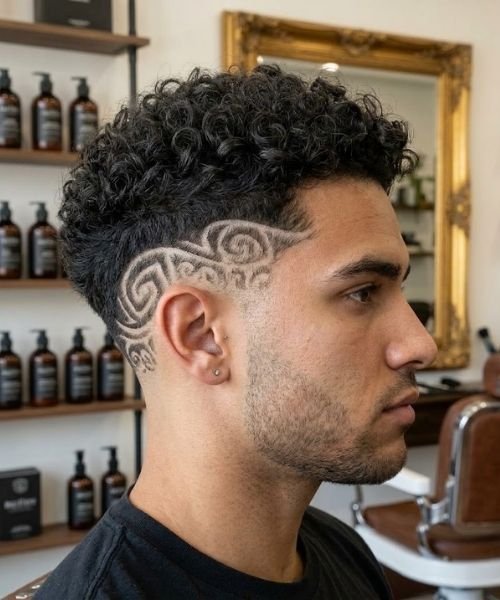
A mid taper fade with curly hair designs and patterns adds a creative detail to a clean, textured haircut. The barber keeps your curls on top and adds a shaved line or geometric pattern near the temple or side of the head. A single curved line can create a subtle accent, while double lines or angular patterns produce a more noticeable effect. The mid taper provides a clean background for the design, allowing the shaved detail to stand out without overwhelming the natural curls.
This style is flexible because you can choose the level of detail that matches your personality. A simple line is often easier to maintain and works well if you want a modern look without making the haircut too busy. More complex designs require careful planning, particularly when the pattern needs to follow the shape of your head. Your barber should consider the direction of your hair growth, the position of the taper, and how the design will look from the front and side. If you have very tight coils, keeping the top naturally shaped can provide a strong contrast with the clean linework.
Remember that shaved designs grow out faster visually than the rest of the haircut. If you want the pattern to remain crisp, you may need touch-ups more often than you would for a basic taper. Start with a simple design if you are unsure how much maintenance you want. You can always try a more elaborate pattern at a later appointment once you know which placement and shape suit you best.
What to tell your barber: “Keep my natural curls on top and give me a mid taper around the temples and neckline. Add one clean razor-line design on the side, and show me the placement before cutting the pattern.”
Best Mid Taper Fade for Curly Hair by Face Shape
Your face shape can help you choose the top length and overall silhouette, but it shouldn’t be the only factor. Hair density, curl pattern, head shape, and your preferred look are equally important when deciding how to style a mid taper.
| Face shape | Styles to consider | Styling advice |
|---|---|---|
| Oval | Classic curls, fringe, quiff, afro | Most top shapes can work |
| Round | Curly quiff, blowout, taller textured top | Add controlled height |
| Square | Short curls, textured afro, side part | Keep the shape balanced |
| Oblong or long | Curly fringe, wider afro, side-swept curls | Avoid excessive height |
| Heart-shaped | Curly fringe, medium curls, textured top | Balance the forehead and chin |
| Diamond-shaped | Side-swept curls, textured fringe, moderate volume | Avoid excessive width at the cheek area |
If you have a round face and want a more elongated appearance, a curly quiff or moderate blowout can add height without requiring a high fade. If your face is longer, a forward fringe or fuller top with less height may create a more balanced look.
For a square face, short curls or a textured afro can work well with the natural angles of the jaw. Oval faces generally have more flexibility, so your curl pattern and maintenance preferences can take priority. If you’re unsure, ask your barber to recommend a top shape that complements your head rather than relying on a face-shape chart alone.
How to Talk to Your Barber About a Mid Taper Fade for Curly Hair
A successful curly haircut starts with clear communication. The words “mid taper” describe the general placement, but they don’t explain how short the blend should be, how much curl length you want to keep, or whether you prefer a natural hairline.
Bring a reference photo that resembles your own curl pattern and current hair length. A picture of very loose curls may not translate directly to tightly coiled hair, even if the haircut has the same name.
The Exact Script: What to Say Word for Word
You can tell your barber, “I want a mid taper around the temples and neckline, with a gradual blend that doesn’t go too high into the sides. Keep the curls on top at this length, shape them according to how they naturally sit when dry, and don’t push my hairline back.”
If you want a skin finish, add that you want the lowest section taken down to the skin. If you prefer a softer appearance, ask for a shadow taper that leaves a little visible hair at the bottom. You can also specify whether you want a line-up, beard blend, curly fringe, or extra volume on top.
If you’re growing your curls, say so before the barber starts cutting. Ask for the perimeter to be cleaned up while preserving the length needed for your future style. This is especially important if your curls shrink significantly after drying.
Should Curly Hair Be Cut Wet or Dry?
Curly hair can be cut wet, dry, or with a combination of both methods, depending on the curl pattern and the result you want. Dry cutting allows the barber to see how the curls naturally sit and how much they shrink, while wet cutting can help with certain shaping techniques.
For highly textured or tightly coiled hair, checking the natural dry shape is particularly useful because the hair may look much longer when wet or stretched. A barber who understands curly hair can decide when each method is appropriate instead of following one rule for every client.
If your main concern is keeping a specific curl length, arrive with your hair in its usual natural state when possible. Tell the barber whether you normally wear it defined, picked out, stretched, or brushed into a particular shape.
Questions to Ask Your Barber Before the Cut
Before the haircut begins, ask how high the taper will sit and whether the lowest section will be shaved to the skin. These questions help you understand how much contrast to expect around the temples and neckline.
You can also ask how much length the barber plans to remove from the top and whether your curls will be checked in their natural dry state. If you want a particular shape, ask whether your hair has enough length to achieve it without excessive thinning.
Finally, confirm whether the haircut includes a line-up, beard blend, or design. These details can change the finished appearance, so it’s better to agree on them before the cut rather than making assumptions.
How to Style Mid Taper Fade Curly Hair Step by Step
A good styling routine should define your curls without making them feel stiff, greasy, or heavy. You don’t need a complicated collection of products; the right method depends on your hair’s texture and the amount of hold you prefer.
Start with clean hair and choose products that suit your curl pattern. Apply styling products evenly, use gentle handling, and allow the curls to dry without repeatedly disturbing their shape.
Daily Styling Routine
Begin by checking whether your hair needs a full wash or simply a light refresh. If your curls are already clean, you can dampen them with a little water instead of shampooing every day. Frequent washing isn’t necessary for everyone and may leave some hair types feeling dry.
Apply a suitable leave-in conditioner or curl cream, distributing it through the top with your fingers. Use a gentle scrunching motion if you want more curl definition, or lift the roots lightly if you prefer a fuller style. Avoid pulling the curls straight unless stretching is part of the look you’re aiming for.
Let your hair air-dry or use a diffuser on a moderate setting. Once it’s dry, avoid excessive touching because repeated handling can loosen the curl pattern and create frizz. If you use gel, a small amount can help hold the shape, but you shouldn’t need to make the hair feel hard or coated.
Best Products for Mid Taper Fade Curly Hair
The best products depend on your hair’s needs rather than the haircut’s name. A mid taper doesn’t require a special product; the curls on top determine what you should use.
| Product | Main purpose | Best use |
|---|---|---|
| Gentle shampoo | Cleans the scalp and hair | Wash days |
| Conditioner | Improves softness and manageability | During washing |
| Leave-in conditioner | Adds moisture and helps with detangling | Dry or textured curls |
| Curl cream | Supports curl definition and softness | Natural curls and fringes |
| Styling gel | Adds hold and helps curls keep their shape | Defined curls or longer tops |
| Diffuser attachment | Helps dry curls with less direct airflow | Voluminous or defined styles |
| Lightweight oil | Helps reduce moisture loss and adds slip | When appropriate for your hair |
You don’t need to use every item in the table. For short curls, a leave-in conditioner may be enough, while longer curls may benefit from a cream or gel. If your hair feels coated or your scalp develops buildup, reduce the amount of product and clean the hair appropriately.
Night Care Routine for Curly Mid Taper Fade
Night care helps reduce friction while you sleep. A satin or silk bonnet, scarf, or pillowcase can help limit rubbing that may disturb curls and contribute to dryness.
If your curls are longer, arrange them gently before covering your hair rather than pulling them tightly into a style that strains the roots. Short curls may need very little preparation beyond protecting the hair from friction.
Avoid applying heavy layers of product every night simply to refresh the style. If the hair feels dry, use a suitable light moisturizer when needed. The aim is to preserve the curl pattern and comfort of your hair and scalp, not to keep adding product.
How to Maintain Your Mid-Taper Fade Curly Hair
Maintaining a mid taper means looking after both the blend and the curls on top. The taper gradually loses its sharp appearance as the hair grows, while the top may need trimming or shaping to keep its intended silhouette.
Your schedule depends on how crisp you want the sides to look. If you prefer a fresh barbered finish, you may need more frequent touch-ups than someone who likes a softer, natural grow-out.
Grow-Out Timeline: What to Expect Week by Week
Hair doesn’t grow at exactly the same rate for everyone, so the following timeline is a general guide rather than a fixed rule.
| Time after the haircut | What you may notice | What to do |
|---|---|---|
| Week 1 | The taper looks fresh and defined | Maintain your normal curl routine |
| Week 2 | Short hairs around the temples and neckline become more visible | Refresh the curls and check the edges |
| Week 3 | The blend may look softer, especially around the sideburns | Book a cleanup if you prefer sharp edges |
| Week 4 | The original taper shape may be less distinct | Consider a trim based on your preferred look |
For many men, a cleanup every two to four weeks is a useful starting point. If your hair grows quickly or you want a very sharp finish, you may prefer a shorter interval. If you are growing the top, tell your barber to maintain the taper without cutting away the length you’ve gained.
Between visits, avoid trying to recreate the taper yourself unless you’re comfortable using clippers. Cutting too high or creating uneven steps can be difficult to correct without shortening more of the haircut.
Frequently Asked Questions
Is a mid-taper fade good for curly hair?
Yes. A mid taper works well with curly hair because it cleans the temples and neckline while allowing the top to retain its natural texture. It can be adapted to short curls, long curls, fringes, blowouts, and textured afros.
What is the difference between a mid taper fade and a mid fade for curly hair?
A mid taper generally focuses on the temples and neckline, while a mid fade usually blends a wider area of the sides and back. A taper often preserves more natural fullness around the sides, whereas a mid fade creates more noticeable contrast.
How often should I get a mid-taper fade with curly hair?
Many men refresh the taper every two to four weeks, depending on how sharp they want it to look. You can leave more time between visits if you prefer a softer grow-out or are concentrating on growing the top.
Should curly hair be cut wet or dry for a mid-taper fade?
Either method can work, depending on the curl pattern and desired result. Checking the hair in its natural dry state is particularly useful when shrinkage may change the finished length. A barber experienced with curls can choose the most suitable method.
What products are best for styling curly hair with a mid-taper fade?
A gentle shampoo, conditioner, and leave-in conditioner are useful starting points. Depending on your curls, you may also want a curl cream for definition or a gel for extra hold. Use only the products your hair needs to avoid unnecessary buildup.
Does the mid-taper fade work for all face shapes?
It can be adapted to most face shapes, but the top style influences the overall balance. A quiff or blowout can add height, while a curly fringe or fuller afro can preserve more width. Choose a shape that suits your preferences as well as your natural proportions.
How is a mid-taper fade different for Black men with afro-textured hair?
The basic taper placement is similar, but the barber needs to account for curl shrinkage, density, and the way coils expand after drying. A suitable top length and careful shaping help preserve the desired silhouette. For Type 4 hair, it’s particularly useful to explain how you normally wear and style your hair.