

The blowout taper textured fringe is a modern men’s haircut that combines tapered sides, natural volume, and a forward-flowing textured fringe for a clean but effortless look. Whether you prefer a low, mid, or high taper, the right height can completely change the shape and overall appearance of your haircut. In this guide, you’ll learn exactly what to ask your barber for, which taper height suits your face and hair type, how to style the fringe at home, and how often to maintain the cut so it stays sharp.
What Is a Blowout Taper Textured Fringe?
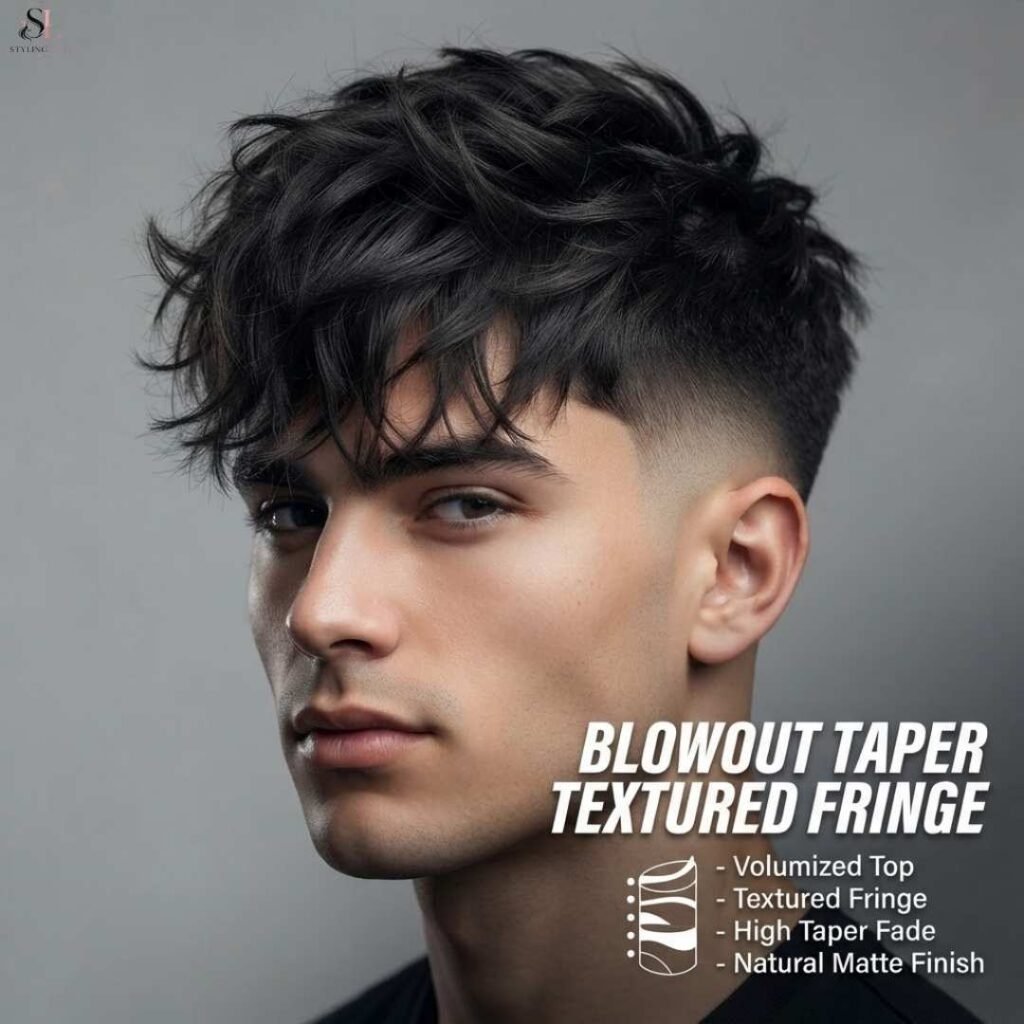
A blowout taper textured fringe is a men’s haircut with gradually tapered hair around the sideburns and neckline, extra volume around the upper sides, and a textured top that falls forward into a fringe.
The style sits between a traditional taper and a more dramatic blowout. Instead of removing most of the side hair, your barber gradually reduces it around the edges while keeping enough length near the upper sides to create the characteristic outward shape. The top stays longer and receives texture so your fringe doesn’t look like one heavy, flat block.
The look works particularly well when you want a modern haircut without committing to an extremely short fade. Your taper height controls how much contrast you create, while the fringe length controls how soft, sharp, messy, or structured the finished style looks.
Defining traits:
- Tapered sideburns and neckline
- Fuller upper sides
- Textured longer top
- Forward-facing fringe
- Blowout-style volume
- Natural movement through the top
- Adjustable low, mid, or high taper
Taper vs. Fade: What’s the Difference?
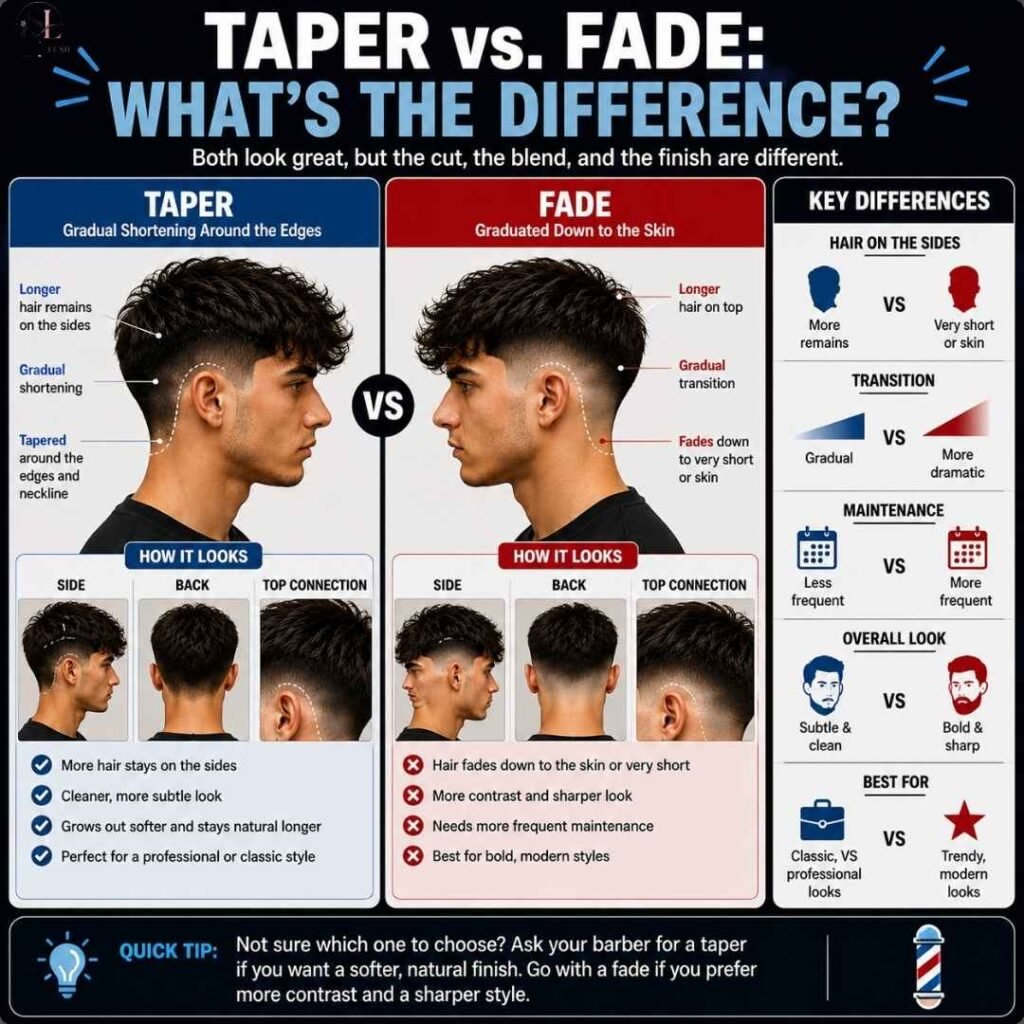
A taper gradually shortens hair around specific edges, while a fade usually creates a more extensive transition from very short or skin-level hair into longer hair above it.
A taper therefore leaves more visible hair around the sides and back. That makes it a strong choice when you want the blowout shape to remain noticeable rather than having the sides look extremely tight.
For this haircut, tell your barber exactly how aggressive you want the transition instead of simply saying “fade.” That single word can produce a significantly shorter result than you expected.
Also read: High Taper Fade with Design: 29 Razor-Cut Styles to Show Your Barber
Textured Fringe vs. Textured Crop
A textured fringe usually keeps more length and movement at the front, while a textured crop often has a shorter, more controlled fringe and a compact silhouette.
Your blowout taper textured fringe should have enough length to move forward naturally. The texture should separate the strands rather than make the fringe look blunt.
If you’re comparing this style with other modern cuts, a textured crop, low taper fade, or French crop can help you identify the amount of fringe and side contrast you actually want.
Which Taper Height Should You Choose?
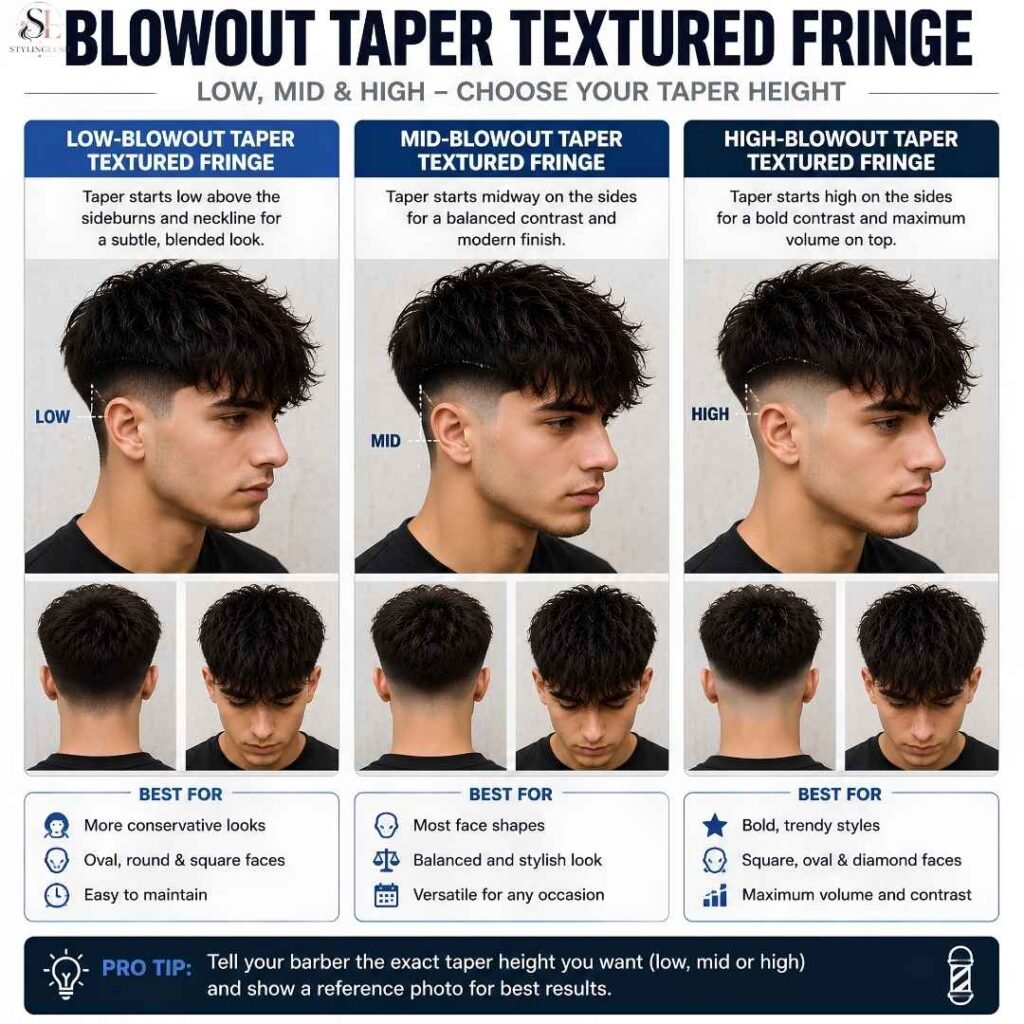
Your taper height determines where the shortest part of the haircut begins and how much of the side profile remains visible.
| Taper height | Side coverage | Contrast | Overall effect | Best for |
| Low | More coverage | Low | Subtle | Conservative looks |
| Mid | Balanced | Medium | Modern | Most face shapes |
| High | Less coverage | High | Bold | Strong contrast |
A low taper keeps the haircut understated, while a high taper makes the textured top and fringe stand out more dramatically. The mid taper sits between them and is generally the easiest option to adapt.
Low-Blowout Taper-Textured Fringe
A low-blowout taper textured fringe keeps the taper close to the sideburns and lower neckline. You retain more weight around the sides, giving the haircut a fuller and softer appearance.
This version works especially well when you don’t want the sides to look aggressively short. The fuller perimeter also makes the transition into the blowout shape more gradual.
Mid-Blowout Taper Textured Fringe
A mid-blowout taper textured fringe creates a stronger separation between the shorter sides and fuller top. It gives you a clean outline without making the haircut as dramatic as a high taper.
This is often the easiest version to wear casually and professionally because the contrast remains noticeable without dominating your face.
High-Blowout Taper Textured Fringe
A high-blowout taper textured fringe creates the sharpest visual contrast. The shorter area rises higher on the sides, allowing the top to appear larger and more pronounced.
This version works best when you want a statement haircut and have enough density on top to support the contrast.
Best Taper Height for Your Face Shape
Oval: A mid taper gives you balanced proportions without adding unnecessary width or height.
Round: A mid-to-high taper can create more vertical emphasis, especially when you style the top upward before directing the fringe forward.
Square: A low or mid taper preserves the strong natural proportions of your jaw while keeping the haircut structured.
Oblong: A low taper works well because it retains side fullness and avoids making your face appear unnecessarily longer.
Heart-shaped: A low-to-mid taper can maintain enough side volume to balance a wider forehead with a narrower chin.
Diamond: A mid taper can complement prominent cheekbones while keeping enough upper-side weight for a balanced silhouette.
What Do You Tell Your Barber?
The safest approach is to describe the taper height, side volume, top length, fringe direction, and texture separately.
- Set the taper height. Tell your barber whether you want low, mid, or high.
Ask: “Keep the taper low, mid, or high exactly as shown here, and don’t take the transition higher.” - Protect the blowout shape. The upper sides need enough weight to create outward volume.
Ask: “Leave enough weight on the upper sides so the hair can blow outward instead of collapsing flat.” - Explain the fringe. Specify whether you want it above the eyebrows, around eyebrow level, or longer.
Ask: “Leave the fringe long enough to fall forward naturally, with an uneven textured edge rather than a blunt line.” - Request controlled texture. Texture should create separation without destroying density.
Ask: “Use point cutting to create movement through the top, but don’t over-thin the hair.” - Confirm the finish before cutting. A reference photograph helps your barber see the exact silhouette you want.
Ask: “Before you finish, check the side profile and front shape against the reference so the taper and fringe match.”
Mistake to avoid: Don’t say only, “Give me a blowout taper.” That leaves too much open to interpretation. Specify taper height, fringe length, top texture, and how much upper-side weight you want.
Is Your Point Cutting Done Right?
Proper point cutting creates separation and movement without making the top look shredded or excessively thin. The barber should remove small amounts from the ends at an angle rather than aggressively thinning the entire top. Your fringe should still have enough density to sit forward.
If your hair suddenly looks wispy, uneven, or difficult to control after excessive texturizing, too much weight may have been removed. A good final result should show movement between sections, not random gaps throughout the fringe.
Does It Work for Your Hair Type?
The blowout taper textured fringe works across several hair textures, but the styling method needs to change according to density, natural movement, and strand thickness.
Straight Hair
Straight hair gives you the cleanest definition around the fringe and taper. Because straight strands can fall heavily, your main goal is creating texture and lift before directing the fringe forward.
Use a lightweight pre-styler and blow-dry the roots upward or slightly forward. Finish with a matte product rather than a heavy wet-look pomade.
Wavy Hair
Wavy hair naturally supplies much of the texture this haircut needs. Instead of fighting your natural pattern, use it to create a loose, separated fringe.
Apply a small amount of lightweight styling cream or mousse to damp hair. Blow-dry only where you need control, then use your fingers to arrange the fringe.
Curly Hair
Curly hair can produce a more expressive version of the style, especially when the fringe retains its natural curl pattern.
The key is maintaining enough length and avoiding excessive brushing. A curl-friendly cream can define the fringe while keeping the blowout taper clean around the edges.
The American Academy of Dermatology recommends treating wet hair gently because it breaks more easily, while people with tightly curled or textured hair can benefit from detangling while the hair is wet.
Fine Hair
Fine hair needs strategic texture rather than aggressive thinning. If your barber removes too much density, the fringe can look sparse and lose its shape.
Keep the top moderately long, use a lightweight volumizing product, and direct the roots upward before bringing the fringe forward.
Asian and Hispanic Hair Textures
Asian and Hispanic hair textures vary considerably, so density, coarseness, wave pattern, and growth direction matter more than ethnicity alone. If your hair is thick and straight, ask for controlled internal texture. If it’s coarse or wavy, focus on reducing excess bulk while preserving enough weight for the blowout silhouette. Your barber should evaluate your actual strand thickness and growth pattern rather than relying on a generic ethnic-hair formula.
How Do You Style It at Home?
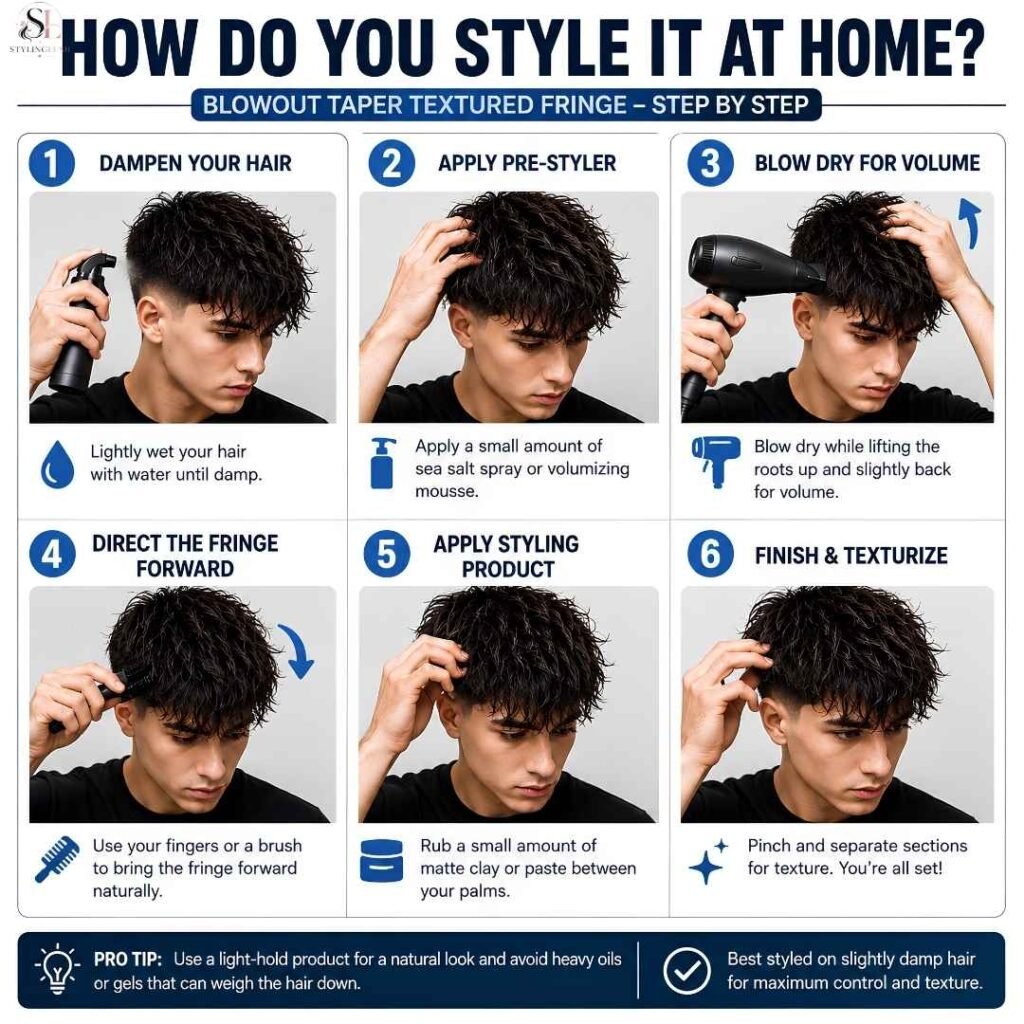
Start with damp hair rather than soaking-wet hair. Apply a lightweight pre-styler, establish your root direction with a blow-dryer, then add a small amount of finishing product.
The American Academy of Dermatology recommends limiting excessive heat and using low or medium settings with heat protection when blow-drying.
Morning Routine for Straight Hair
- Dampen: Lightly mist your hair with water until the top becomes workable.
- Pre-style: Apply a small amount of lightweight mousse, cream, or volumizer.
- Lift: Blow-dry the roots upward and slightly backward to create the blowout shape.
- Direct: Bring the front forward with your fingers to form the fringe.
- Finish: Rub a small amount of matte paste between your palms and pinch individual sections.
Avoid brushing the entire fringe into one solid sheet. Finger styling keeps the texture visible.
Morning Routine for Curly Hair
- Refresh: Mist curls with water or use a lightweight curl refresher.
- Define: Apply curl cream through the top without disturbing the pattern.
- Shape: Use your fingers to position the fringe.
- Dry: Air-dry or use a diffuser on a gentle setting.
- Finish: Add a tiny amount of lightweight cream to reduce unwanted frizz.
Don’t repeatedly rake through dry curls. That can break up the pattern and create unnecessary frizz.
Which Products Ruin This Haircut?
Heavy pomades can flatten the blowout and turn textured strands into one shiny mass. Excessive wax can create buildup and make the fringe difficult to reshape.
Strong, long-lasting products can also encourage repeated combing or manipulation. The AAD advises reducing the use of long-lasting hold styling products and minimizing aggressive styling because excessive handling can contribute to breakage.
Avoid:
- Heavy oil-based pomades
- Excessive hair wax
- Thick gels that harden the fringe
- Too much dry shampoo
- Strong products layered repeatedly
- Excessive heat without protection
If styling products repeatedly touch your forehead, choose formulas carefully. The AAD notes that oily hair products can contribute to clogged pores and breakouts around the hairline and forehead.
How Often Should You Get It Trimmed?
For most people, a blowout taper textured fringe needs a cleanup about every 3–5 weeks, although your ideal schedule depends on how quickly the taper loses its shape and how long you keep the fringe.
The taper usually needs attention before the top does. If the sides and neckline grow quickly, you may want an earlier edge cleanup while keeping the textured top longer.
Regular cutting maintains the appearance of the style, but cutting hair does not make it grow faster. The American Academy of Dermatology specifically explains that trimming removes split ends but does not accelerate growth because growth occurs below the skin.
Does Fringe Length Affect Trim Frequency?
Yes. A short fringe requires more precision because even a small amount of growth can change its position. A longer, messier fringe gives you more flexibility between appointments.
| Fringe length | Maintenance | Styling flexibility | Best approach |
| Short | Higher | Lower | Frequent trims |
| Medium | Moderate | High | Balanced schedule |
| Long | Lower | Highest | Shape as needed |
| Choppy | Moderate | High | Preserve texture |
If your fringe sits close to your eyebrows, schedule trims sooner. If you prefer a longer, loose fringe, you can usually stretch the interval while maintaining the taper separately.
What Mistakes Ruin This Haircut?
- Making the taper too high. A taper that climbs higher than intended can remove the upper-side fullness that creates the blowout silhouette. Fix it by clearly specifying the taper height before the clippers touch your hair.
- Leaving the fringe completely blunt. A straight, heavy edge can make the textured top look like a bowl or crop. Ask for controlled point cutting so the fringe has separation and movement.
- Over-thinning the top. Removing too much density destroys the volume needed for the blowout effect. Tell your barber to texture the top without aggressively thinning it.
- Using too much product. Heavy styling products can collapse the roots and make separate strands stick together. Start with a small amount and add more only where needed.
- Blow-drying in the wrong direction. Drying everything downward makes the top flat and eliminates the lifted silhouette. Establish volume at the roots first, then direct the fringe forward.
- Ignoring the neckline. A grown-out neckline can make an otherwise sharp taper look untidy. Clean the neckline during regular maintenance instead of waiting until the entire haircut needs reshaping.
Is It Appropriate for Work?
Yes, a blowout taper textured fringe can be appropriate for work when you keep the taper controlled, the fringe neat, and the styling relatively natural.
For a conservative workplace, choose a low or mid taper with moderate fringe length and a matte finish. Avoid exaggerated volume, extreme contrast, or a fringe that completely covers your eyes.
For creative workplaces, you can push the texture and blowout volume further. The haircut remains professional when the edges are clean and the top looks intentionally styled rather than neglected.
Your clothing and overall grooming also influence how formal the haircut appears. A controlled version can transition easily from work to casual settings.
Frequently Asked Questions
Is a blowout taper the same as a blowout fade?
No. A blowout taper leaves more hair around the sides and focuses the shorter transition around the edges, while a blowout fade usually creates a more extensive fade effect.
How long should the fringe be?
A medium-length fringe around eyebrow level is a versatile starting point, but the ideal length depends on your face shape, hair texture, and preferred styling direction.
Can you get a blowout taper textured fringe with curly hair?
Yes, curly hair can work particularly well because its natural texture adds separation and volume. Keep enough length to preserve the curl pattern and avoid over-brushing the fringe.
Is a low or high taper better?
A low taper is better when you want a subtle, fuller appearance, while a high taper creates stronger contrast. A mid taper provides a balanced middle ground.
How do you make the textured fringe stay in place?
Start with root direction while blow-drying, then apply a small amount of lightweight matte product. Avoid saturating the fringe with heavy wax or pomade because excessive product can flatten its texture.
Can you style this haircut without a blow-dryer?
Yes. You can air-dry the hair and use your fingers to establish the fringe, particularly if your hair is naturally wavy or curly. However, a blow-dryer gives you more control over root lift and the blowout shape.
For more inspiration, compare this style with related textured fringe haircuts, low taper hairstyles, and modern blowout cuts before your next appointment.
Final Takeaways
The blowout taper textured fringe gives you a flexible combination of tapered edges, upper-side volume, textured length, and a forward fringe. Choose a low taper for a subtle silhouette, a mid taper for balanced contrast, or a high taper for a bolder finish. Tell your barber exactly how high to take the taper, how much weight to preserve, and how long you want the fringe. At home, create root volume first, direct the fringe forward, and use lightweight product to keep the texture visible. Regular edge maintenance keeps the haircut sharp, while your actual trim schedule should follow how quickly your taper and fringe lose their intended shape.
2 thoughts on “Blowout Taper Textured Fringe – Low, Mid & High: What to Ask For and How to Style It”