
If you want a haircut that looks sharp today and still looks good in five years, the classic taper is it. It’s short on the sides and back, gradually blending into longer hair on top, with clean lines around the ears and neckline. No dramatic shave-downs, no trends that age out just a clean, professional cut that works in any decade.
In this guide, you’ll find the different types of classic tapers, over 60 style variations, how to pick one based on your face shape and hair type, styling tips, and exactly what to say to your barber so you don’t leave the chair disappointed.
What is a classic taper haircut?
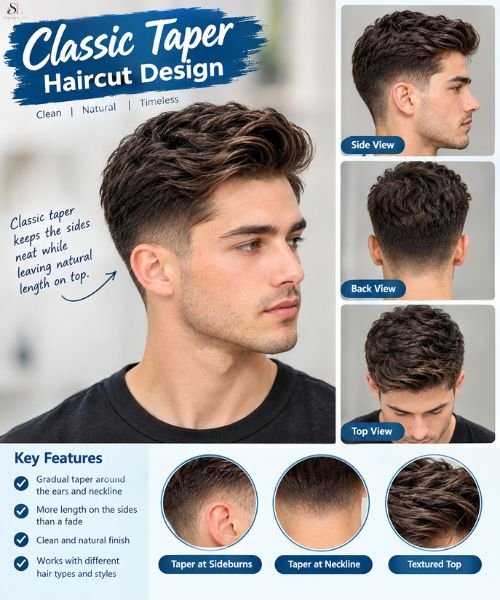
A classic taper haircut is a cut where the hair gradually gets shorter from the top of the head down to the hairline, ears, and neck, without any harsh or visible line of separation. The length on top can be short, medium, or long, but the sides always taper down smoothly.
The word “taper” means a gradual decrease in hair length rather than one specific look. That’s why you’ll see the classic taper paired with a side part, a crew cut, slicked-back hair, or even some texture on top.
What does “classic” mean in the classic taper?
“Classic” refers to the traditional barbershop version of the taper: conservative, neat, and not overly styled. Think of the haircuts barbers were giving in the 1950s through the 1980s clean around the ears, natural-looking on top, and easy to maintain with a comb.
A classic taper avoids extreme design elements like hard parts, shaved designs, or disconnected top pieces. It’s meant to look effortless rather than “done.”
Is a regular taper the same as a classic taper?
Mostly, yes. “Regular taper” and “classic taper” are usually used to mean the same thing a traditional, gradual taper with no fade or hard line. Some barbers use “regular taper” specifically to describe the shortest, most conservative version, while “classic taper” can refer to the whole family of traditional taper styles.
If you’re not sure which term your barber uses, just describe the look: short and neat on the sides, blending smoothly into longer hair on top, no shaved or skin-tight areas.
Also read: Low Taper Fade for Kids & Boys: 15+ School-Safe Styles, Barber Tips & Complete Parent Guide (2026)
Classic taper vs. fade vs. taper fade: Key differences explained
The main difference comes down to how short the sides get and how sharp the blend is. A taper never goes down to the skin, a fade often does, and a taper fade sits in between a tighter blend than a classic taper but not always skin-short.
The core difference
| Feature | Classic Taper | Fade | Taper Fade |
|---|---|---|---|
| Shortest point on sides | Short, but never skin | Can go to skin (skin fade) | Very short, sometimes near-skin |
| Blend style | Gradual, soft | Sharp, defined | Sharp but slightly softer than a full fade |
| Maintenance frequency | Every 4–6 weeks | Every 2–3 weeks | Every 3–4 weeks |
| Best for | Professional, low-maintenance looks | Bold, modern styles | A middle ground — sharp but still office-friendly |
| Grows out gracefully? | Yes | No, looks patchy fast | Somewhat |
If you want something you can leave alone for over a month and still look put-together, the classic taper wins. If you want maximum sharpness and don’t mind frequent touch-ups, a fade suits you better.
What is a classic taper fade?
A classic taper fade combines the traditional taper’s soft, natural blend with a slightly shorter and tighter fade zone right above the ears and at the neckline. It’s a good option for men who want more definition than a basic taper but don’t want a fully skin-short fade.
This style has become popular because it photographs well and looks sharp for job interviews, weddings, and everyday wear — without needing a barber visit every two weeks.
The history of the classic taper haircut: Why it has lasted over 100 years
The taper cut traces back to military and barbershop standards from the early-to-mid 1900s, when short, neat, gradually blended hair was practical for uniforms, hats, and hygiene. Through the decades, the taper adapted rather than disappeared. In the 1950s it was paired with pomade and a side part. In the ’70s and ’80s, it got a bit longer and looser on top. In the 2000s and 2010s, it merged with fade culture to create the taper fade. Today, it’s back in style largely on its own terms clean, low-fuss, and versatile enough for any generation.
60+ classic taper haircut styles for men (explained)
Low classic taper haircut styles
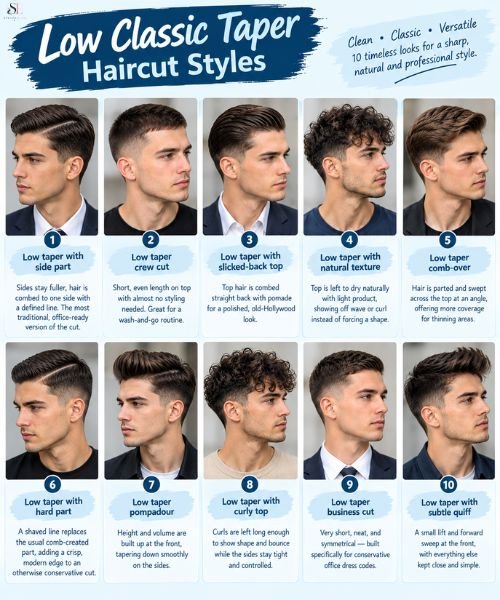
- Low taper with side part – Sides stay fuller, hair is combed to one side with a defined line. The most traditional, office-ready version of the cut.
- Low taper crew cut – Short, even length on top with almost no styling needed. Great for a wash-and-go routine.
- Low taper with slicked-back top – Top hair is combed straight back with pomade for a polished, old-Hollywood look.
- Low taper with natural texture – Top is left to dry naturally with light product, showing off wave or curl instead of forcing a shape.
- Low taper comb-over – Hair is parted and swept across the top at an angle, offering more coverage for thinning areas.
- Low taper with hard part – A shaved line replaces the usual comb-created part, adding a crisp, modern edge to an otherwise conservative cut.
- Low taper pompadour – Height and volume are built up at the front, tapering down smoothly on the sides.
- Low taper with curly top – Curls are left long enough to show shape and bounce while the sides stay tight and controlled.
- Low taper business cut – Very short, neat, and symmetrical — built specifically for conservative office dress codes.
- Low taper with subtle quiff – A small lift and forward sweep at the front, with everything else kept close and simple.
Mid classic taper haircut styles (Medium taper)
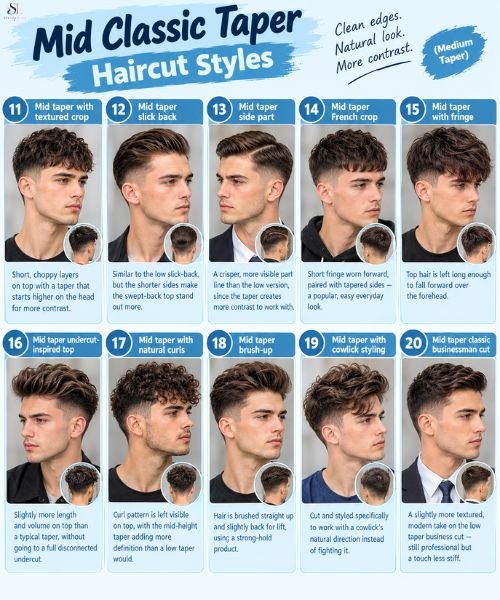
- Mid taper with textured crop – Short, choppy layers on top with a taper that starts higher on the head for more contrast.
- Mid taper slick back – Similar to the low slick-back, but the shorter sides make the swept-back top stand out more.
- Mid taper side part – A crisper, more visible part line than the low version, since the taper creates more contrast to work with.
- Mid taper French crop – Short fringe worn forward, paired with tapered sides a popular, easy everyday look.
- Mid taper with fringe – Top hair is left long enough to fall forward over the forehead.
- Mid taper undercut-inspired top – Slightly more length and volume on top than a typical taper, without going to a full disconnected undercut.
- Mid taper with natural curls – Curl pattern is left visible on top, with the mid-height taper adding more definition than a low taper would.
- Mid taper brush-up – Hair is brushed straight up and slightly back for lift, using a strong-hold product.
- Mid taper with cowlick styling – Cut and styled specifically to work with a cowlick’s natural direction instead of fighting it.
- Mid taper classic businessman cut – A slightly more textured, modern take on the low taper business cut still professional but a touch less stiff.
High classic taper haircut styles
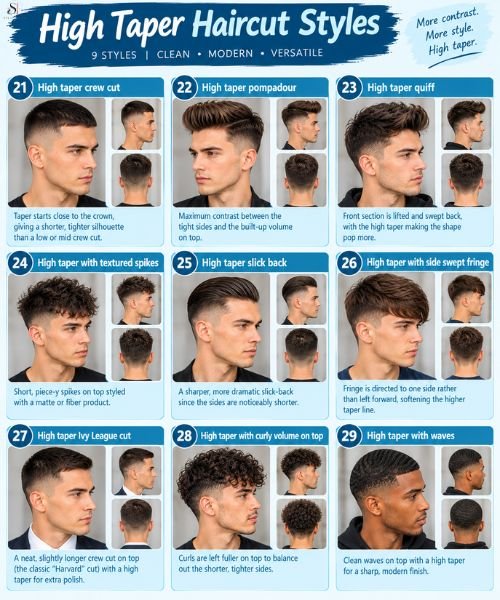
- High taper crew cut – Taper starts close to the crown, giving a shorter, tighter silhouette than a low or mid crew cut.
- High taper pompadour – Maximum contrast between the tight sides and the built-up volume on top.
- High taper quiff – Front section is lifted and swept back, with the high taper making the shape pop more.
- High taper with textured spikes – Short, piece-y spikes on top styled with a matte or fiber product.
- High taper slick back – A sharper, more dramatic slick-back since the sides are noticeably shorter.
- High taper with side swept fringe – Fringe is directed to one side rather than left forward, softening the higher taper line.
- High taper Ivy League cut – A neat, slightly longer crew cut on top (the classic “Harvard clip”) with a high taper for extra polish.
- High taper with curly volume on top – Curls are left fuller on top to balance out the shorter, tighter sides.
Short classic taper haircut
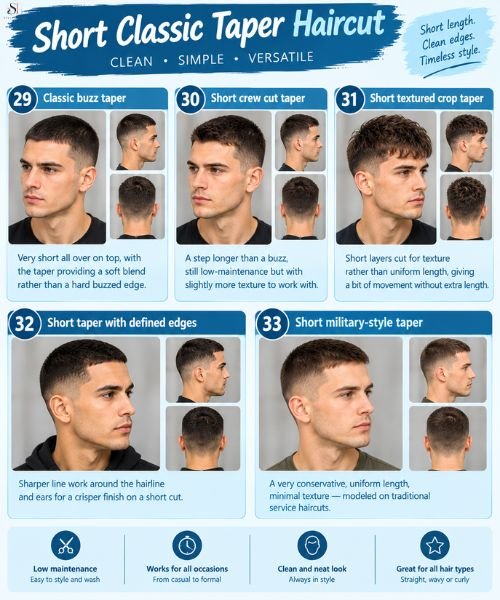
- Classic buzz taper – Very short all over on top, with the taper providing a soft blend rather than a hard buzzed edge.
- Short crew cut taper – A step longer than a buzz, still low-maintenance but with slightly more texture to work with.
- Short textured crop taper – Short layers cut for texture rather than uniform length, giving a bit of movement without extra length.
- Short taper with defined edges – Sharper line work around the hairline and ears for a crisper finish on a short cut.
- Short military-style taper – Very conservative, uniform length, minimal texture modeled on traditional service haircuts.
Long classic taper haircut
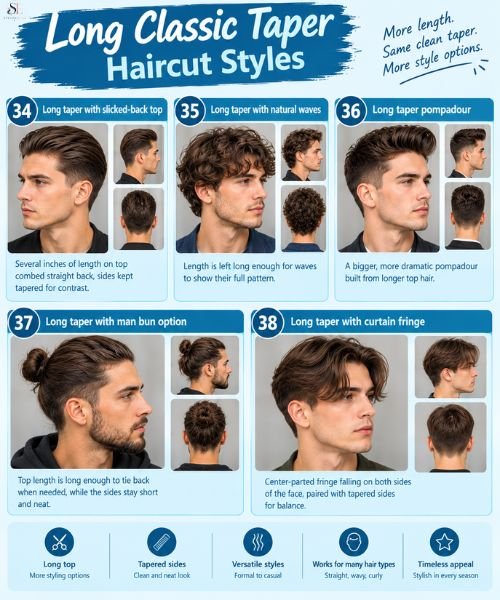
- Long taper with slicked-back top – Several inches of length on top combed straight back, sides kept tapered for contrast.
- Long taper with natural waves – Length is left long enough for waves to show their full pattern.
- Long taper pompadour – A bigger, more dramatic pompadour built from longer top hair.
- Long taper with man bun option – Top length is long enough to tie back when needed, while the sides stay short and neat.
- Long taper with curtain fringe – Center-parted fringe falling on both sides of the face, paired with tapered sides for balance.
Classic taper fade styles
- Low taper fade – The blend gets slightly sharper and shorter than a standard low taper, without reaching the skin.
- Mid taper fade – A tighter, more defined blend starting at mid-head height.
- High taper fade – The sharpest version before crossing into full fade territory lots of contrast, still not skin-short.
- Taper fade with hard part – Combines the tighter blend with a shaved part line for extra definition.
- Taper fade with textured top – Choppy, piece-y top paired with a crisper fade underneath.
- Taper fade pompadour – Classic pompadour shape with a sharper fade instead of a soft taper on the sides.
- Taper fade with curly top – Tighter sides make curly volume on top stand out even more.
Classic taper haircut with beard
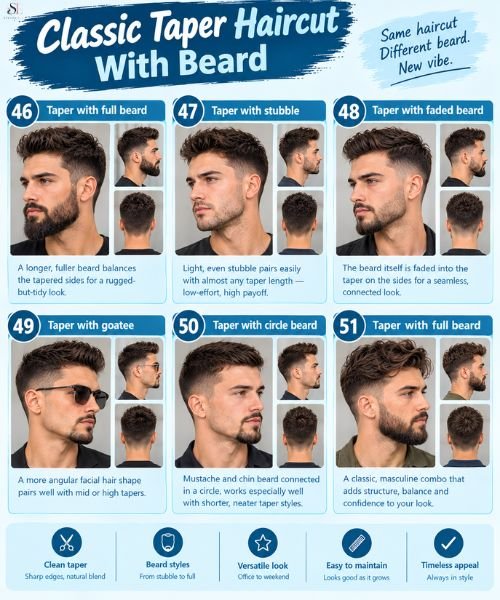
- Taper with full beard – A longer, fuller beard balances the tapered sides for a rugged-but-tidy look.
- Taper with stubble – Light, even stubble pairs easily with almost any taper length low-effort, high payoff.
- Taper with faded beard – The beard itself is faded into the taper on the sides for a seamless, connected look.
- Taper with goatee – A more angular facial hair shape that pairs well with mid or high tapers.
- Taper with circle beard – Mustache and chin beard connected in a circle, works especially well with shorter, neater taper styles.
Classic taper for Black men
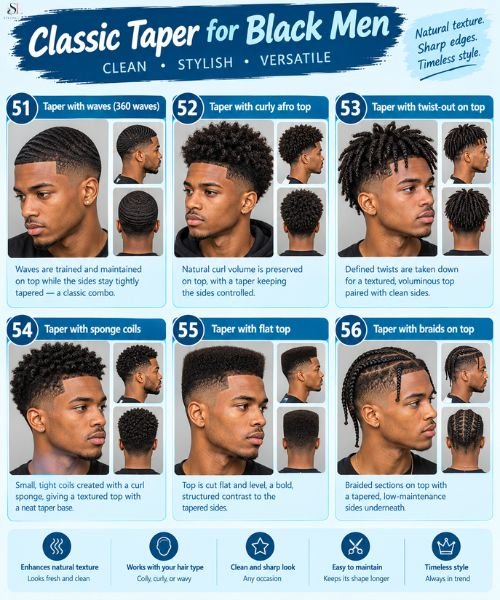
- Taper with waves (360 waves) – Waves are trained and maintained on top while the sides stay tightly tapered.
- Taper with curly afro top – Natural curl volume is preserved on top, with a taper keeping the sides controlled.
- Taper with twist-out on top – Defined twists are taken down for a textured, voluminous top paired with clean sides.
- Taper with sponge coils – Small, tight coils created with a curl sponge, giving a textured top with a neat taper base.
- Taper with flat top – Top is cut flat and level, a bold, structured contrast to the tapered sides.
- Taper with braids on top – Braided sections on top with tapered, low-maintenance sides underneath.
Additional classic taper variations
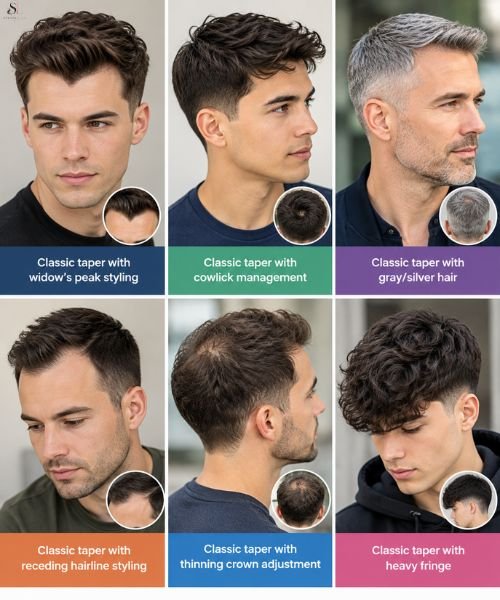
- Classic taper with widow’s peak styling – Cut and styled to work with a widow’s peak instead of trying to hide it.
- Classic taper with cowlick management – Adjusted cutting technique to keep a cowlick from sticking up or looking uneven.
- Classic taper with gray/silver hair – No color-specific cutting needed, but shorter, cleaner styles tend to show off gray tones best.
- Classic taper with receding hairline styling – Slightly shorter top length and softer taper line to minimize contrast at the hairline.
- Classic taper with thinning crown adjustment – Barber leaves a touch more length at the crown to reduce the appearance of thinning.
- Classic taper with heavy fringe – Thick, forward-falling fringe paired with tapered sides for a bold, youthful look.
Classic taper haircut for every face shape: Which style is right for you?
The right taper style depends on how much height and volume you add on top, and where the sides taper begins. Here’s a quick breakdown before the details.
| Face Shape | Best Taper Style | Why It Works |
|---|---|---|
| Round | High taper with height on top | Adds vertical length, reduces width |
| Square | Mid taper with soft texture | Balances strong jawline without adding bulk |
| Oval | Almost any taper style | Naturally balanced proportions |
| Diamond | Taper with fringe or side sweep | Softens a narrow forehead and chin |
| Heart | Low to mid taper with volume at the jaw area | Balances a wider forehead |
| Oblong/Long | Low taper with fuller sides | Adds width, avoids extra height |
Classic taper for a round face
Go with a high taper and more height on top, like a pompadour or quiff. This creates the illusion of length and keeps the face from looking wider than it is. Avoid low tapers with flat tops, since they emphasize roundness.
Classic taper for square face
A mid taper with some texture on top softens strong, angular jawlines. Avoid perfectly straight, blunt tops — a little movement works better with square features.
Classic taper for oval face
Oval faces are naturally balanced, so almost every taper style works well here. This is the one face shape where you can pick based on personal preference rather than correcting proportions.
Classic taper for diamond face
Diamond faces are widest at the cheekbones and narrower at the forehead and jaw. A taper with a side-swept fringe or soft layers on top adds width up top and balances the narrower chin.
Classic taper for a heart-shaped face
Heart-shaped faces have a wider forehead and narrower chin. A low or mid taper with volume kept lower (not swept up) helps balance the proportions instead of drawing more attention to the forehead.
Classic taper for oblong/long face
Long faces benefit from added width, not height. A low taper with fuller sides and less height on top keeps the face from looking stretched.
Classic taper haircut for every hair type
Classic taper for straight hair
Straight hair holds a taper cleanly and shows off the blend well. Side parts and slick-backs work especially well since straight hair moves predictably with product.
Classic taper for wavy hair
Wavy hair adds natural texture to a taper, which works great for textured crops and quiffs. A light matte product enhances the wave pattern without weighing it down.
Classic taper for curly hair
Curly hair pairs beautifully with tapers because the curls add natural volume and shape on top while the sides stay controlled. Ask your barber to taper the sides tighter than usual so the curls on top don’t look overwhelming by comparison.
Classic taper for thick hair
Thick hair can get bulky if left too long on top. A taper helps manage the weight by removing bulk gradually at the sides, and a slightly shorter top length keeps things manageable.
Classic taper for fine/thin hair
Fine hair benefits from a taper because shorter sides make the top hair look fuller by comparison. Avoid growing the top too long, since fine hair can look flat and thin if there’s too much unsupported length.
Business classic taper haircut: The professional man’s guide
Why the classic taper is the ultimate business haircut
The classic taper checks every box for a corporate environment: it’s neat, it’s not flashy, it grows out cleanly, and it works with or without a beard. Unlike a fade, there’s no risk of it looking “undone” as it grows between appointments which matters when you’re not able to get to the barbershop every two weeks.
Business classic taper vs. business casual taper
A strict business taper is shorter overall, usually a low or mid taper with a defined side part and minimal texture. A business casual taper can be a bit longer on top, with some natural texture or a soft quiff, giving a more relaxed but still polished look.
| Setting | Recommended Style | Top Length |
|---|---|---|
| Corporate/formal office | Low or mid taper, side part | Short to medium |
| Business casual office | Mid taper with texture | Medium |
| Client-facing/sales roles | Mid taper, slick back or textured crop | Medium |
| Creative industries | High taper with more texture or fringe | Medium to long |
How to style the business classic taper for a job interview
For an interview, keep it simple: a low or mid taper with a clean side part communicates that you take the meeting seriously without looking like you tried too hard. Get your haircut 4–6 days before the interview, not the day before — freshly cut hair can look too sharp and stiff on camera or in person.
Why the classic taper is the best low-maintenance haircut for men
The classic taper doesn’t require weekly touch-ups, complicated styling routines, or expensive products. Because there’s no hard line to maintain, small amounts of regrowth don’t ruin the look the way they would with a skin fade.
Maintenance comparison table
| Haircut Type | Barber Visits Needed | Daily Styling Time | Grows Out Well? |
|---|---|---|---|
| Classic taper | Every 4–6 weeks | 2–5 minutes | Yes |
| Skin fade | Every 2–3 weeks | 3–5 minutes | No |
| Buzz cut | Every 2–3 weeks | Under 1 minute | Somewhat |
| Long layered cut | Every 6–8 weeks | 5–10 minutes | Yes |
How long does a classic taper last?
A classic taper typically looks sharp for 4 to 6 weeks before it needs a refresh. Because the blend is soft rather than sharply defined, it doesn’t show regrowth as obviously as a fade, so you have more flexibility in scheduling your next appointment.
At-home maintenance between barbershop visits
- Trim stray hairs around the ears and neckline with clippers if you’re comfortable doing it yourself.
- Use a light pomade or matte paste to keep the top styled daily.
- Wash with a mild shampoo 2–3 times a week to avoid drying out your scalp.
- Comb or brush the top in the direction you want it to fall while damp for easier styling.
How to make your classic taper last longer
Ask your barber to keep slightly more length on the sides at the last visit before a longer gap (like before a vacation). This gives the taper room to grow out gracefully instead of looking shaggy after four weeks.
How to ask your barber for a classic taper haircut
Step-by-step: How to ask for a classic taper
- Start with the basics: “I’d like a classic taper — no fade, just a gradual blend on the sides.”
- Specify the taper height: low, mid, or high.
- Give a clipper guard number for the sides if you know one (see table below).
- Describe your desired top length in inches or in comparison to your current length.
- Mention any styling preference — side part, slick back, natural texture, etc.
- Bring a photo reference. Even a rough match helps avoid miscommunication.
- Ask for the neckline and edges to be cleaned up, since this is what keeps a taper looking fresh.
Classic taper clipper guard reference table
| Guard Number | Length (inches) | Common Use |
|---|---|---|
| #1 | 1/8″ | Shortest taper point (rarely skin) |
| #2 | 1/4″ | Low taper starting point |
| #3 | 3/8″ | Common low-to-mid taper length |
| #4 | 1/2″ | Mid taper blending zone |
| #5 | 5/8″ | Upper taper zone, close to top length |
| Scissor over comb | Varies | Used for the softest, most natural blend |
How to style a classic taper haircut: Step-by-step
Step-by-step styling guide
- Start with clean, towel-dried hair not soaking wet, not fully dry.
- Apply a small, coin-sized amount of your chosen product evenly through your palms.
- Work the product through the top section first, from roots to ends.
- Use a comb for sleek looks (side part, slick back) or your fingers for textured looks.
- Style the sides down and back to blend with the taper, even though they’re short.
- Let it air dry or blow dry on a low, cool setting for extra hold and shape.
- Touch up with a small amount of product midday if needed, especially in humid weather.
Best styling products for a classic taper (by finish type)
| Desired Finish | Product Type | Best For |
|---|---|---|
| High shine, sleek | Pomade (oil-based) | Slick backs, side parts |
| Natural matte | Matte clay or paste | Textured crops, everyday looks |
| Light hold, natural movement | Light styling cream | Wavy or curly hair |
| Strong hold, low shine | Fiber or matte pomade | Business styles, all-day hold |
| Maximum volume | Texturizing powder | Fine or thin hair |
Classic taper haircut: Celebrity inspiration and reference guide
Ryan Gosling: Classic low taper + side part
Gosling’s go-to look combines a low taper with a clean, classic side part. It’s a great reference for anyone wanting a business-appropriate taper with a bit of old-school charm.
David Beckham: Classic mid taper + slick back
Beckham has worn several variations of the mid taper with a slicked-back top, showing how versatile the cut can be across different hair lengths and occasions, from casual to red carpet.
Chris Evans: Classic low taper + textured matte top
Evans often wears a low taper with a matte, textured top — a great option for guys who want a natural, effortless look without heavy product or shine.
Brad Pitt: Classic mid taper + natural texture
Pitt’s taper looks lean into natural texture and movement rather than a rigid, styled finish, making this a good reference for wavy or curly hair types.
George Clooney: Classic low taper (silver hair)
Clooney’s low taper proves the style works just as well arguably even better with gray or silver hair, keeping a distinguished, polished look without trying to hide the natural color.
Frequently Asked Questions
Is a classic taper good for thinning hair?
Yes. Because the sides stay short and neat, a classic taper draws less attention to thinning areas on top and can make the remaining hair look fuller by contrast.
Can I get a classic taper with long hair on top?
Yes. The taper only affects the sides and back the top can be as long as you want, from a short crop to several inches of length for styles like pompadours or slicked-back looks.
How much does a classic taper haircut cost?
Pricing varies by location and barbershop, but a classic taper typically costs about the same as a standard men’s haircut, since it doesn’t require the extra time a sharp skin fade needs.
Does a classic taper work for curly or coily hair?
Yes, and it’s a popular choice for curly and coily hair types because the tapered sides balance out volume on top without flattening the natural curl pattern.
What’s the difference between a taper and a low fade?
A taper never goes down to the skin, while a low fade does, just closer to the neckline and ears rather than higher up the head. A taper also blends more gradually, with less contrast between the shortest and longest points.
How often should I get my classic taper trimmed?
Most men get a classic taper trimmed every 4 to 6 weeks. Because it grows out more gracefully than a fade, you have more flexibility if you need to stretch it a bit longer.
Is the classic taper a good choice for a receding hairline?
Yes. Keeping the sides tapered and the top slightly shorter or textured can help minimize the appearance of a receding hairline without drawing extra attention to it.
Can women get a classic taper haircut too?
While the classic taper is most commonly associated with men’s haircuts, the same tapering technique is used in many women’s short haircuts and pixie cuts, especially around the neckline and sides.
1 thought on “Classic Taper Haircut: 60+ Styles, Types, Barber Tips & Expert Guide”